
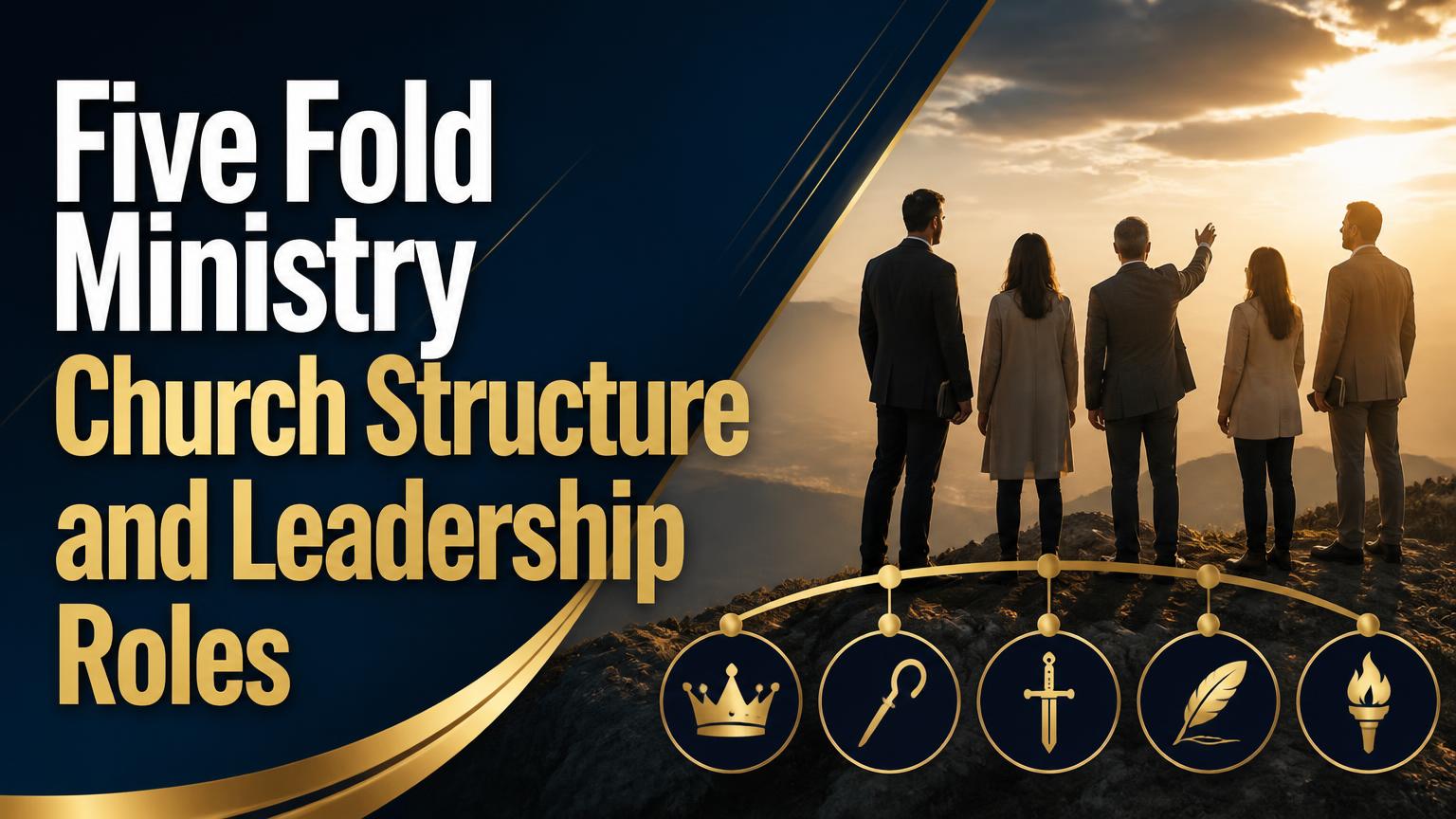
The Five Fold Ministry Church Structure describes a leadership and ministry model drawn primarily from Ephesians 4:11–13: apostles, prophets, evangelists, pastors, and teachers. These ministries are presented as gifts Christ gives to the church to equip believers, strengthen unity, promote maturity, and prepare God’s people for service. The passage does not provide a complete organizational chart for every congregation, however. A healthy structure must also account for biblical qualifications, shared accountability, local church needs, and the authority of Scripture.
Five Fold Ministry Church Structure: Roles and Relationships
Ephesians 4:11 names five ministry functions that serve the church in different but complementary ways. The purpose is not to create five competing centers of power. It is to equip the entire body of Christ for ministry so that leadership does not become concentrated in one personality or limited to professional clergy.
The terms describe recognizable emphases rather than completely isolated activities. An evangelist may teach, a pastor may evangelize, and a teacher may help establish churches. Nevertheless, each role contributes a distinct strength to the church’s mission.
Apostles Establish and Advance the Church
An apostle is, in the broad sense, a person sent with authority and responsibility to represent Christ and extend the gospel. The New Testament uses the term most distinctly for the Twelve and Paul, whose foundational witness carries unique authority. It also uses the word in a broader ministry sense for people such as Barnabas in Acts 14:14.
In contemporary churches, those who identify with an apostolic ministry usually emphasize pioneering work: planting congregations, developing leaders, establishing ministry networks, entering unreached communities, and helping churches pursue a larger mission. This does not mean a modern leader possesses the same authority as the original apostles or may add to Scripture. Any present-day apostolic claim should remain subject to biblical testing, humility, and accountability.
Prophets Discern and Declare God’s Truth
Prophetic ministry involves communicating a message believed to be prompted by God, applying biblical truth to the church’s circumstances, and helping people recognize spiritual priorities. New Testament prophecy may include encouragement, exhortation, warning, or insight, as seen in 1 Corinthians 14:3.
Prophecy must not be treated as unquestionable personal direction. The New Testament instructs believers to weigh prophetic messages, and all prophecy must agree with the revealed character and teaching of Scripture. A prophet does not replace the Bible, govern through private revelations, or control another person’s decisions. In a healthy church, prophetic ministry strengthens obedience to Christ rather than dependence on the prophet.
Evangelists Proclaim the Gospel
Evangelists focus on announcing the good news of Jesus Christ to people who do not yet believe. Their ministry may occur through preaching, personal witness, public outreach, missions, apologetics, or training other Christians to share their faith. Philip is specifically called an evangelist in Acts 21:8, and Paul instructs Timothy to do the work of an evangelist in 2 Timothy 4:5.
An evangelist serves more than the numerical growth of a congregation. Faithful evangelism includes clearly explaining sin, grace, repentance, the death and resurrection of Christ, and the call to discipleship. Evangelistic success cannot be measured only by attendance or recorded decisions. The goal is the formation of genuine disciples and the incorporation of new believers into the life of the church.
Pastors Shepherd and Care for People
Pastors provide spiritual care, protection, guidance, encouragement, and correction. The biblical image is that of a shepherd who knows, feeds, guards, and tends the flock. Pastoral ministry includes preaching and teaching, but it also involves counseling, visitation, prayer, conflict care, restoration, and patient presence during suffering.
The word “pastor” is closely related to the New Testament language of shepherding elders and overseers. For that reason, a church should not treat the pastoral role as a platform position detached from character or relationships. A pastor’s authority is exercised through service, trustworthy teaching, and care for people—not through intimidation, celebrity, or personal ownership of the congregation.
Teachers Explain and Apply Christian Truth
Teachers help believers understand Scripture accurately and apply it faithfully. Their work includes explaining biblical context, clarifying doctrine, answering questions, correcting error, and connecting Christian belief with daily conduct. Teaching is not merely the transfer of information; it aims at obedience, wisdom, spiritual maturity, and transformed character.
Because teaching shapes what a congregation believes, the New Testament treats it as a serious responsibility. James 3:1 warns that teachers will be judged more strictly. A teacher therefore needs more than communication skill. Sound interpretation, moral integrity, intellectual honesty, and willingness to remain accountable are essential. Teaching should lead people toward Christ and faithful living rather than toward admiration of the teacher.
The Five Ministries Work Together
The five roles are strongest when they operate as a team. Apostolic vision may establish a mission, prophetic discernment may identify spiritual dangers and priorities, evangelistic ministry may reach outsiders, pastoral care may nurture the community, and teaching may provide doctrinal stability. None of these functions is sufficient by itself.
This cooperation also protects the church from imbalance. A congregation with vision but no pastoral care may exhaust people. A church with teaching but no evangelistic concern may become inward-looking. A church that welcomes prophecy without testing may become unstable, while a church that emphasizes administration alone may lose its missionary purpose. The fivefold model is therefore best understood as an equipping partnership, not a rigid ranking of leaders.
The Biblical Purpose of Fivefold Ministry
Ephesians 4:12 gives the purpose of these ministries: “to equip the saints for the work of ministry, for the edifying of the body of Christ.” Leaders are not meant to perform every ministry task while the congregation watches. Their responsibility includes preparing ordinary believers to serve, witness, pray, teach, encourage, give, and care for others.
The result described in Ephesians 4:13–16 is maturity in faith, unity in the knowledge of Christ, stability against false teaching, and growth in love. This means a church should evaluate its leadership structure by asking what kind of people it produces. If leaders attract dependence, fear, passivity, or personality worship, the structure has failed its biblical purpose even if it uses correct terminology.
The fivefold ministries also operate within the wider New Testament teaching about the body of Christ. Believers possess different gifts, and no single leader embodies every gift. The church needs both recognized leaders and broad participation from its members. Leadership equips the body; it does not replace the body.
Is Five Fold Ministry a Formal Church Government?
The Bible does not establish one universal five-office government that every local church must reproduce. Ephesians 4:11 identifies ministry gifts or functions, while passages such as 1 Timothy 3 and Titus 1 describe qualifications for overseers and deacons. Acts also shows churches appointing elders, and the New Testament emphasizes mutual submission, shared discernment, and responsible oversight.
Christian traditions differ in how they interpret apostles and prophets today. Some believe all five ministries continue as recognizable leadership functions. Others believe the foundational apostles and prophets had a unique role in establishing the church and that their authority is not continued in the same form. Still others affirm contemporary prophetic or apostolic activity but distinguish it sharply from the authority of the biblical apostles and the completed scriptural witness.
Because of these differences, the phrase “fivefold ministry” should not automatically be treated as a job description, a rank above elders, or a justification for centralized control. A church can recognize apostolic, prophetic, evangelistic, pastoral, and teaching gifts while still using elders, pastors, deacons, ministry teams, or other forms of local governance. The central question is whether the arrangement is faithful to Scripture and produces accountable, mature disciples.
How to Organize a Healthy Fivefold Ministry Church
A practical church structure can recognize the five ministry functions while preserving clear authority, accountability, and congregational participation. The exact arrangement will vary according to the church’s size, denomination, culture, and mission.
Keep Christ and Scripture as the Highest Authority
No ministry title gives a leader permission to act independently of Jesus Christ or biblical truth. The church’s doctrine, moral standards, financial decisions, and major direction should be tested through Scripture, prayer, wise counsel, and transparent processes. Prophetic impressions, strategic visions, and personal convictions may inform discernment, but they must not override clear biblical teaching.
Define Responsibilities Without Creating Rival Power Centers
Written role descriptions can prevent confusion. An apostolic leader may oversee church planting or mission expansion; a prophetic leader may help cultivate prayer and discernment; an evangelist may direct outreach; a pastor may oversee care; and a teacher may lead doctrinal formation. These descriptions should clarify collaboration rather than create five independent authorities competing for influence.
Establish Character-Based Accountability
Leaders should meet recognized biblical standards for integrity, self-control, faithfulness, humility, and sound teaching. Accountability may involve a plurality of elders, a governing board, denominational oversight, financial controls, regular evaluation, and a process for addressing accusations or misconduct. A leader who claims extraordinary spiritual authority but rejects ordinary accountability presents a serious danger to the church.
Equip the Whole Congregation for Ministry
The measure of success is not how many activities leaders personally control. It is whether believers are becoming capable servants. Churches should provide opportunities for members to discover and develop gifts, receive training, serve under supervision, and grow in maturity. This approach reflects 1 Corinthians 12, where many members contribute different functions to one body.
Common Misunderstandings About the Model
One misconception is that every church must have five individuals, each holding one official title. Ephesians 4 does not require that numerical arrangement. A congregation may experience these ministries through a team, a network, visiting ministers, or leaders whose gifts overlap.
Another misconception is that the five roles form a ladder, with apostles at the top and teachers at the bottom. The passage does not establish a simple status hierarchy. Different responsibilities may carry different forms of authority, but all Christian leadership is accountable to Christ and measured by service.
A third misconception is that spiritual gifting replaces character and competence. A person may be gifted in preaching, leadership, prophecy, or evangelism and still require substantial growth in wisdom and integrity. Giftedness can attract attention quickly; character determines whether that influence blesses or harms the church.
Conclusion
The Five Fold Ministry Church Structure is best understood as a model of complementary ministry functions drawn from Ephesians 4:11–13. Apostles help advance mission, prophets help discern and exhort, evangelists proclaim the gospel, pastors care for people, and teachers establish believers in truth. These roles are not designed to create celebrity leaders or a rigid chain of command. Their purpose is to equip the whole church for faithful service and maturity.
A biblically responsible structure therefore combines ministry gifts with qualified elders, accountable governance, sound doctrine, and broad participation. Churches may disagree about whether every role continues in the same form, but they can agree on the central test: leadership should honor Christ, submit to Scripture, protect people, develop disciples, and build up the body in love.