
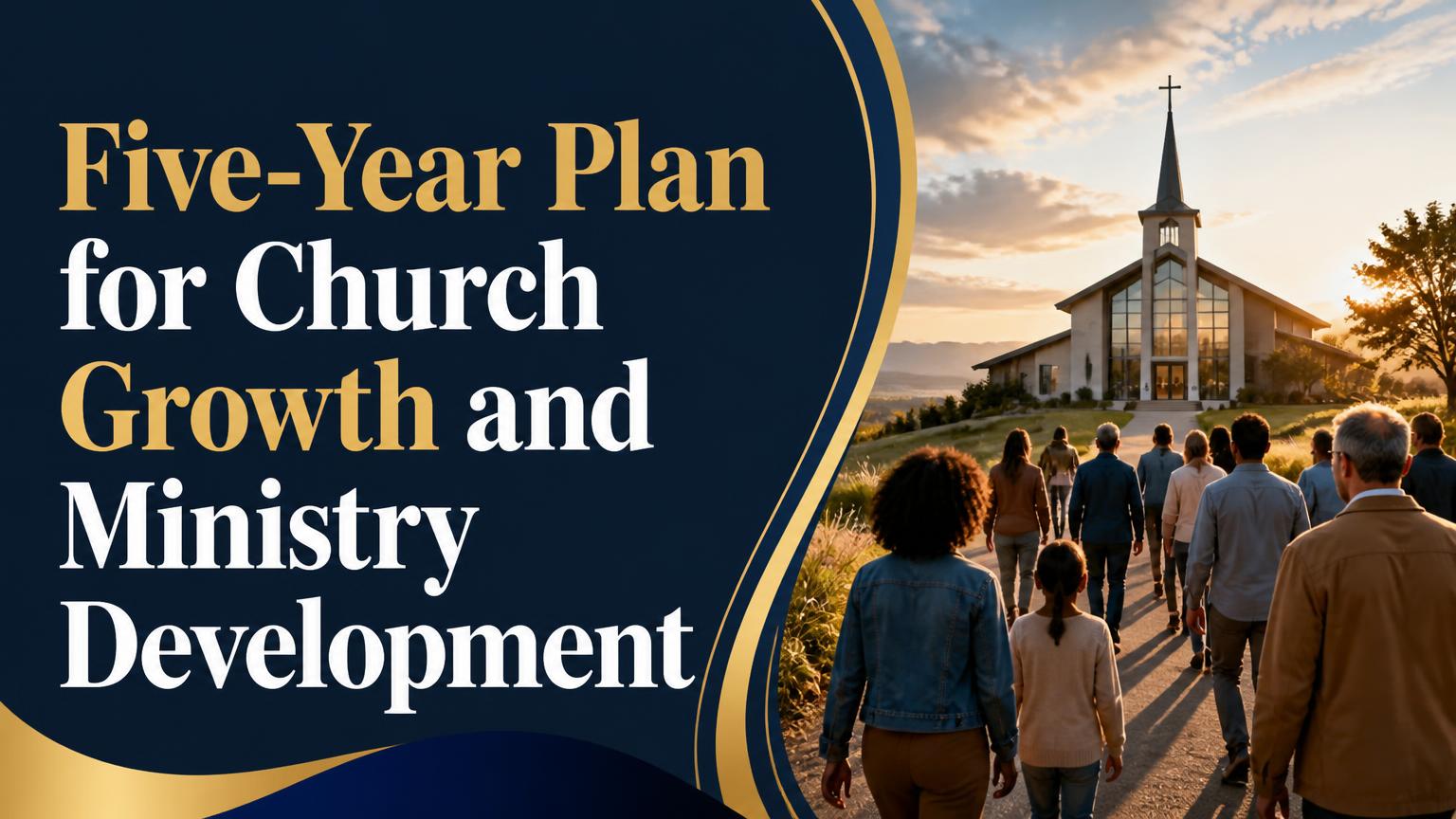
A five-year plan for church growth gives a congregation a shared direction, measurable priorities, and a practical sequence for developing ministry. It should address more than attendance. Healthy growth includes people coming to faith, becoming mature disciples, serving others, developing leaders, strengthening families, and building systems that can support future ministry.
The plan should be specific enough to guide decisions but flexible enough to respond to changing needs. Scripture supports both dependence on God and responsible preparation: Paul planted and Apollos watered, but God gave the growth (1 Corinthians 3:6–7). Planning is therefore an act of stewardship, not an attempt to control results.
Five-Year Plan for Church Growth
A useful five-year plan moves from assessment and foundation to development, multiplication, and evaluation. The exact goals will differ according to the church’s size, location, theological tradition, resources, and community. The following framework provides a realistic structure that can be adapted rather than copied mechanically.
Define What Church Growth Means
Before setting numerical goals, the church must decide what kind of growth it is seeking. Attendance is one indicator, but it cannot measure the whole mission of a congregation.
A balanced definition may include:
- Spiritual growth: increasing biblical understanding, prayer, obedience, holiness, and dependence on Christ.
- Relational growth: stronger participation in small groups, pastoral care, fellowship, and mutual support.
- Missional growth: more effective evangelism, community service, mercy ministry, and local engagement.
- Leadership growth: developing pastors, ministry leaders, teachers, volunteers, and future church planters.
- Numerical growth: welcoming new people, retaining members, baptizing believers, and increasing regular participation.
- Organizational growth: improving communication, safeguarding, finances, facilities, administration, and ministry processes.
Acts 2:42–47 presents a picture of church life that combines teaching, fellowship, prayer, generosity, worship, witness, and visible community. Numerical increase appears in that account, but it is connected to a deeper pattern of shared discipleship and faithful practice. A church that grows in attendance while neglecting spiritual formation and pastoral care may become larger without becoming healthier.
Assess the Church’s Starting Point
The first year should begin with an honest assessment rather than ambitious promises. Leaders need to understand both the congregation and the community it serves.
Review:
- Average weekly attendance and seasonal variation
- New visitors, return visitors, conversions, baptisms, and departures
- Age groups, family structures, and demographic changes
- Participation in groups, classes, prayer meetings, and service teams
- Volunteer capacity and leadership gaps
- Financial income, expenses, reserves, and giving patterns
- Building use, accessibility, safety, and capacity
- Community needs, institutions, schools, and existing partnerships
- Congregational strengths, conflicts, traditions, and areas of resistance
Use both numerical information and personal listening. Surveys, interviews, home visits, member meetings, and conversations with community leaders can reveal issues that attendance figures cannot. For example, a church may discover that its main barrier is not a lack of outreach ideas but unclear newcomer follow-up, inconvenient meeting times, or a shortage of trained children’s workers.
The assessment should end with a short list of priorities. A church cannot pursue every desirable ministry simultaneously without exhausting its people and resources.
Year One: Establish a Healthy Foundation
The first year should clarify the church’s mission, strengthen trust, and repair weak ministry systems. It is often better to improve the experience and care of existing people before aggressively pursuing expansion.
Key priorities may include:
- Clarifying the church’s mission and discipleship pathway
- Establishing a consistent process for welcoming and following up with visitors
- Reviewing safeguarding, financial controls, communication, and membership records
- Training ministry leaders and volunteers
- Improving preaching, teaching, prayer, and pastoral care
- Identifying the community the church is specifically called to serve
- Creating a simple annual budget connected to ministry priorities
The church should also explain why changes are being made. People are more likely to support a plan when they understand its biblical purpose and practical reasoning. Luke 14:28 uses the image of counting the cost before building. This does not imply that ministry can be reduced to financial calculation; it means faithful work requires honest preparation.
Year Two: Strengthen Discipleship and Outreach
Once the foundation is more stable, the second year can focus on helping people move from attendance to participation and maturity.
A clear discipleship pathway might guide people through stages such as:
- Welcoming and belonging
- Exploring the Christian faith
- Joining the church community
- Learning core Christian practices
- Serving according to gifts and character
- Mentoring or discipling others
Outreach should be connected to real relationships and actual community needs. Possible initiatives include neighborhood meals, parenting support, youth programs, food assistance, English-language classes, hospital visitation, or partnerships with trusted local organizations. These activities should not function merely as advertising. They should express genuine love of neighbor while creating natural opportunities for conversation and witness.
Matthew 28:19–20 connects making disciples with both baptism and teaching obedience to Christ. That means evangelism and discipleship should not be treated as unrelated departments. New believers need a clear path into community, instruction, worship, and service.
Year Three: Develop Leaders and Expand Ministry Capacity
Growth becomes fragile when every responsibility depends on one pastor or a small group of highly committed members. The third year should emphasize leadership development and the multiplication of ministry teams.
A leadership process should include:
- Identifying people with spiritual maturity, character, teachability, and appropriate gifts
- Providing training in Scripture, pastoral care, communication, and ministry practice
- Giving emerging leaders supervised responsibility
- Offering feedback and regular encouragement
- Establishing reasonable expectations and healthy boundaries
- Creating succession plans for key roles
Ephesians 4:11–16 describes leaders as equipping believers for ministry rather than performing every ministry themselves. Delegation is therefore more than an administrative convenience. It helps the whole body contribute and reduces dependence on a single individual.
Expansion might involve adding a second service, starting a new congregation, launching a campus ministry, creating a new small-group network, or increasing ministry among an underserved population. Expansion should follow demonstrated capacity rather than wishful thinking. A church should ask whether it has enough leaders, volunteers, finances, pastoral care, and administrative support to sustain the new work.
Year Four: Multiply Disciples, Teams, and Ministry Expressions
By the fourth year, the church can move from building programs to multiplying healthy ministry. Multiplication may occur through new group leaders, apprentice teachers, church plants, community partnerships, new worship communities, or members equipped to serve outside the congregation.
The central question is not simply, “How many activities can we add?” It is, “What can be reproduced without lowering quality or exhausting people?”
For example, a small-group ministry may develop a repeatable process:
- Train an apprentice leader.
- Establish a group with clear pastoral support.
- Evaluate participation, care, and discipleship.
- Multiply the group when the new leader is ready.
- Continue coaching both leaders.
This approach creates capacity gradually. It also protects against growth that depends on a few gifted individuals who cannot be replaced.
Year Five: Evaluate, Consolidate, and Plan the Next Season
The fifth year should include a thorough evaluation rather than an automatic continuation of every initiative. Some ministries will have achieved their purpose; others may need revision or closure.
Evaluate:
- Which goals were achieved, partially achieved, or missed?
- Did participation produce deeper discipleship or merely more activity?
- Are leaders healthier and better equipped than five years earlier?
- Are new believers being integrated and cared for?
- Did outreach serve the community with dignity and consistency?
- Are finances sustainable?
- Which ministries depend too heavily on one person?
- What did the church learn about its calling and context?
The evaluation should combine data with testimony and pastoral discernment. A ministry can be fruitful even if it does not produce immediate numerical growth, while a popular program may have little lasting spiritual value. The next plan should retain what is fruitful, repair what is weak, and stop what no longer serves the mission.
How to Set Healthy Church Growth Goals
Goals should be specific enough to guide action but humble enough to recognize uncertainty. Instead of declaring that the church will “grow significantly,” establish targets such as:
- Train 20 new small-group or ministry leaders
- Increase the proportion of regular attendees involved in a discipleship group
- Create a visitor follow-up process within 48 hours
- Baptize and integrate a defined number of new believers
- Establish two community partnerships
- Maintain a specified financial reserve
- Develop apprentices for every major ministry role
- Improve retention of children, youth, or young adults through appropriate pastoral care
Use a mixture of leading indicators and lagging indicators. Attendance, baptisms, and giving are lagging indicators: they show outcomes after many factors have already operated. Training completed, follow-up contacts made, groups formed, and pastoral visits conducted are leading indicators: they show whether the practices that support growth are actually happening.
Every goal should have:
- A responsible person or team
- A target date
- The resources required
- A method of measurement
- A review schedule
- A clear connection to the church’s mission
Avoid treating numerical targets as a measure of personal worth or divine approval. Numbers can reveal patterns, but they cannot fully evaluate faithfulness, spiritual maturity, or the quality of care.
Ministry Systems That Support Sustainable Growth
A plan succeeds only when the church builds the systems needed to carry it. Several systems deserve particular attention.
Discipleship: People need a visible pathway from conversion or first attendance toward maturity and service. Classes, groups, mentoring, preaching, and personal pastoral care should reinforce one another rather than operate as isolated programs.
Leadership: Recruitment should consider character and reliability, not only talent. Training, supervision, rest, and succession planning prevent burnout and protect the congregation.
Assimilation: Visitors and new members need timely welcome, clear information, personal connection, and opportunities to belong. A crowded calendar does not automatically create community.
Pastoral care: Larger churches need organized care structures, but organization must not become impersonality. Trained small-group leaders, deacons, elders, and visitation teams can help the church notice needs that staff cannot see alone.
Communication: People should know the church’s priorities, how decisions are made, where to serve, and whom to contact. Confusing communication often produces lower participation even when ministries are strong.
Finances and administration: Budgets should reflect mission rather than preserve every existing activity indefinitely. Financial transparency builds trust, while safeguarding and sound recordkeeping protect both people and the church’s witness.
Common Mistakes to Avoid
A five-year plan can become harmful when it adopts the assumptions of a business strategy without theological discernment.
Common errors include:
- Pursuing attendance while neglecting discipleship
- Copying another church’s model without considering local context
- Launching too many programs at once
- Relying on the pastor to solve every ministry problem
- Measuring activity instead of transformation
- Ignoring resistant members or unresolved conflict
- Treating volunteers as an unlimited resource
- Failing to budget for training and pastoral care
- Refusing to revise the plan when conditions change
- Equating rapid growth with God’s approval or slow growth with failure
Church growth also requires ethical care. Children and vulnerable adults need appropriate protection. New members should never be pressured into giving, serving beyond their capacity, or accepting leadership before they are ready. Healthy growth is patient enough to build trust.
A Practical Review Rhythm
The plan should be reviewed at several levels:
- Monthly: ministry actions, attendance patterns, urgent needs, and finances
- Quarterly: progress toward goals, volunteer health, and emerging obstacles
- Annually: priorities, budget, leadership development, community impact, and spiritual fruit
- At the end of five years: comprehensive evaluation and renewed discernment
Each review should ask three questions: What is happening? Why is it happening? What faithful response is needed? This keeps evaluation from becoming either vague optimism or purely numerical analysis.
A five-year plan for church growth should provide direction without pretending to predict the future. Its purpose is to help a congregation faithfully steward people, time, money, gifts, and opportunities while remaining responsive to God’s leading.
The strongest plan defines growth as spiritual maturity and mission, not attendance alone; establishes a realistic sequence from foundation to multiplication; develops leaders rather than concentrating ministry in a few people; and measures both activity and fruit. Faithful planning does not guarantee a particular result, but it can create the clarity, health, and capacity through which a church serves its people and community more effectively.