
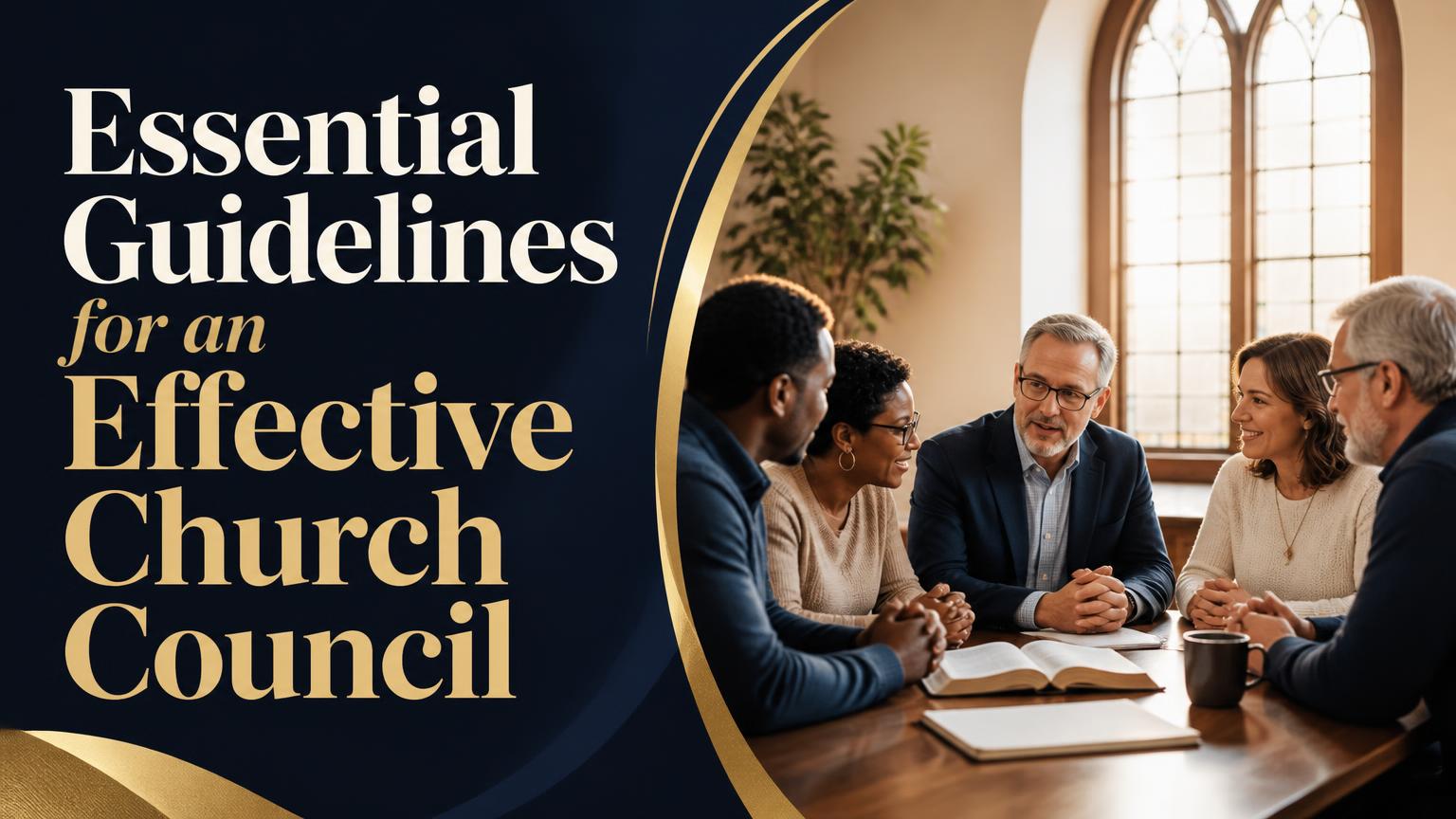
An effective church council helps a congregation pursue its mission with spiritual discernment, responsible governance, and mutual accountability. It should not function as a political committee or replace the pastoral ministry of the church. Its purpose is to seek God’s direction, make decisions within its authority, steward the church’s resources, and serve the congregation faithfully.
Because church polity differs among denominations, the council should always follow its denomination’s constitution, bylaws, governing documents, and applicable law. The following guidelines provide a broadly useful framework for building a healthy and effective council.
Guidelines for a Church Council
Define the Council’s Purpose and Authority
A church council needs a written purpose that answers three questions:
- Why does the council exist?
- What decisions is it authorized to make?
- What decisions belong to the pastor, staff, ministry teams, elders, deacons, or congregation?
Without these boundaries, councils often become either passive discussion groups or unofficial bodies that make decisions beyond their authority.
A council may be responsible for matters such as:
- Interpreting and implementing the church’s mission
- Approving ministry priorities and annual plans
- Reviewing finances and major expenditures
- Supporting and evaluating the pastor or senior leadership according to church policy
- Overseeing facilities, personnel, risk management, and compliance
- Coordinating ministries that require cooperation across the congregation
- Bringing significant matters to the congregation for approval
The council should govern at the appropriate level rather than managing every ministry detail. For example, it may approve a ministry’s goals and budget without deciding the wording of every event announcement or supervising every volunteer.
Choose Members for Character, Wisdom, and Representation
A council should include people who demonstrate spiritual maturity, sound judgment, reliability, humility, and a genuine commitment to the church’s mission. Technical skills can help, but competence should not substitute for character.
The New Testament connects church leadership with qualities such as self-control, faithfulness, hospitality, integrity, and the ability to teach or encourage others (1 Timothy 3:1–13; Titus 1:5–9). These passages do not prescribe one universal council structure, but they show that Christian leadership is fundamentally a matter of character and stewardship.
A healthy selection process should consider:
- Spiritual maturity and participation in the life of the church
- Ability to listen before forming conclusions
- Willingness to work collaboratively
- Capacity to handle confidential information
- Representation of different generations, experiences, and areas of ministry
- Availability to prepare for meetings and fulfill assigned responsibilities
- Freedom from unresolved conflicts of interest
Representation does not mean that every group receives a permanent voting seat or that every decision becomes a contest among constituencies. It means the council should understand the congregation it serves and avoid allowing one narrow perspective to dominate.
Establish Clear Roles and Responsibilities
Every council member should understand what is expected of them. Written role descriptions can prevent confusion and reduce conflict.
Typical roles include:
- Chair or moderator: Guides meetings, keeps discussion focused, and ensures that decisions follow the church’s governing procedures.
- Vice chair or alternate: Assists the chair and assumes responsibilities when necessary.
- Secretary or clerk: Maintains accurate minutes, records decisions, and preserves official documents.
- Treasurer or finance representative: Reports financial conditions clearly and helps the council monitor stewardship.
- Pastor or ministry leader: Provides pastoral and theological perspective while participating according to the church’s polity.
- Members at large: Prepare, deliberate, vote when authorized, and support decisions once they are made.
The chair should not control the council’s conclusions, and the pastor should not be expected to carry every leadership responsibility alone. A council is healthiest when pastoral leadership and shared governance complement rather than compete with each other.
How a Church Council Should Make Decisions
Begin With Prayer and Shared Discernment
Prayer should shape the council’s work, not merely open a meeting. Members should ask whether a proposal reflects the church’s mission, serves people faithfully, and uses the church’s resources responsibly.
Acts 15 presents an example of leaders addressing a serious disagreement through testimony, theological reasoning, Scripture, communal listening, and a decision communicated to the wider church. The passage does not provide a technical meeting procedure, but it illustrates a pattern: leaders listen carefully, seek truth together, and make decisions for the good of the whole body.
Prayerful discernment does not eliminate preparation or disagreement. It changes the goal from winning an argument to seeking a faithful course of action.
Use Reliable Information and Written Proposals
Important decisions should be based on adequate information rather than assumptions, urgency, or the confidence of the most vocal member. A proposal should normally identify:
- The problem or opportunity
- The ministry or congregational objective
- Available options
- Financial and staffing implications
- Relevant risks
- The people affected
- The proposed timeline
- The decision requested from the council
Complex matters may require consultation with qualified professionals, denominational offices, legal advisers, financial specialists, or safeguarding personnel. Seeking advice is not a failure of faith; it is part of responsible stewardship.
Encourage Honest but Ordered Discussion
Members need permission to raise concerns without being treated as disloyal. At the same time, discussion should remain relevant, respectful, and proportionate to the decision.
A useful process is to:
- State the decision clearly.
- Present the relevant facts.
- Hear questions before debating solutions.
- Invite different perspectives.
- Identify areas of agreement and disagreement.
- Clarify the motion or proposed action.
- Decide according to the church’s rules.
- Record the result and assign responsibility.
James 1:19 urges believers to be “quick to listen, slow to speak, slow to become angry.” This principle is especially practical in council meetings because rushed speech and personal defensiveness can turn a solvable disagreement into a relationship problem.
Distinguish Consensus, Voting, and Congregational Approval
Some councils seek consensus; others use formal motions and votes. Neither approach is automatically more spiritual or more effective. The governing documents should determine which method applies.
Consensus means members can support a decision even when it is not their first preference. It does not require pretending that everyone agrees on every detail. Formal voting provides clarity when consensus cannot be reached or when the church’s rules require a vote.
The council should also know which decisions require congregational approval. Major property transactions, changes to bylaws, calling or dismissing certain leaders, borrowing money, or adopting a budget may be reserved for the congregation or another governing body. A council should never claim authority simply because a decision seems urgent.
Structure Meetings for Faithful Work
Prepare an Agenda That Reflects Priorities
A good agenda gives the most time to the most consequential matters. It may include:
- Prayer and spiritual reflection
- Approval of previous minutes
- Review of assigned actions
- Pastor’s or ministry reports
- Financial and operational reports
- Strategic or ministry decisions
- Congregational concerns requiring council attention
- Confirmation of responsibilities and deadlines
- Closing prayer
Routine reports should not consume the entire meeting. Written reports can communicate basic information while meeting time is reserved for discussion, discernment, and decisions.
Provide Materials in Advance
Members should receive the agenda, minutes, financial statements, proposals, and relevant background information early enough to prepare. Sending documents immediately before a meeting encourages shallow discussion and places too much influence in the hands of those who already know the details.
Members should read the materials, identify questions, and disclose any personal interest that could affect their judgment.
Record Decisions, Not Every Conversation
Minutes should create an accurate institutional memory. They should normally record:
- Date, time, and attendees
- Whether a quorum was present
- Motions and amendments
- The final decision
- Abstentions or recusals when relevant
- Assigned responsibilities
- Deadlines and follow-up actions
Minutes should not become a transcript of personal comments, especially when sensitive pastoral or personnel matters are discussed. Confidential information should be handled according to the church’s policy and legal obligations.
Practice Accountability, Confidentiality, and Transparency
Keep Appropriate Confidentiality
Council members may hear information about pastoral care, personnel, finances, complaints, or safeguarding concerns. They must protect confidential information and share it only with people who have a legitimate need to know.
Confidentiality does not mean concealing misconduct or preventing appropriate reporting. Allegations of abuse, threats, harassment, financial wrongdoing, or other serious harm should be handled through established safeguarding, legal, and denominational procedures. A council should never use “confidentiality” to protect an institution’s reputation at the expense of vulnerable people.
Disclose and Manage Conflicts of Interest
A conflict of interest exists when a member’s personal, family, professional, or financial interest could improperly influence a decision or appear to do so. The member should disclose the conflict and, when appropriate, refrain from discussion or voting.
For example, a council member whose company is bidding on church construction work should not control the selection process. Transparent procedures protect both the church and the individual from suspicion.
Communicate Decisions Clearly
After a decision is made, the council should communicate what was decided, why it was decided when appropriate, who is responsible, and what happens next. Communication should respect confidentiality while avoiding unnecessary secrecy.
Poor communication creates rumors, duplicated work, and resistance. Clear communication helps the congregation understand that the council is serving the church rather than governing from a distance.
Handle Conflict in a Christian and Responsible Way
Conflict is not automatically evidence of council failure. Faithful leaders may disagree about priorities, interpretation, timing, or risk. The problem arises when disagreement becomes personal, manipulative, or destructive.
Members should address concerns directly and respectfully. Jesus’ teaching in Matthew 18:15–17 emphasizes speaking with the person involved before escalating a matter. In council life, this means avoiding private campaigns, gossip, anonymous accusations, and attempts to recruit supporters before the issue has been discussed honestly.
A council should intervene when disagreement involves:
- Bullying or intimidation
- Repeated personal attacks
- Retaliation against members who raise concerns
- Persistent refusal to follow governing procedures
- Financial or ethical misconduct
- Threats to safety or the church’s legal responsibilities
Reconciliation does not always mean restoring someone to a leadership role. Forgiveness and accountability belong together. A council may need mediation, an impartial investigation, formal discipline, or outside assistance.
Evaluate the Council’s Effectiveness
A council should periodically evaluate not only what it has accomplished but also how it has operated. Useful questions include:
- Are we making decisions consistent with the church’s mission?
- Do members receive information early enough to prepare?
- Does discussion include quieter voices?
- Are responsibilities and deadlines being followed?
- Do meetings focus on important matters rather than unnecessary detail?
- Are we communicating appropriately with the congregation?
- Have we protected confidentiality and managed conflicts of interest?
- Are we developing new leaders?
- What should we stop, start, or improve?
An annual review can examine attendance, decision follow-through, financial oversight, ministry outcomes, and the council’s working relationships. Training may be needed in governance, finance, safeguarding, conflict resolution, or denominational procedures.
The goal is not efficiency alone. A council can make decisions quickly and still lead poorly if it neglects prayer, people, truth, or accountability.
Common Mistakes Church Councils Should Avoid
Several patterns regularly weaken church councils:
- Micromanaging ministries: The council becomes absorbed in minor operational details and neglects mission-level leadership.
- Allowing one leader to dominate: Members stop offering honest counsel, making the council a formality rather than a governing body.
- Confusing tradition with authority: A long-standing practice may be valuable, but it should not automatically override written policy or sound judgment.
- Making decisions without records: Verbal agreements create confusion about what was approved and who must act.
- Avoiding difficult subjects: Delaying a financial, personnel, or safeguarding concern usually increases the eventual cost.
- Treating disagreement as disloyalty: A council that cannot tolerate questions makes poor decisions and hides problems.
- Discussing confidential matters casually: Informal disclosure can damage people and expose the church to serious consequences.
- Failing to revisit decisions: Circumstances change. A responsible council monitors outcomes and adjusts plans when necessary.
Final Principles for a Healthy Church Council
A strong church council combines spiritual humility with practical discipline. It prays, prepares, listens, decides within its authority, records its actions, communicates responsibly, and accepts accountability. It protects the vulnerable, manages resources honestly, and keeps the church’s mission ahead of personal preference.
The most effective council is not the one that eliminates every disagreement. It is the one that handles disagreement truthfully, makes decisions carefully, and continues serving together after the decision is made.