
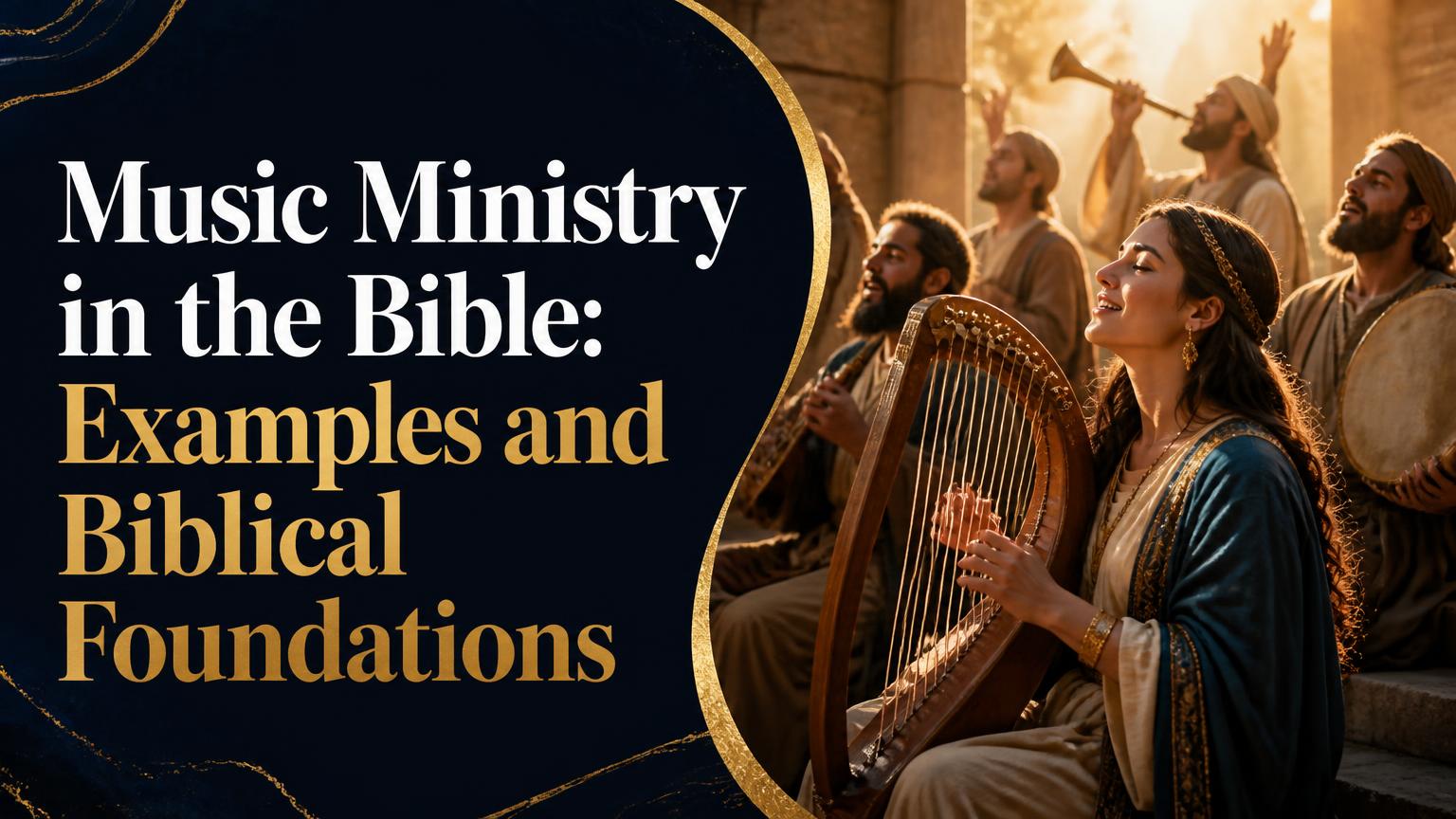
Music ministry in the Bible is more than providing background music for a worship service. Scripture presents music as a God-directed means of praise, prayer, remembrance, teaching, communal participation, and spiritual encouragement. Musicians served in public worship, accompanied prophetic activity, helped Israel remember God’s acts, and strengthened believers through sung truth. At the same time, the Bible never treats musical skill, emotional intensity, or performance quality as substitutes for obedience and faithfulness.
Music Ministry in the Bible: Biblical Foundations and Examples
In biblical terms, music ministry is the use of singing, instruments, and musical leadership to honor God and serve His people. The Bible does not use the modern phrase “music ministry” as the name of a church department, but it repeatedly describes musical service among God’s people. Its purpose was not entertainment alone. Music expressed worship, communicated truth, unified the congregation, and directed attention toward God.
Music as Worship, Praise, and Thanksgiving
The earliest major example is Israel’s song after God delivered the nation from Egypt. Moses and the Israelites sang in Exodus 15, while Miriam led the women with tambourines and dancing. Their music interpreted the event: God had acted in power, defeated Israel’s enemies, and revealed Himself as Savior. The song was therefore both praise and theological testimony.
The Psalms develop this pattern extensively. They include songs of thanksgiving, lament, confession, confidence, royal celebration, and praise. Psalm 150 calls God’s people to praise Him with various instruments, while other psalms show that worship can include sorrow, questions, repentance, and renewed trust. Biblical music ministry does not require pretending that suffering does not exist; it brings the whole experience of faith before God.
Music also appears in celebrations connected with national and congregational worship. David brought the ark to Jerusalem with singing and instruments (1 Chronicles 15–16), and Solomon’s temple dedication included singers, trumpeters, and other musicians (2 Chronicles 5:11–14). In these scenes, music served the gathered people as they recognized God’s presence and covenant faithfulness.
The Levites and Organized Musical Service
Under David’s leadership, particular Levites were appointed to minister with music before the tabernacle and later in the temple. Asaph, Heman, and Jeduthun are named as leaders, and 1 Chronicles 25 describes their families as musicians who served with lyres, harps, and cymbals. Some are also described as prophesying with musical instruments.
This organization shows that musical service could involve preparation, leadership, training, and responsibility. The biblical musicians were not simply individuals who happened to perform during worship. They served within the larger ministry of the priests and the worshiping community. Their roles were connected to God’s appointed worship, not to personal celebrity.
The temple structure should not be transferred mechanically into a modern church. Christians are not required to reproduce the Levitical system, temple sacrifices, or Israel’s national institutions. However, the passages do establish enduring principles: musical service can be organized, skill matters, leaders should be accountable, and music belongs under the direction of God’s revealed truth.
Music Connected With Prophetic Ministry
Several passages connect music with prophetic activity. In 1 Samuel 10:5, Saul encounters a group of prophets accompanied by instruments. In 2 Kings 3:15, the prophet Elisha asks for a musician to play, and the passage says that the Lord’s hand came upon him.
These accounts should be interpreted carefully. They do not teach that music mechanically produces prophecy or forces God to speak. The musician’s role created a setting in which the prophet received and declared God’s message, but the divine revelation came from God. Music may help focus the mind, quiet distraction, or express spiritual realities, yet it is never a technique for controlling the Holy Spirit.
Singing as Teaching and Spiritual Formation
The Bible presents songs as a way to remember and internalize truth. God commanded Moses to teach Israel a song that would serve as a witness to the nation’s future unfaithfulness (Deuteronomy 31:19–21). The song was not merely emotional expression; it carried a message that shaped the people’s understanding of their covenant relationship with God.
The New Testament continues this teaching function. Ephesians 5:19 encourages believers to address one another with psalms, hymns, and spiritual songs. Colossians 3:16 says that believers should teach and admonish one another through songs while allowing the word of Christ to dwell richly among them. Christian singing therefore has a horizontal dimension: worshipers sing to God, but they also strengthen, instruct, and encourage one another.
This gives content a central place in music ministry. A song may be musically attractive and emotionally moving, but biblical ministry asks whether its words are true, clear, and consistent with the gospel. Singing helps a congregation remember doctrine because melody and repetition can carry words into memory and make them available during prayer, suffering, and daily obedience.
Music in Suffering, Prayer, and Spiritual Conflict
Music accompanies faith in difficult circumstances. Paul and Silas prayed and sang hymns while imprisoned in Philippi (Acts 16:25). Their singing did not deny the danger of their situation or guarantee immediate release. It expressed confidence in God while they suffered, and it became a public testimony to the other prisoners.
The Bible also uses musical imagery in contexts of spiritual conflict. Israel sometimes praised God in the face of enemies, and the Psalms repeatedly portray worship as a declaration of trust in God’s rule. However, Scripture does not support the popular idea that music functions as an automatic spiritual weapon that guarantees victory, removes every problem, or drives away evil whenever it is performed. Music can proclaim truth and strengthen faith, but God—not a musical formula—gives deliverance.
Who Should Serve in Music Ministry?
The Bible presents musical service as a spiritual responsibility rather than merely a platform for talented performers. Those who lead or participate in music should consider both ability and character. Skill helps a congregation sing together, but integrity determines whether the ministry reflects the message being sung.
Musical Ability and Faithful Preparation
The musicians appointed for Israel’s worship were trained and organized. First Chronicles 25 refers to skilled people who learned and served under experienced leadership. This supports careful rehearsal, competence with instruments, vocal development, knowledge of arrangements, and thoughtful preparation.
Preparation is not opposed to dependence on God. In fact, it can be an expression of love for the congregation. A poorly prepared team may distract worshipers, obscure lyrics, or create confusion. Excellence in the biblical sense means offering one’s abilities responsibly, not pursuing flawless performance or impressing an audience.
Character, Humility, and Accountability
Musical prominence can create opportunities for pride, competition, and self-display. Scripture consistently places character above public ability. Church leaders must be spiritually mature, and every believer is called to humility, service, and love. A musician who sings biblical words while cultivating arrogance or division contradicts the ministry’s content.
Accountability also protects both leaders and congregations. Music ministry benefits from clear expectations, shared leadership, pastoral oversight, financial transparency where relevant, and a culture in which correction is possible. The goal is not control for its own sake but faithful stewardship of a visible ministry.
Congregational Participation Rather Than Celebrity
The New Testament emphasizes the gathered church singing and encouraging one another. Although some people may lead vocally or instrumentally, the congregation is not meant to become a passive audience. A music ministry serves the church best when arrangements, volume, song selection, and leadership help ordinary believers participate.
This principle also broadens the ministry beyond a stage. Children, older adults, people with different musical abilities, instrumentalists, songwriters, choir members, and unrecognized servants may all contribute. The measure of success is not how much attention a leader receives but whether the church is helped to worship God and live faithfully.
Biblical Principles for Music Ministry
A biblical music ministry is centered on God rather than on the musicians. Scripture calls people to sing to the Lord, proclaim His character, remember His works, and respond to His salvation. Music may be beautiful, but its beauty should direct attention toward God instead of making the ministry itself the object of admiration.
Truth and edification must also govern musical choices. Ephesians 5:19 and Colossians 3:16 connect singing with spiritual instruction, gratitude, and the word of Christ. This does not require every song to use academic language or follow one musical style. It does require words that are understandable, theologically responsible, and suitable for the congregation’s actual faith and circumstances.
Biblical worship also holds excellence and humility together. The musicians of Israel were skilled, yet the purpose of their skill was service. Excellence can involve musical quality, clear sound, appropriate arrangements, and disciplined preparation. It becomes distorted when technical achievement, emotional manipulation, novelty, or public recognition matters more than truthful worship and love for the church.
Finally, music should contribute to unity and order. First Corinthians 14:26–40 addresses gathered worship and insists that participation should build up the church. Although the passage is not a detailed manual for modern music teams, its principle applies: worship should not be organized around confusion, competition, or the preferences of a few people. Music should help the congregation worship together.
Applying Biblical Music Ministry Today
Churches do not need to copy ancient Israel’s temple structure to apply biblical principles. The New Testament does not establish a required number of instruments, a particular musical genre, a fixed order of service, or a separate “worship leader” office. Congregations have freedom to use different forms, provided those forms serve truthful worship and the church’s edification.
A practical ministry can therefore begin with several questions. Are the lyrics faithful to Scripture? Can the congregation understand and participate? Does the arrangement support the song’s meaning, or does it make performance the focus? Are leaders serving with humility? Does the ministry include and encourage the wider church rather than dividing people into performers and spectators?
Context also matters. A small congregation with one instrument can offer biblical music ministry, just as a large church with a choir and orchestra can. Musical culture differs across nations and generations, but the biblical purposes remain stable: praise God, proclaim truth, express prayer and lament, strengthen believers, and unite the church in worship.
What the Bible Does Not Say About Music Ministry
The Bible does not say that one musical style is the only faithful style. Scripture includes voices, choirs, strings, wind instruments, percussion, responsive singing, individual songs, and congregational praise. Some traditions may prefer particular forms, but preference should not be confused with a universal biblical command.
The Bible also does not equate strong emotion with spiritual authenticity. Music can move people for many reasons, including memory, cultural familiarity, harmony, volume, and rhythm. Emotional response may accompany genuine worship, but it does not prove that a song is doctrinally sound or that God has approved every aspect of a service.
Nor does Scripture teach that musical leaders are spiritual intermediaries who bring people into God’s presence in a way other believers cannot. Through Christ, believers have access to God; music serves that worship but does not replace faith, prayer, Scripture, repentance, or obedience. A congregation should evaluate music ministry by its fruit—truth, love, humility, participation, and faithful discipleship—not merely by its atmosphere.
Conclusion
Music ministry in the Bible is a form of worship and service grounded in God’s character and acts. From Moses and Miriam to the Levites, the Psalms, Jesus and His disciples, Paul and Silas, and the singing church described in the New Testament, music helps God’s people praise, remember, teach, pray, endure, and encourage one another.
The central biblical standard is therefore not musical style or professional polish. Faithful music ministry joins truthful words, prepared skill, godly character, congregational participation, and humble service. When music fulfills those purposes, it becomes more than a performance: it helps the church respond to God with understanding, gratitude, courage, and obedience.