
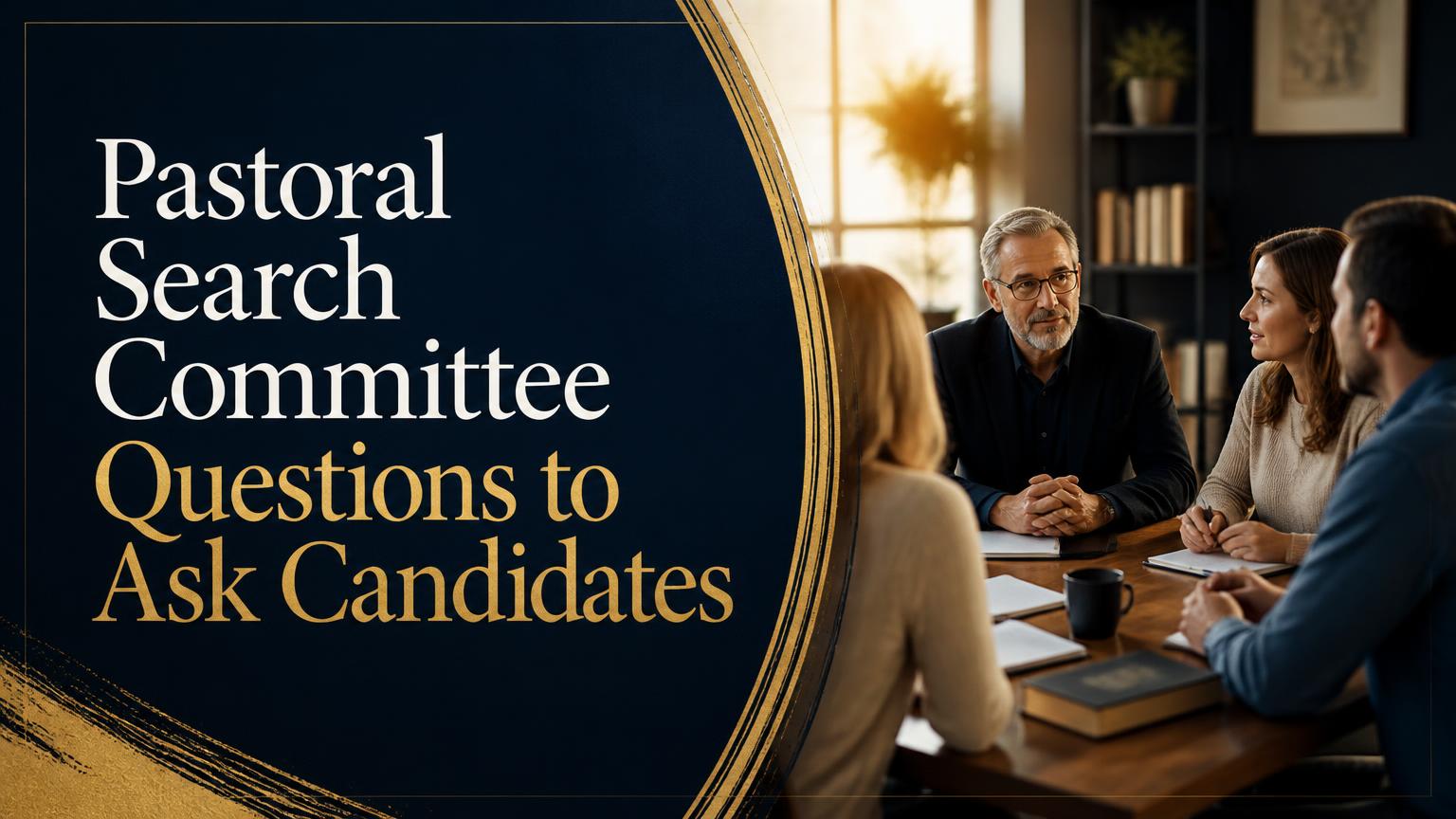
A pastoral search committee needs more than a list of interview questions. It needs questions that reveal a candidate’s theology, calling, character, pastoral instincts, leadership habits, and fit for the congregation’s actual needs. The strongest interview explores both what a pastor believes and how that belief shapes decisions, relationships, preaching, conflict, and care. Questions should be asked consistently, followed by thoughtful probing, and evaluated alongside references, a candidate’s ministry history, and the church’s clearly defined expectations.
Pastoral Search Committee Questions to Ask Candidates
The best pastoral interview questions are open-ended rather than designed to produce a rehearsed “correct” answer. Ask candidates to explain their reasoning, describe actual experiences, and identify lessons learned. A committee should listen for theological clarity, humility, emotional maturity, and alignment between stated convictions and demonstrated behavior.
Calling, Conversion, and Spiritual Maturity
Begin by asking, “How did you come to faith in Christ, and how have you sensed God’s call to pastoral ministry?” Follow with questions such as:
- What has confirmed your call to this particular pastoral role?
- Which parts of pastoral ministry give you the greatest joy?
- Which responsibilities are most difficult for you?
- How do you maintain your own spiritual life while serving others?
- Who has permission to challenge or correct you?
These questions help distinguish a deeply considered vocation from a general desire for leadership or employment. A candidate does not need a dramatic conversion or calling story, but should be able to describe a sustained conviction that pastoral ministry involves serving Christ and His people. First Peter 5:2–3 presents shepherding as willing, responsible service rather than domineering control. Look for evidence of prayer, teachability, endurance, and a realistic understanding of ministry’s burdens.
Theology, Preaching, and Handling Scripture
Ask candidates to summarize their core doctrinal convictions and explain how those convictions shape their preaching. Useful questions include:
- What do you believe about the authority, inspiration, and interpretation of Scripture?
- How would you describe the gospel in a few minutes?
- How do you plan a sermon series?
- How do you balance biblical exposition with application?
- How would you preach a difficult or unpopular biblical teaching?
- Which theological doctrines are essential for this church’s identity?
The committee should ask for examples rather than evaluating only theological vocabulary. Request an explanation of a recent sermon, including the passage’s main meaning, the structure of the message, and how the application was developed. A faithful preacher should neither use Scripture as a collection of inspirational quotations nor treat application as disconnected advice. The goal is to understand whether the candidate handles the biblical text carefully, communicates clearly, and applies truth with both conviction and pastoral wisdom.
Shepherding, Care, and Difficult Situations
Pastoral ministry includes grief, illness, marital strain, addiction, spiritual doubt, conflict, and crisis. Ask:
- How do you respond when someone comes to you with a serious personal problem?
- How do you decide when counseling should be referred to a licensed professional?
- Describe a time you walked with someone through grief or crisis.
- How would you respond to an allegation of abuse or misconduct?
- How do you protect confidentiality while addressing situations that threaten someone’s safety?
- What does pastoral presence look like when you cannot solve the problem?
Strong answers recognize both compassion and appropriate boundaries. A pastor is not a substitute for a physician, therapist, attorney, or safeguarding authority. Candidates should understand mandatory reporting requirements where applicable, church safety policies, and the limits of confidentiality. The committee should also listen for patience: effective shepherding often involves presence, prayer, careful listening, and wise referral rather than quick advice.
Leadership, Conflict, and Change
Ask candidates to describe how they lead people with different preferences, generations, and levels of commitment. Questions might include:
- Tell us about a significant conflict you helped resolve.
- How do you respond when a respected church member strongly disagrees with you?
- How do you make decisions when the congregation is divided?
- What changes would you avoid making during your first year?
- How do you equip lay leaders instead of doing every task yourself?
- Describe a leadership failure and what you learned from it.
The committee should distinguish confidence from control. A pastor must be able to make decisions, but pastoral leadership also requires listening, patience, transparency, and respect for the church’s governing structure. Healthy candidates can name mistakes without blaming everyone else. They understand that change requires theological clarity, relationship-building, communication, and attention to the congregation’s history. Ephesians 4:11–12 describes ministry leaders as equipping the saints for service, not monopolizing ministry themselves.
Discipleship, Evangelism, and Community Presence
A church should learn how a candidate understands spiritual growth beyond attendance at services. Ask:
- How do you define a mature disciple?
- What practices help people grow in prayer, Scripture, worship, service, and holiness?
- How would you help parents and households disciple children?
- How do you equip members to share the gospel naturally?
- What role should small groups, mentoring, or classes play?
- How should this church serve its surrounding community?
These questions reveal whether the candidate has a practical pathway for forming disciples or merely uses the language of growth. Look for an approach that includes both gathered worship and daily obedience. Evangelism should not be reduced to occasional events, and community service should not become a replacement for proclaiming the gospel. The candidate should be able to connect compassion, hospitality, justice, witness, and discipleship without confusing the church’s mission with a political program or a general social club.
Character, Family, and Accountability
Character questions should be direct, consistent, and connected to the responsibilities of pastoral ministry. Consider asking:
- What habits help you remain above reproach?
- How do you respond to criticism?
- Have you ever faced a moral, financial, or relational failure in ministry? What followed?
- What boundaries do you maintain in counseling and personal relationships?
- How do you handle money, gifts, travel, and the use of church resources?
- What structures provide accountability for you?
The qualifications in 1 Timothy 3:1–7 and Titus 1:5–9 emphasize character, self-control, faithfulness, hospitality, and the ability to lead responsibly. They do not describe perfection, but they do rule out concealment, habitual misconduct, and unaccountable leadership. Questions about family life should be relevant to the role and asked consistently of every candidate. Avoid intrusive questions about private matters that have no legitimate bearing on ministry. Focus on support, boundaries, workload, and the practices that help a pastor care for personal responsibilities faithfully.
Expectations, Role Fit, and Practical Stewardship
A candidate may be theologically sound and still be a poor fit for a particular congregation. Ask:
- What do you believe a pastor should accomplish in the first year?
- How should preaching, pastoral care, administration, and leadership be balanced?
- What staff or volunteer structures help you work effectively?
- How do you manage time when urgent needs compete with sermon preparation?
- What are your expectations regarding office hours, hospital visits, weddings, funerals, and availability?
- How do you approach budgets, facilities, technology, and administrative work?
- What questions do you have about this church’s history, challenges, and hopes?
These questions prevent vague expectations from becoming later conflict. A small congregation may expect substantial hands-on ministry, while a larger church may require team leadership, delegation, and organizational oversight. Discuss decision-making authority, compensation, time off, continuing education, relocation, housing, and evaluation before a call is extended. Practical details are not less spiritual than theological issues; unclear responsibilities can damage trust and make faithful ministry unnecessarily difficult.
How to Evaluate a Candidate’s Answers
Good pastoral search committee questions are only useful when the committee evaluates answers carefully. Do not judge a candidate solely by charisma, preaching style, or the ability to speak quickly under pressure. Compare answers with the candidate’s sermons, résumé, references, ministry history, and observed treatment of people who cannot advance the candidate’s interests.
Listen for Humility, Specificity, and Self-Awareness
Strong candidates usually answer with concrete examples, acknowledge complexity, and explain what they learned. They can describe decisions without presenting themselves as the hero of every story. Watch for ownership of mistakes, willingness to seek counsel, and respect for former churches or colleagues. Repeated blame, evasiveness, exaggerated success claims, or contempt for disagreement deserve further investigation.
A polished answer is not automatically a trustworthy answer. Ask follow-up questions such as, “What did you do next?” “What would you change now?” and “How did the other person experience that situation?” These prompts move the conversation from ideals to actual patterns of conduct.
Use a Consistent Process and Multiple Perspectives
Prepare a core set of questions that every candidate receives, while allowing limited follow-up for clarification. This improves fairness and makes comparisons more reliable. Assign committee members different areas to explore, then discuss observations after each interview rather than allowing the most forceful personality to determine the group’s impression.
References should test, not merely confirm, the interview. Ask former supervisors and ministry partners about reliability, conflict, financial integrity, pastoral care, staff relationships, and reasons for leaving previous positions. The committee should also define non-negotiable doctrinal and ethical requirements before interviews begin. Otherwise, personal preferences may quietly replace the church’s stated mission.
Questions the Committee Should Answer Before Interviews
The search committee should first clarify what the church is seeking. Is the primary need preaching, revitalization, pastoral care, church planting, staff leadership, youth ministry oversight, community engagement, or a combination of responsibilities? No candidate can be evaluated fairly against an undefined role. Review the church’s theology, mission, governance, attendance patterns, financial realities, ministry strengths, unresolved conflicts, and areas requiring change.
The committee should also agree on which qualifications are essential, which are preferred, and which are negotiable. Determine who will make the final recommendation, how confidentiality will be handled, how candidates will be informed of the process, and how references will be checked. Honest communication about the church’s condition is an ethical responsibility. A candidate cannot discern a call accurately if major conflicts, financial problems, leadership expectations, or workload realities are concealed.
Common Mistakes in Pastoral Interviews
One common mistake is asking questions that invite only ideal answers: “Do you value prayer?” or “Do you care about people?” Nearly every candidate will answer yes. Better questions ask how prayer shapes a weekly schedule or how the candidate responded to a specific pastoral crisis. Another mistake is spending most of the interview discussing preaching while neglecting conflict, boundaries, administration, finances, and personal accountability.
Committees should also avoid treating cultural similarity as spiritual maturity. A candidate who shares the committee’s communication style may still lack wisdom or integrity, while a candidate with a different personality may serve the church faithfully. Do not rush because of anxiety, compare candidates unfairly, or ignore troubling information because the church urgently needs a pastor. Careful discernment protects both the congregation and the candidate.
Final Guidance for a Pastoral Search Committee
The most valuable pastoral search committee questions reveal how a candidate thinks, serves, responds under pressure, handles Scripture, and treats people. They should uncover calling and character before focusing on presentation. The committee should seek a pastor whose theology aligns with the church, whose conduct supports that theology, and whose gifts fit the congregation’s real season of ministry.
A sound process combines thoughtful interviews with prayer, consistent evaluation, reference checks, congregational wisdom, and honest discussion of expectations. The aim is not to find a flawless personality or the most impressive performer. It is to recognize a trustworthy shepherd who can preach the gospel, care for people, equip the church, accept accountability, and lead with humility and courage.