
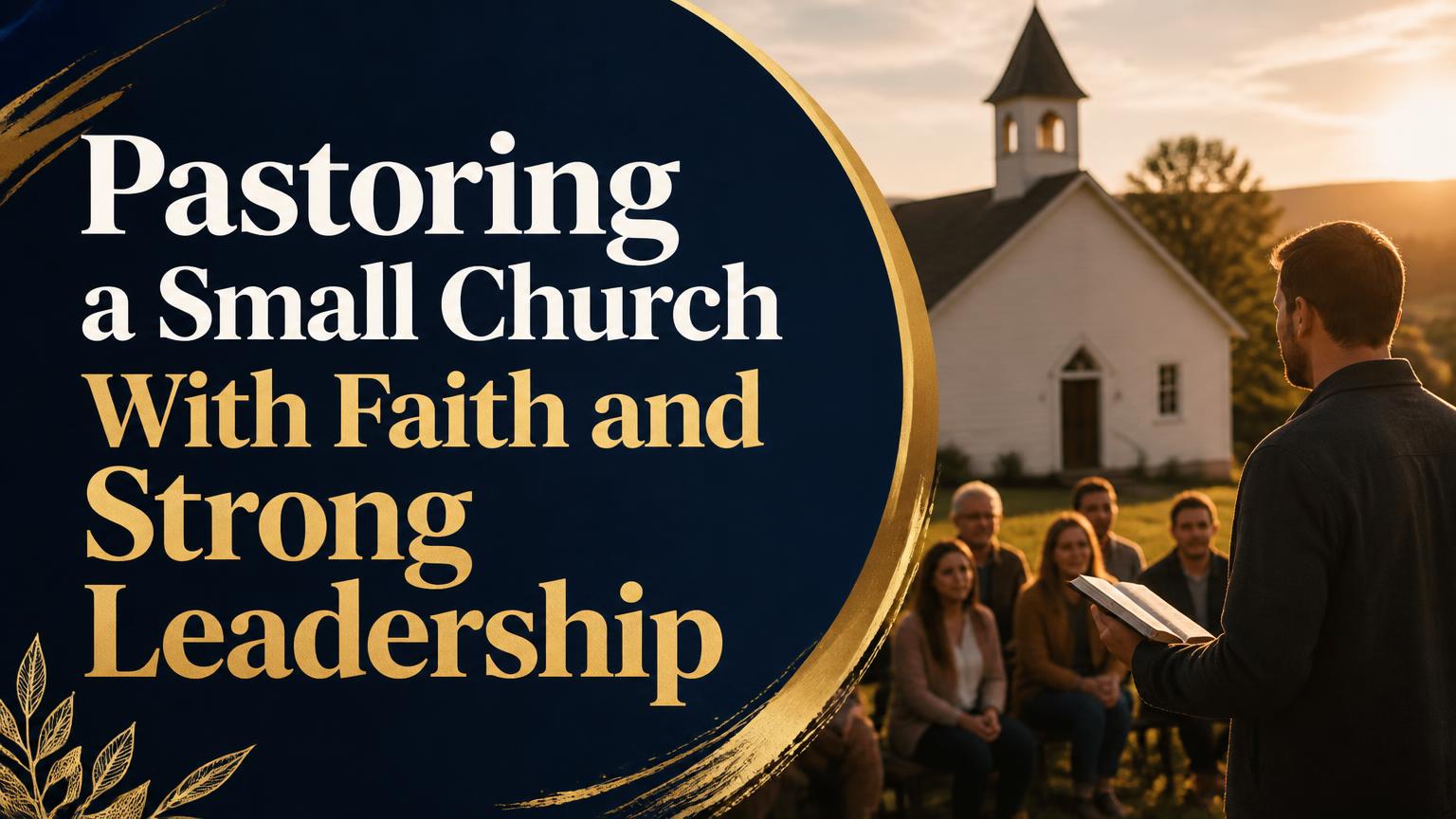
Pastoring a small church requires more than managing limited attendance, budgets, or programs. It calls for faithful shepherding in a setting where relationships are close, resources may be scarce, and the pastor’s influence is highly visible. The strongest small-church pastors combine biblical conviction with relational attentiveness, shared leadership, wise prioritization, and sustainable personal rhythms.
Pastoring a Small Church
A healthy approach to pastoring a small church begins with recognizing its distinctive strengths. A smaller congregation can foster deep relationships, personal discipleship, quick communication, and meaningful participation across generations. At the same time, the pastor may carry several responsibilities at once: preaching, pastoral care, administration, visitation, outreach, conflict resolution, and sometimes practical work that larger churches assign to staff.
The answer is not to imitate a large church with fewer people. It is to lead the congregation faithfully within its actual context.
Shepherd People Before Managing Programs
The central pastoral task is caring for people. Jesus described His followers as sheep who need guidance, protection, nourishment, and personal attention. Peter likewise instructed elders to shepherd God’s flock willingly and by example rather than by domineering over it (1 Peter 5:2–3).
In a small church, shepherding is often visible through ordinary acts:
- knowing members’ names and circumstances
- praying with people rather than only for them
- visiting the sick and homebound
- noticing prolonged absence
- listening carefully during seasons of grief or uncertainty
- helping believers apply Scripture to work, family, suffering, and decision-making
Small congregations can make pastoral care deeply personal, but familiarity can also create assumptions. A pastor may think he already knows what people need and stop asking careful questions. Faithful shepherding requires presence and attention, not merely long-term familiarity.
Pastoral care also needs appropriate boundaries. A pastor is responsible to care for people, but not to become the solution to every problem. Serious mental-health concerns, abuse, addiction, legal matters, and medical crises may require qualified professionals or appropriate authorities. Referring someone for specialized help is not a failure of pastoral faithfulness.
Establish a Focused Biblical Vision
A small church usually cannot pursue every ministry idea. A focused vision helps the congregation distinguish between what God is calling it to do and what it merely wishes it could imitate.
A church’s vision should arise from Scripture and its actual mission, not from comparison with larger congregations. Jesus’ command to make disciples (Matthew 28:18–20), the call to love God and neighbor (Matthew 22:37–40), and the church’s responsibility to encourage believers and care for those in need provide a durable foundation.
A useful vision answers practical questions:
- Whom is this church called to serve?
- What kind of spiritual maturity should disciples develop?
- Which ministries most directly support that purpose?
- What should the church stop doing because it consumes energy without producing lasting fruit?
- How will members know whether the church is growing in faithfulness?
A focused vision might lead a congregation to prioritize expository preaching, small-group discipleship, ministry to older adults, neighborhood outreach, or stronger care for families. The specific emphasis will differ, but the principle remains: depth and faithfulness usually matter more than a crowded ministry calendar.
Build Ministry Around Shared Participation
One of the greatest dangers in a small church is pastor-centered ministry. When few people are available, it can seem efficient for the pastor to do nearly everything. Over time, this weakens the congregation. Members become consumers, gifted people remain unused, and the pastor becomes exhausted.
Ephesians 4:11–12 presents church leaders as people who equip believers for ministry, not as substitutes for the entire body. The pastor’s responsibility includes teaching, organizing, encouraging, and developing others so that ministry becomes a shared calling.
Delegation works best when it includes real trust and clear expectations. Instead of saying, “Someone needs to handle this,” identify a person’s gifts, explain the responsibility, provide necessary support, and establish a reasonable point for review.
Shared ministry may include:
- prayer and visitation teams
- lay leaders for small groups or Bible studies
- members who coordinate benevolence
- worship, technology, children’s, or hospitality teams
- trained mentors for new believers
- deacons or ministry leaders who handle appropriate practical responsibilities
A small church should not recruit people merely to fill gaps. It should help believers serve according to their gifts, character, maturity, and capacity. Ministry becomes healthier when service is an expression of discipleship rather than an emergency response to every vacancy.
Steward Limited Resources With Wisdom
Small churches often operate with limited finances, facilities, volunteers, and time. Stewardship therefore requires honest assessment rather than guilt-driven expansion.
Before beginning a new program, consider:
- Does it support the church’s mission?
- Who will lead it?
- What ongoing time and money will it require?
- Which current ministry may need to change or end?
- Will it deepen discipleship or merely increase activity?
- Can the church sustain it during a difficult season?
Financial transparency is especially important in a small congregation because members often know one another personally and may be directly affected by budget decisions. Leaders should communicate clearly about priorities, obligations, benevolence, maintenance, missions, and reserves. Confidentiality should protect individual giving and assistance, but secrecy should not replace responsible governance.
Limited resources can also encourage creativity. A church may partner with nearby congregations, share training or facilities, use homes for discipleship, or cooperate in local service projects. Cooperation is not a sign that a church lacks identity. It can be a wise expression of Christian fellowship and stewardship.
Lead Through Presence, Not Control
A pastor’s authority should be pastoral, biblical, and accountable—not personal domination. Jesus contrasted servant leadership with the power-oriented behavior common among worldly rulers (Mark 10:42–45). In a small church, control can be especially tempting because decisions affect familiar people and disagreements feel personal.
Healthy leadership includes:
- explaining decisions rather than issuing unexplained directives
- inviting appropriate counsel
- distinguishing biblical convictions from personal preferences
- allowing mature leaders to disagree respectfully
- addressing problems directly instead of relying on indirect conversations
- keeping confidential matters confidential
- accepting correction when judgment has been poor
The pastor should also understand the congregation’s history. Resistance to a proposal may not mean resistance to ministry; it may reflect previous hurt, broken trust, financial disappointment, or fear of losing the church’s identity. Listening to the story behind a concern often reveals what needs healing before change can succeed.
The Distinctive Challenges of a Small Church
Small-church ministry has challenges that require more than general leadership advice. The pastor’s close involvement can produce strong care, but it can also magnify conflict, blur roles, and create unrealistic expectations.
Managing Multiple Roles
A pastor may preach on Sunday, counsel during the week, organize repairs, attend community events, prepare a budget, and respond to a family emergency—all within a few days. Without priorities, urgent tasks will displace important ones.
A workable rhythm protects time for:
- Scripture, prayer, and spiritual examination
- sermon preparation
- pastoral visits and conversations
- leadership development
- administration
- rest and family life
Acts 6:1–7 shows the early church responding to competing needs by clarifying responsibilities rather than allowing every task to remain concentrated in the apostles’ hands. The principle applies to modern ministry: important work still requires boundaries and shared responsibility.
Handling Conflict in a Relational Setting
Conflict in a small church rarely remains abstract. People worship together, live near one another, and may share family or community connections. A disagreement about music, spending, leadership, or building use can become a disagreement between friends.
Pastors should address conflict early, privately, and truthfully. Matthew 18:15 emphasizes direct conversation with the person involved rather than spreading the matter through the congregation. That conversation should aim at understanding, repentance where necessary, reconciliation, and a workable path forward.
Not every disagreement is a moral crisis. Some involve preferences, traditions, or differing judgments. Wisdom includes knowing when Scripture requires conviction, when Christian liberty applies, and when a congregation must make a practical decision despite sincere disagreement.
Caring for the Pastor’s Own Soul
A pastor cannot sustain faithful care while treating personal health as irrelevant. The demands of small-church ministry can be hidden because the congregation may assume that a highly available pastor is a faithful pastor.
Jesus Himself withdrew from constant activity to pray and rest (Mark 1:35; 6:31). Rest does not compete with ministry; it helps prevent ministry from becoming self-reliant, resentful, or careless.
Pastors need relationships in which they are not always the leader. A trusted mentor, denominational connection, peer group, counselor, or spiritually mature friend can provide perspective and prayer. Family members also need more than whatever time remains after church demands. Protecting a day of rest, taking regular leave, and setting communication boundaries are acts of stewardship rather than selfishness.
What Healthy Growth Looks Like
Growth in a small church should not be measured only by attendance. Numerical increase can be a blessing, but Christian maturity also appears through deeper prayer, repentance, generosity, reconciliation, service, evangelistic courage, and care for vulnerable people.
A congregation may be growing healthily when:
- members increasingly minister to one another
- new believers are discipled rather than merely counted
- leaders are being developed
- conflict is handled with truth and grace
- worship and teaching are centered on Scripture
- people serve without constant pressure from the pastor
- the church responds to local needs wisely
- members understand the congregation’s mission
- the pastor is not indispensable to every ministry
This broader view prevents two opposite errors. A church should not dismiss numerical growth as unimportant, since reaching people matters. But it should also avoid judging faithfulness by attendance alone, especially when a congregation serves a small, aging, rural, or otherwise limited community.
Practical Priorities for a New Small-Church Pastor
During the first season of ministry, a pastor should resist the urge to change everything quickly. A wise beginning usually includes:
- Listen to the congregation’s story. Learn its strengths, wounds, traditions, and hopes.
- Clarify expectations. Discuss responsibilities, decision-making, compensation, time off, and communication.
- Know the people personally. Build relationships before proposing major changes.
- Preach and teach consistently. Let Scripture shape the church’s spiritual direction.
- Identify trustworthy leaders. Look for character and faithfulness, not merely availability.
- Choose a few priorities. Focus effort where it can produce lasting spiritual benefit.
- Review ministry honestly. Keep what serves the mission and revise what does not.
- Create sustainable rhythms. Establish boundaries before exhaustion forces them upon you.
Patience does not mean passivity. It means giving relationships, trust, teaching, and prayer time to produce durable change.
Conclusion
Pastoring a small church is best understood as faithful shepherding within a particular community, not as managing a reduced version of a large church. The pastor’s central work is to teach Scripture, care for people, equip the congregation for ministry, steward limited resources, and lead without control. Healthy small-church ministry combines personal presence with shared responsibility and spiritual conviction with practical wisdom. Its success is seen not only in attendance, but in a congregation increasingly formed by Christ, equipped to serve, and able to care for one another faithfully.