
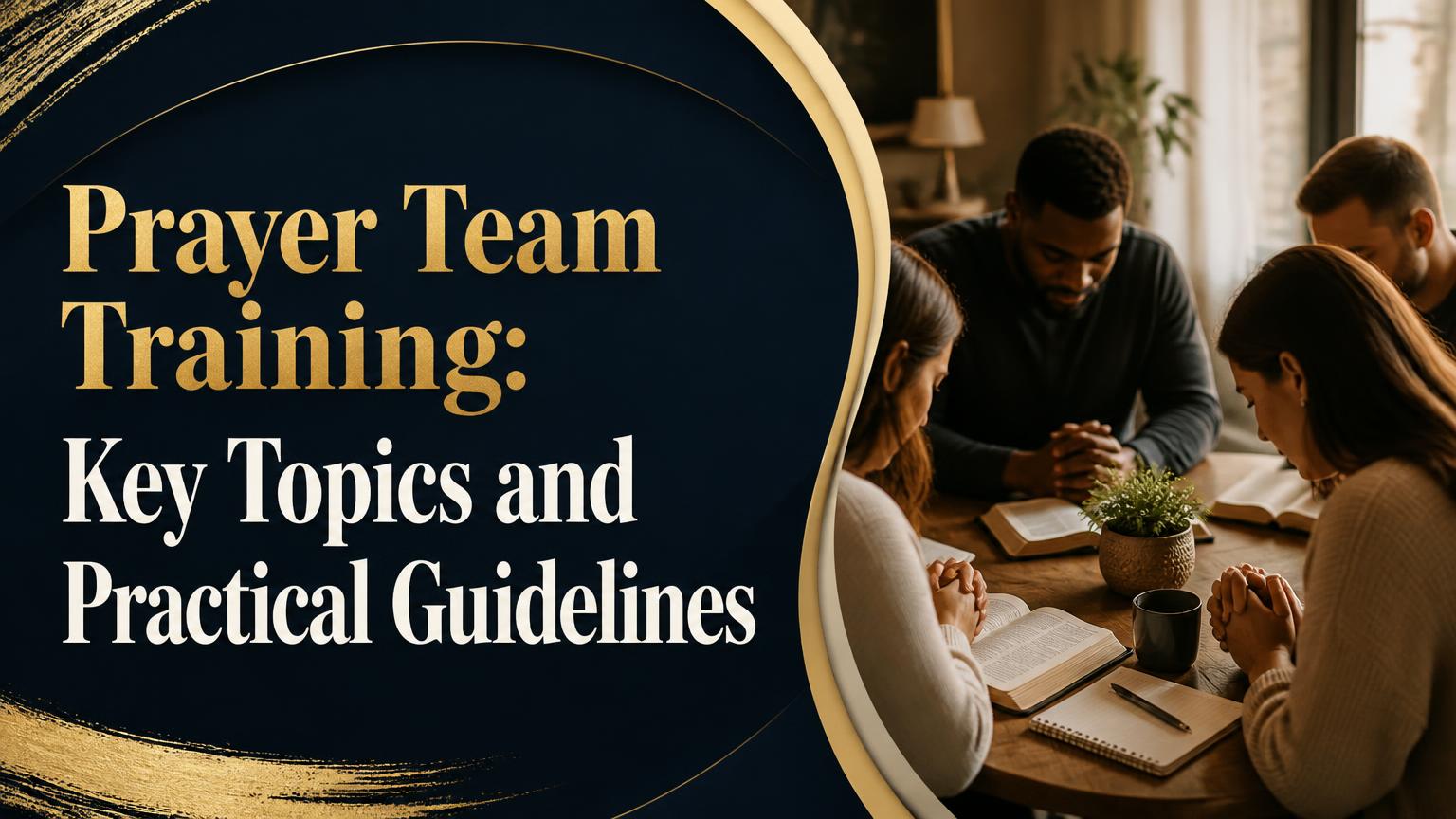
Prayer team training equips volunteers to pray with others in a way that is biblically grounded, pastorally sensitive, spiritually discerning, and practically responsible. Effective training goes beyond teaching people to use familiar phrases or pray at length. It prepares them to listen well, respect confidentiality, recognize limits, respond appropriately to serious needs, and keep the focus on God rather than on the personality or supposed insight of the person praying.
Prayer Team Training: Key Topics and Practical Guidelines
A strong training program combines biblical formation, practical skills, supervised experience, and clear accountability. Prayer ministers should understand both the privilege and the limits of their role: they serve people through prayer, but they are not substitutes for pastors, counselors, physicians, emergency services, or other qualified professionals.
Establish a Biblical Foundation and Purpose
Prayer team members should begin with a clear understanding of what Christian prayer is and why the church prays with people. Prayer is an act of dependence on God, not a technique for controlling outcomes. Jesus teaches his followers to seek the Father’s will, trust his provision, pursue forgiveness, and ask for protection from evil (Matthew 6:9–13). Philippians 4:6–7 connects prayer with bringing concerns to God and receiving his peace, while James 5:13–16 presents prayer as a meaningful part of the church’s care for suffering and sick people.
Training should also clarify the purpose of a prayer team. Its ministry may include intercession during worship services, prayer appointments, prayer for healing, support for people facing grief or crisis, and ongoing prayer for church needs. The team’s purpose is not to impress people, guarantee particular results, or make theological judgments about why someone is suffering. Its purpose is to serve faithfully, listen compassionately, and entrust people and circumstances to God.
Teach Team Members How to Pray With People
Prayer with another person requires more than knowing what to say. Volunteers should learn to introduce themselves, ask permission to pray, clarify the person’s request, and determine whether the person wants a brief prayer or a longer conversation. A simple question such as “What would you like us to pray about?” allows the individual to set the direction instead of being overwhelmed by the minister’s assumptions.
Prayers should generally be understandable, focused, and appropriate to the situation. Team members can thank God, acknowledge the person’s need, ask for wisdom or help, and leave room for God’s will. They should avoid turning prayer into a sermon, interrogation, political speech, or public display. Listening is part of ministry. A person who is grieving may need a quiet, compassionate prayer rather than a long explanation of suffering.
Training should include role-play. Volunteers can practice praying for anxiety, illness, family conflict, financial pressure, grief, repentance, and uncertainty. After each exercise, trainers can discuss whether the prayer respected the person’s request, used appropriate language, avoided assumptions, and communicated hope without making promises God has not made.
Develop Discernment Without Presumption
Prayer team members need spiritual discernment, but discernment should not be confused with certainty about another person’s motives, sin, medical condition, or future. A volunteer may sense that a particular concern should be included in prayer, yet that impression should be offered humbly rather than announced as an unquestionable message from God. Statements such as “I may be wrong, but would it be helpful to pray about…” preserve freedom and reduce pressure.
This principle is especially important in churches that practice prophetic prayer, words of knowledge, or prayer for healing. Each congregation should train volunteers according to its doctrinal commitments and established pastoral oversight. Regardless of tradition, prayer ministers should test impressions against Scripture, character, wisdom, and the person’s freedom. They should never use spiritual language to demand compliance, expose private information, predict death, direct major life decisions, or claim that a person’s lack of healing proves inadequate faith.
Discernment also includes knowing when not to continue. If someone becomes distressed, confused, agitated, or uncomfortable, the volunteer should pause and ask what the person needs. Respectful prayer leaves room for consent, questions, and refusal.
Practice Confidentiality, Consent, and Boundaries
Confidentiality is a foundational requirement for prayer ministry. Team members should not share a person’s story casually, use it as an illustration, discuss it in group messages, or turn a request into congregational gossip. Training should distinguish between private information and situations that must be reported or escalated, such as imminent danger, abuse involving a child or vulnerable adult, threats of suicide, or other circumstances governed by church policy and applicable law.
Consent should be specific and ongoing. A person’s request for prayer does not automatically authorize physical touch, public mention, contact from the team, or disclosure to others. Volunteers should ask before placing a hand on someone, and churches should provide a no-touch option without embarrassment. Prayer teams should also use appropriate safeguards for opposite-sex ministry, one-to-one meetings, minors, and online prayer interactions.
Boundaries protect both the person receiving ministry and the volunteer. Team members should not create secretive relationships, provide unqualified counseling, borrow or lend money, make business arrangements with people they serve, or present themselves as the person’s exclusive spiritual support. A prayer team serves people; it does not possess them.
Prepare for Crisis, Illness, and Referral
Prayer team training must explain how to respond when a request involves serious risk. If someone expresses an immediate intention to harm themselves or another person, the volunteer should not promise secrecy or attempt to manage the situation alone. The team should follow the church’s crisis procedure, involve appropriate pastoral leadership, and contact emergency or crisis services when necessary.
The same principle applies to medical and psychological concerns. Prayer can accompany medical treatment, counseling, recovery programs, and practical support, but it should not replace them. Volunteers should never instruct someone to stop prescribed medication, abandon professional care, or reject urgent medical attention. If a person reports symptoms that may indicate an emergency, the appropriate response is to encourage immediate qualified help while offering prayer.
A referral is not a failure of faith. It is often an expression of wisdom and love. Churches should maintain a current list of pastoral, medical, mental-health, domestic-violence, addiction, and community resources. Team members should know whom to contact when a need exceeds their training.
Build Team Culture and Accountability
Prayer ministry becomes safer and more fruitful when it operates as a team rather than as a collection of independent volunteers. Members should receive feedback, attend periodic refreshers, and know who supervises the ministry. Leaders can review general patterns, difficult situations, and safeguarding concerns without exposing unnecessary personal details.
A healthy team culture values humility, teachability, and mutual support. Galatians 6:1 describes restoration as a gentle ministry carried out with self-awareness, and 1 Corinthians 14:40 calls for congregational ministry to be conducted properly and orderly. These principles apply to prayer teams: spiritual enthusiasm should be matched by maturity, structure, and accountability.
Leaders should also watch for burnout. Volunteers who pray with people regularly may absorb significant emotional weight. Scheduled breaks, debriefing, rotation, and permission to step away help preserve compassion. A team that expects constant availability can unintentionally turn service into exhaustion, resentment, or unhealthy dependence.
How to Structure a Practical Prayer Team Training Program
A useful training program can be delivered in several sessions rather than one information-heavy meeting. Begin with the ministry’s purpose, biblical foundations, church doctrine, leadership structure, and safeguarding expectations. Explain what volunteers may do, what requires pastoral involvement, and what lies outside the team’s role. Written policies should cover confidentiality, consent, physical touch, minors, crisis response, documentation, and referral.
The next stage should develop practical skills. Demonstrate a respectful prayer conversation from beginning to end: welcome the person, listen, clarify the request, ask permission, pray simply, and close without creating pressure. Use role-play for ordinary and difficult situations. Include examples involving grief, anger toward God, chronic illness, marital conflict, trauma, spiritual doubt, and requests for prophetic guidance. Participants should receive constructive feedback on listening, language, posture, boundaries, and follow-up.
New volunteers should then serve under supervision before praying independently. Pair them with experienced team members, establish a clear process for requesting help, and schedule a review after initial service. Ongoing development might include quarterly training, case discussions, Scripture reflection, prayer, and updates to safety procedures. Churches should evaluate the ministry by asking whether people are treated with dignity, whether volunteers remain within their competence, whether concerns are escalated appropriately, and whether the team reflects Christlike humility.
A Simple Model for Prayer With Individuals
A consistent framework helps volunteers serve confidently without making prayer mechanical. One practical model has five movements:
- Welcome: Introduce yourself, create a calm setting, and ask whether the person would like prayer.
- Listen: Invite the person to describe the request in their own words. Do not demand details that are unnecessary for prayer.
- Clarify: Ask what kind of support would be helpful and whether there are boundaries around touch, public prayer, or follow-up.
- Pray: Address God directly, keep the prayer appropriate and understandable, and avoid promises about specific outcomes.
- Close: Thank the person, ask whether anything else would be helpful, and explain any appropriate next step or referral.
This model is flexible. A grieving person may need silence and a short prayer; someone requesting intercession for a long-term illness may welcome more time. The framework protects the person’s agency while giving the volunteer a dependable path through the conversation.
Common Mistakes in Prayer Team Ministry
Several practices can undermine otherwise sincere prayer ministry. One is treating emotional intensity as evidence of spiritual power. Loudness, dramatic language, or prolonged prayer may affect people strongly, but they do not prove that prayer is more faithful or effective. Another mistake is giving explanations for suffering too quickly. Statements such as “God did this because…” can deepen pain and exceed what the volunteer knows.
Prayer teams should also avoid making healing promises. Christians may pray boldly for healing while recognizing that prayer does not give volunteers control over the result. A person who remains ill should never be shamed, blamed, or told that insufficient faith caused the outcome. The team should offer continued compassion and practical support.
Finally, volunteers should avoid confusing prayer with counseling, deliverance ministry, diagnosis, or pastoral discipline unless they are specifically trained and authorized for those responsibilities. Clear role boundaries make prayer more trustworthy because they prevent spiritual authority from being used beyond its proper purpose.
Conclusion
Prayer team training should form servants who combine confidence in God with humility about their own knowledge and authority. The essential curriculum includes biblical prayer, attentive listening, consent, confidentiality, discernment, crisis awareness, referral, supervised practice, and ongoing accountability. Prayer ministers can pray with genuine faith without guaranteeing outcomes, diagnosing hidden causes, or replacing qualified care. When a team serves within clear boundaries and keeps the person’s dignity at the center, prayer becomes a faithful expression of the church’s care: compassionate, orderly, spiritually grounded, and open to God’s work.