
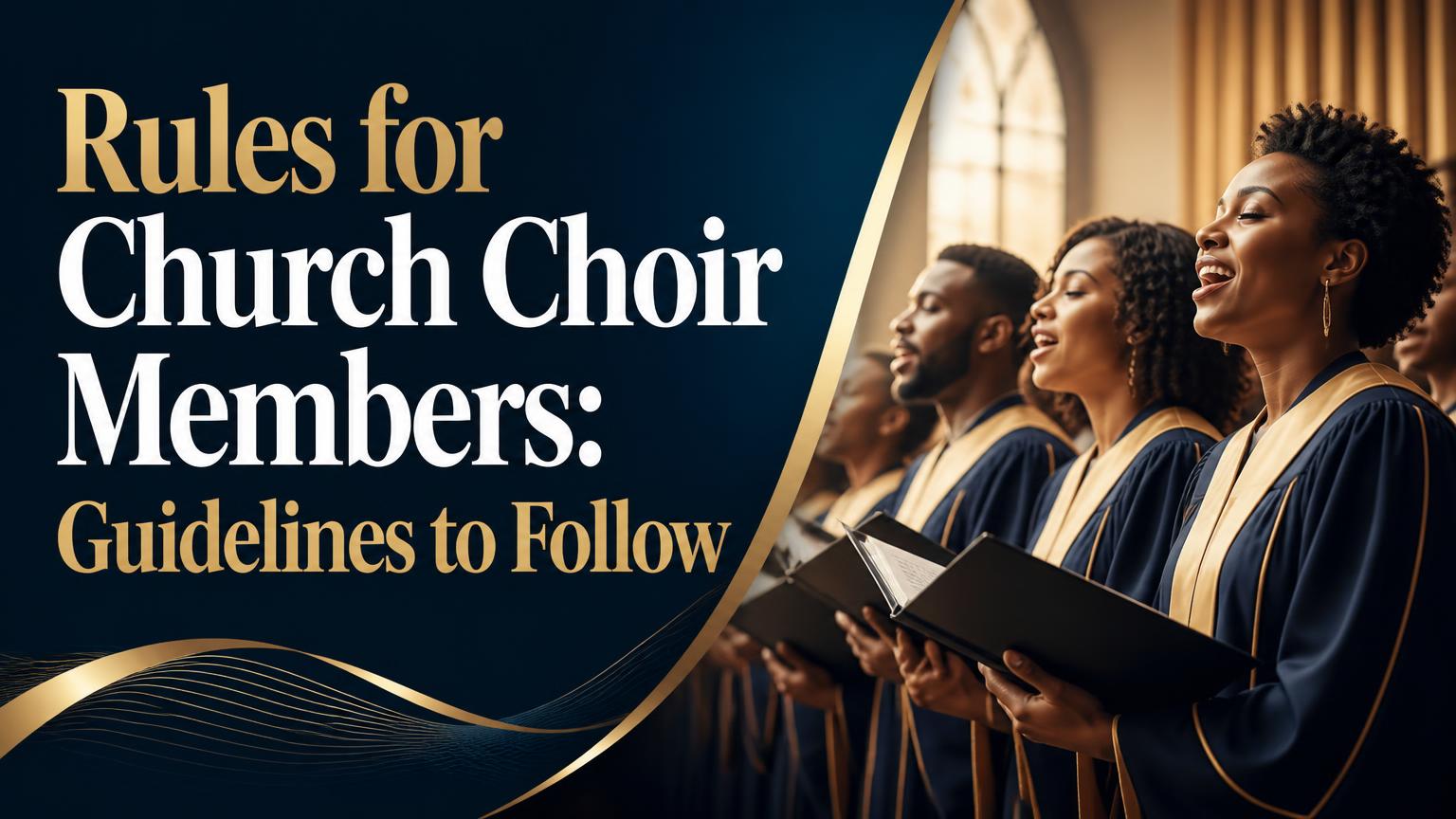
Church choir members help lead the congregation in worship, so their responsibilities extend beyond singing correct notes. Effective choir guidelines address spiritual purpose, musical preparation, attendance, conduct, relationships, appearance, leadership, and care for others. These rules should support worship rather than create unnecessary control. While each church may establish its own standards, the best rules are clear, consistently applied, biblically grounded, and designed to help members serve with humility, reliability, unity, and joy.
Rules for Church Choir Members
Church choir rules should explain how members prepare, behave, cooperate, and represent the ministry. They are not intended to demand perfection. Rather, they create a shared standard that allows the choir to serve the congregation without avoidable distractions or conflict.
Commit to Worship, Not Performance
A church choir exists to honor God and help the congregation participate in worship, not to showcase individual talent. Members should approach rehearsals and services with a teachable, prayerful attitude. Musical ability is valuable, but it does not replace humility, reverence, or concern for the spiritual purpose of the service. Colossians 3:16 connects singing with teaching and encouraging one another, which means the choir’s ministry should strengthen the church rather than draw attention primarily to individual performers.
Attend Rehearsals and Arrive Prepared
Members should attend scheduled rehearsals consistently, arrive on time, bring the required music, and review assigned material before practice. Regular attendance allows the director to teach harmonies, dynamics, entrances, pronunciation, and transitions efficiently. If illness, work, family responsibilities, or an emergency prevents attendance, the member should notify the appropriate leader as soon as possible. Repeated absence without communication can place an unfair burden on those who remain and may make a person unreliable for particular services.
Learn the Music and Follow the Director
Choir members should learn their vocal parts, observe markings in the music, and follow the director’s instructions about tempo, volume, phrasing, posture, and when to sing. Members should not change arrangements, add frequent improvisations, or begin singing independently simply because they prefer another interpretation. A director’s role is to coordinate many voices into one musical offering. Questions and suggestions are appropriate at the right time, but public resistance during rehearsal weakens order and makes it harder for the group to improve.
Sing With Discipline and Blend
Good choir singing requires more than knowing the melody. Members should listen to the surrounding sections, match vowels and consonants, control volume, and avoid overpowering nearby singers. A strong voice is not automatically the most helpful voice in a choir; balance and blend often matter more than individual prominence. Members should also respect vocal health by using proper breathing, avoiding unnecessary shouting, and telling the director when a part is uncomfortable or beyond their current range.
Protect Unity and Show Respect
Members should speak respectfully to the director, accompanists, musicians, fellow singers, pastors, and congregation. Gossip, mocking mistakes, cliques, personal criticism, and competition between sections can damage trust quickly. Disagreements should be addressed privately and directly through the appropriate leader rather than circulated through group messages or informal conversations. Romans 12:10 calls believers to honor one another, and that principle applies when personalities, musical preferences, and levels of experience differ.
Maintain Appropriate Conduct and Appearance
Choir members should follow the church’s reasonable expectations for clothing, grooming, platform behavior, and use of phones. Clothing should fit the worship setting and avoid becoming a distraction, while standards should be applied fairly and respectfully rather than used to shame people. During services, members should remain attentive, avoid unnecessary talking, and handle movement between the choir area and platform discreetly. Appearance guidelines should serve modesty, unity, and focus—not impose personal preferences as though they were universal biblical commands.
Respect Safeguarding and Personal Boundaries
Choir ministries often include children, teenagers, older adults, and people who may be vulnerable. Members should follow the church’s safeguarding procedures, avoid inappropriate private contact, respect physical and emotional boundaries, and report genuine concerns through the designated process. Leaders should not assume that musical ministry eliminates the need for supervision or accountability. Clear rules about transportation, changing areas, communication, and one-on-one interactions protect both participants and volunteers.
Accept Correction and Keep Growing
A choir member should be willing to receive correction without treating every musical suggestion as a personal attack. Directors may adjust a singer’s volume, seating, part, posture, or participation because they are considering the needs of the whole ensemble. At the same time, leaders should give feedback privately when possible, explain expectations clearly, and distinguish skill development from character judgment. A healthy choir treats correction as part of learning while preserving the dignity of every member.
Handle Commitments Reliably
Members should communicate early when they cannot fulfill an assignment, need a substitute, or face a change in availability. They should return borrowed music or equipment, care for choir robes and facilities, and complete responsibilities such as setup, cleanup, or sectional practice when those tasks are assigned. Reliability matters because worship services involve coordinated schedules. One unexplained absence can affect microphones, seating, harmonies, solos, and the confidence of the entire group.
Biblical Principles Behind Choir Service
The Bible does not provide a single universal dress code, rehearsal schedule, or membership form for every church choir. It does, however, provide principles that shape wise guidelines. Worship should be offered sincerely and reverently, as reflected in Jesus’ teaching about worship “in spirit and truth” in John 4:24. Psalm 100 presents singing as joyful service, while 1 Corinthians 14:40 instructs the church to conduct gatherings decently and in order. These passages support preparation and structure, but they do not turn musical preference into a test of spiritual worth.
The New Testament also emphasizes mutual encouragement, humility, and unity. Philippians 2:3–4 warns against selfish ambition and calls believers to consider others, while Ephesians 4:15–16 describes the church growing as each part contributes properly. Applied to a choir, this means members should use their abilities for the good of the congregation, accept that different people have different roles, and avoid treating visibility, solo opportunities, or vocal strength as measures of personal importance.
How Churches Should Apply Choir Rules
Rules work best when leaders explain them before problems arise. A written choir handbook can state attendance expectations, rehearsal procedures, clothing standards, audition or placement practices, safeguarding requirements, communication methods, and the process for addressing concerns. New members should receive orientation rather than being expected to discover unwritten traditions through embarrassment or criticism. Leaders should also distinguish firm requirements from preferences; for example, child-safety procedures may be nonnegotiable, while a particular color or seating arrangement may reflect local custom.
Fair application is equally important. Leaders should avoid favoritism, shifting standards, public humiliation, and discipline based on personality or social status. When a member falls short, the first response should usually be clarification and pastoral conversation. Persistent disregard for responsibilities may require a change in assignments or temporary removal from the choir, but such steps should follow the church’s stated process and allow the person to understand what needs to change. Rules should produce trust and order, not fear.
A church should also make reasonable room for growth. Some members may be inexperienced, have disabilities, lack formal musical training, or need adapted materials. Training, mentoring, accessible communication, and patient instruction can uphold standards without confusing professionalism with spiritual maturity. A choir becomes stronger when expectations are high but participation is not restricted to people who already possess advanced musical skills.
Common Mistakes in Choir Guidelines
One mistake is treating every local preference as a biblical command. Churches may legitimately choose a formal or informal style, use robes or ordinary clothing, sing from printed music or screens, and rehearse on different schedules. Those choices can support a congregation’s culture, but they should be identified as local decisions rather than presented as the only faithful Christian approach.
Another mistake is measuring commitment only by visibility or vocal quality. A quiet alto who attends faithfully, encourages others, and serves responsibly may contribute more to the ministry’s health than a talented singer who regularly creates conflict. Conversely, good intentions do not remove the need for preparation and accountability. Healthy guidelines hold both truths together: character and worshipful purpose matter, and reliable musical service matters too.
Conclusion
Rules for church choir members should guide people toward faithful service, musical preparation, respectful conduct, unity, and care for the congregation. The strongest guidelines are specific enough to prevent confusion but flexible enough to recognize differences among churches and members. They encourage punctuality without legalism, excellence without pride, correction without humiliation, and standards without favoritism. When choir members prepare well, follow leadership, protect one another, and keep worship rather than personal recognition at the center, their singing becomes part of a broader ministry of encouragement and shared devotion.