
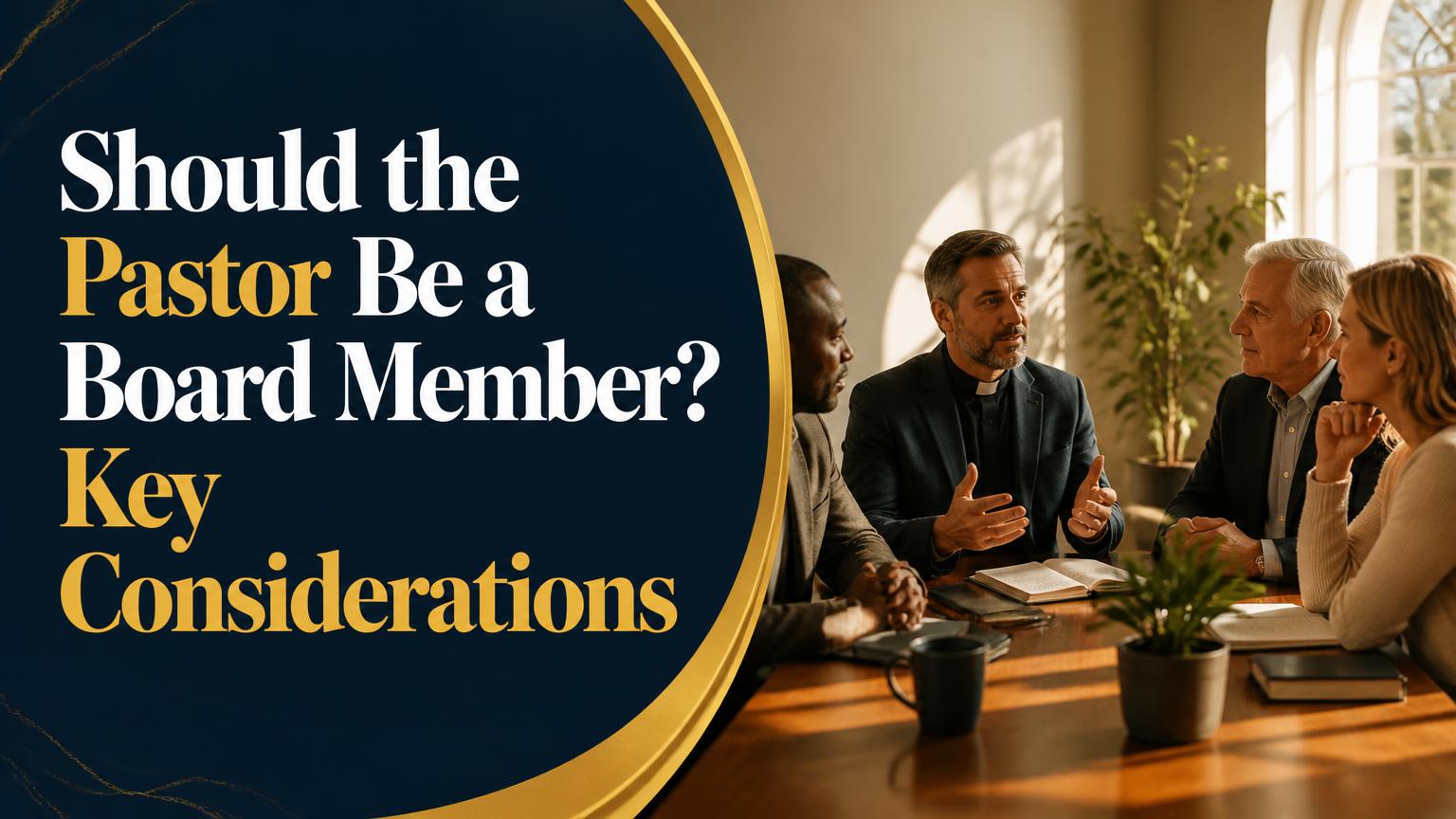
A pastor can appropriately serve as a church board member, but the answer is not automatically yes or no. The decision should reflect the church’s theology of leadership, legal structure, governance model, and need for independent accountability. In many churches, the healthiest arrangement allows the pastor to participate meaningfully while ensuring that lay leaders retain genuine oversight and that the pastor does not control decisions about personal compensation, evaluation, or employment.
Should the Pastor Be a Board Member?
The Case for Including the Pastor
Including the pastor on the board can connect governance decisions with the church’s ministry, doctrine, mission, and pastoral realities. The pastor often understands the congregation’s needs, ministry opportunities, staff dynamics, and theological commitments better than anyone else involved in administration.
A pastor’s participation can also prevent the board from making decisions in isolation from the church’s spiritual purpose. Decisions about staffing, facilities, budgets, outreach, discipleship, and strategic priorities are not merely business questions. They affect how the church carries out its mission.
A pastor who serves on the board may also help promote unity between the board and staff. When the pastor is excluded from important discussions, the board may unintentionally create an “us versus them” relationship. Conversely, participation gives the pastor an opportunity to explain ministry needs, listen to concerns, and help the board understand the consequences of its decisions.
This arrangement works best when the pastor welcomes accountability rather than treating board membership as a guarantee of authority. Board participation should involve shared deliberation, not automatic agreement.
The Case Against Automatic Board Membership
The strongest argument against automatic membership is the need for independent oversight. In many churches, the board is responsible for hiring, evaluating, compensating, and, if necessary, removing the pastor. If the pastor is a voting board member, the church must carefully manage the conflict between the pastor’s role as a decision-maker and the board’s role as the pastor’s employer or overseer.
A pastor may also have disproportionate influence because of preaching authority, personal loyalty, theological expertise, or control over staff communication. Even without intending to dominate, the pastor may make it difficult for other board members to disagree openly. A board that exists only to approve the pastor’s preferences is not providing meaningful governance.
There are also practical concerns. Board work requires attention to budgets, legal compliance, risk management, personnel, policies, and long-term planning. A pastor may be gifted in spiritual leadership but have limited interest or training in these responsibilities. The church should not assume that pastoral gifting automatically equals governance competence.
Excluding the pastor from board membership does not necessarily mean excluding the pastor from leadership. The pastor may attend meetings, provide reports, participate in discussion, and help shape ministry strategy without holding a vote on every matter.
Three Governance Models Used by Churches
Churches commonly use one of three arrangements:
The pastor serves as a full voting board member.
The pastor participates in discussion and votes on most or all board matters. This model may fit a church in which the board functions as a group of elders or ministry overseers, especially when the pastor is one elder among several.The pastor serves ex officio, often without a vote.
“Ex officio” means membership exists because of the person’s office. However, ex officio status does not automatically mean nonvoting status; the bylaws must specify the person’s rights. A nonvoting role allows the pastor to contribute information and counsel while preserving greater independence for the board.The pastor is not a board member but regularly participates by invitation.
This model separates pastoral leadership from formal corporate governance. It can be useful when the board’s primary responsibilities involve legal, financial, and employment oversight. The pastor should still have a clear channel for presenting ministry needs and responding to board concerns.
No model is inherently biblical in every setting. The important issue is whether the structure reflects the church’s actual responsibilities and produces trustworthy, accountable leadership.
The Pastor’s Role Changes Under Each Model
A voting pastor must be prepared to distinguish personal interest from the church’s interest. For example, the pastor should not vote on personal compensation, contract renewal, performance evaluation, or a complaint involving the pastor. The pastor may provide relevant information, but the board should deliberate and decide independently.
A nonvoting pastor must still be treated as a significant ministry leader, not merely as an employee who receives instructions. If the pastor is excluded from meaningful discussion, the board may make decisions without understanding their pastoral and theological consequences.
A pastor who is not a board member needs clarity about authority. The pastor should know which decisions belong to the board, which belong to staff leadership, and which require congregational approval. Ambiguity produces both frustration and unhealthy informal power.
What Scripture Requires—and What It Does Not
The New Testament does not prescribe a modern nonprofit board structure. It does not state that every pastor must be a legal director of a corporation, nor does it establish one universal relationship between pastors, elders, deacons, congregations, and boards.
It does, however, provide principles for evaluating church leadership.
Pastoral Leadership Is Spiritual, Not Merely Administrative
Pastors and elders are called to shepherd God’s people, teach sound doctrine, provide spiritual care, and lead by example. In 1 Peter 5:1–4, elders are instructed to shepherd willingly and humbly rather than domineering over those entrusted to them. This principle applies whether the church uses the title pastor, elder, overseer, or another structure.
The pastor’s authority, therefore, should not be understood merely as executive power. Christian leadership is exercised through service, truth, character, and responsibility before Christ. A board structure that gives a pastor unchecked control conflicts with this model, even if the pastor holds an official title.
Shared Oversight Protects the Church
The New Testament also presents leadership as shared rather than concentrated in one person. The qualifications for elders in 1 Timothy 3 and Titus 1 emphasize character, sound teaching, household leadership, and a good reputation. Acts 15 portrays important doctrinal and practical questions being addressed through collective deliberation rather than through the unilateral decision of one leader.
That does not mean every decision must be made by a large committee. It does mean that churches should resist arrangements in which one pastor becomes practically unaccountable. A board can help provide wisdom, correction, encouragement, and protection when its members are spiritually mature and willing to speak honestly.
The Legal Board and the Spiritual Eldership May Not Be Identical
A church may use the word “board” for several different bodies. A board of directors may exist primarily to fulfill corporate, financial, and legal responsibilities. A board of elders may primarily shepherd and oversee the spiritual life of the congregation. Some churches combine these functions; others separate them.
That distinction matters. A pastor who should participate in spiritual oversight may not need to control every corporate decision. Likewise, a legally responsible board cannot neglect financial and employment duties simply because the church also has a spiritual leadership structure.
The church’s governing documents should clearly explain how these responsibilities relate.
Questions That Should Decide the Structure
Is the Board Governing the Corporation or Serving as Elders?
First identify what the board actually does. If it functions as a council of elders, including the pastor may be natural, particularly if the pastor is one elder among several. If it functions as a corporate board responsible for fiduciary duties and employment decisions, independence and conflict-of-interest procedures become especially important.
Some churches need two coordinated bodies: spiritual elders for pastoral oversight and a board of directors for legal and financial governance. That arrangement requires clear communication, authority boundaries, and a process for resolving disagreements.
Who Hires and Evaluates the Pastor?
If the board hires and evaluates the pastor, it must be able to do so without intimidation or undue dependence on the pastor’s vote. A pastor serving on that board should leave the room for discussions involving compensation, evaluation, discipline, contract renewal, or termination.
The pastor should never be the sole person who determines whether the pastor is performing well. Healthy accountability includes input from other leaders and, where appropriate, the congregation.
Does the Board Have Genuine Independence?
A board is not independent merely because it contains several names. Members should be capable of disagreeing, asking difficult questions, reviewing financial information, and challenging proposals without fear of retaliation.
The pastor should not personally select every board member, control the agenda, determine which information reaches the board, and preside over every meeting. Those practices can make formal checks meaningless even when the bylaws appear sound.
What Does the Church’s Polity Expect?
Congregational, elder-led, presbyterian, episcopal, and other governance traditions assign authority differently. The church should honor its stated polity rather than adopting an informal structure based solely on the preferences of a current pastor or board chair.
The congregation’s bylaws, statement of faith, denominational requirements, and applicable nonprofit law may also determine whether the pastor must serve, may serve, or must not serve as a director. Legal requirements vary by jurisdiction and should be reviewed with qualified counsel.
Can the Pastor Handle Dissent and Recusal?
The pastor’s character is as important as the organizational chart. A pastor who treats disagreement as disloyalty will weaken any board structure. A pastor who can listen, receive correction, disclose conflicts, and support a decision after honest debate is more likely to strengthen governance.
The same standard applies to board members. They must distinguish legitimate oversight from personal criticism, factionalism, or resistance to every ministry change.
If the Pastor Serves, Build in Safeguards
A pastor can be a productive board member when the church establishes practical boundaries.
Use Written Role Definitions
The bylaws and governance policies should state who has authority over doctrine, ministry direction, finances, personnel, facilities, and legal matters. They should also distinguish the pastor’s staff leadership from the board’s oversight responsibilities.
Keep Independent Oversight
The board should include mature lay leaders who are not dependent on the pastor for employment or personal benefit. The pastor should not constitute a majority or hold enough influence to prevent meaningful review.
Many churches also benefit from having a board chair other than the pastor. This is not an absolute rule, but an independent chair can help manage agendas, encourage participation, and make it easier for the board to evaluate the pastor objectively.
Separate Discussion, Voting, and Employment Decisions
The pastor should receive notice of concerns and an opportunity to respond, but should not vote on matters involving the pastor’s own compensation, evaluation, discipline, or employment. Recusal should be a normal governance practice, not an accusation of wrongdoing.
Meeting minutes should record significant conflicts of interest and the steps taken to address them.
Maintain Financial Transparency
Regular financial reports, budget approval, internal controls, documented spending authority, and appropriate review protect both the church and its pastor. Financial accountability should not depend on whether the pastor is trusted. It should be part of the church’s ordinary stewardship.
Revisit the Arrangement Periodically
A structure that works in a small church may become inadequate as the congregation grows, adds staff, acquires property, or faces more complex legal and financial responsibilities. The board should periodically assess whether its membership, authority, and procedures still serve the church well.
A Practical Recommendation
There is no universal rule that a pastor must or must not be a board member. A sound default for many churches is to include the pastor in substantive leadership discussions while preserving independent lay oversight. Whether the pastor should have a vote depends chiefly on whether the board functions as a shared spiritual leadership body, a legal governing board, or both.
If the pastor is a voting member, the church should require clear recusal procedures, a non-pastoral majority or substantial independent representation, transparent financial practices, and a chair who can provide objective oversight. If the board primarily exists to supervise the pastor and manage corporate responsibilities, an ex officio nonvoting role may offer a better balance.
The governing principle is not exclusion or control. It is faithful stewardship: pastoral leadership should be welcomed, shared authority should be protected, and no leader should become practically unaccountable.