
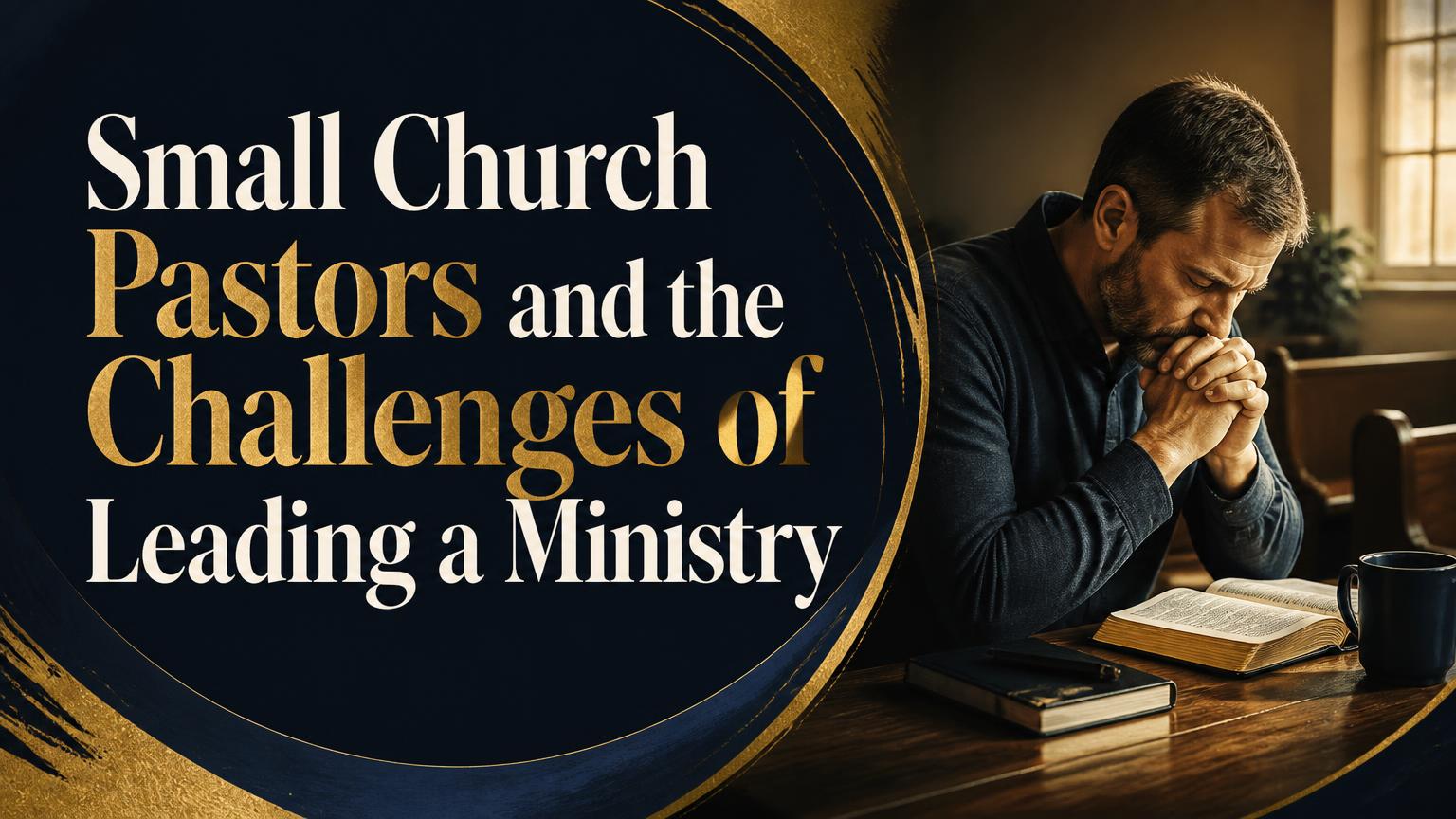
Small church pastors lead congregations where relationships are close, resources are often limited, and one person may carry responsibilities that would be divided among several staff members in a larger church. Their work commonly includes preaching, pastoral care, administration, volunteer coordination, community ministry, conflict resolution, and organizational planning. The challenge is not simply having fewer people; it is leading faithfully when capacity, finances, and ministry infrastructure are limited.
Small Church Pastors
Small church pastors serve in many different settings: rural congregations, urban neighborhood churches, church plants, aging congregations, and communities with limited financial resources. There is no universal membership number that defines a “small church.” The more useful distinction is functional: a small church usually has fewer staff, fewer volunteers, less specialized infrastructure, and a high dependence on personal relationships.
What Small Church Pastors Typically Do
A pastor in a small congregation may preach weekly, prepare Bible studies, visit the sick, counsel families, lead worship planning, oversee finances, recruit volunteers, manage the church building, and represent the church in the community. Some pastors also work outside the church, making them bivocational.
This breadth of responsibility can be both a strength and a burden. The pastor often knows members personally and can respond quickly to needs. At the same time, urgent pastoral concerns may interrupt sermon preparation, leadership development, or long-term planning.
The central task remains spiritual shepherding. Preaching and teaching, prayer, pastoral care, spiritual formation, and the equipping of believers should not disappear beneath administrative demands. Ephesians 4:11–12 describes church leaders as equipping God’s people for ministry, not performing every ministry task themselves. That principle is especially important in a small church, where the pastor’s effectiveness depends on developing shared ownership rather than becoming the congregation’s permanent solution to every need.
Why Small Churches Depend Heavily on Relationships
In a small congregation, trust is often built through repeated personal contact. Members may expect their pastor to attend significant family events, remember personal circumstances, visit during illness, and participate in the ordinary life of the community. Pastoral presence can therefore have unusual influence.
This relational closeness also creates pressure. A pastor’s decisions are rarely experienced as merely institutional. Changes to worship, staffing, finances, or ministry priorities may feel personal because members associate those decisions with the pastor they know.
Healthy leadership requires both compassion and appropriate boundaries. A pastor can care deeply for people without being constantly available, resolving every disagreement, or accepting responsibility for every outcome. Clear communication, scheduled pastoral visits, protected study time, and shared care among mature believers help preserve relationships without making the pastor the sole source of support.
The Main Challenges Facing Small Church Pastors
The most common challenges are interconnected rather than isolated.
Limited resources. A small budget may restrict staffing, facilities, technology, outreach, and training. Financial limitations can also create anxiety about compensation and long-term sustainability. Faithful ministry does not require expensive programs, but financial reality still affects what a congregation can responsibly promise and maintain.
Too many competing roles. A pastor who spends every week reacting to immediate needs may have little time for sermon preparation, prayer, leadership development, or strategic thought. The result can be exhaustion and a ministry shaped by urgency rather than calling.
Volunteer fatigue. Small churches often depend on a small group of reliable people. When the same individuals teach, serve on committees, organize events, and manage practical tasks, they may become overextended. Recruiting volunteers is not enough; leaders must create simple roles, provide training, express appreciation, and make it possible for people to serve without carrying an entire ministry alone.
Conflict and resistance to change. Close relationships do not eliminate disagreement. In fact, they can intensify it because decisions are tied to history, identity, and personal memory. A proposal that seems operational to the pastor may feel like a threat to a long-standing member. Change is more likely to be received when leaders explain the pastoral reason for it, listen seriously, move at a responsible pace, and distinguish biblical convictions from inherited preferences.
Isolation. A pastor may be the only paid ministry leader and may have no colleague in the building with whom to discuss difficult decisions. Confidential pastoral matters also limit what can be shared with congregational members. Without outside friendships, mentoring, or denominational support, isolation can quietly become discouragement.
Unclear expectations. Members may want a pastor who is an excellent preacher, counselor, administrator, evangelist, chaplain, fundraiser, and community leader. Some of these expectations may be reasonable individually but impossible when combined without support. A written role description, agreed priorities, and regular conversations with church leaders can reduce confusion.
How Small Church Pastors Can Lead More Sustainably
Sustainable ministry does not mean avoiding sacrifice. It means directing sacrifice toward the church’s mission rather than allowing every demand to consume the pastor indiscriminately.
Establish Biblical and Practical Priorities
A pastor should identify the responsibilities that most directly serve the congregation’s spiritual health: faithful preaching and teaching, prayer, pastoral care, disciple-making, leadership development, and wise oversight. Acts 6:1–7 illustrates a related principle. The apostles responded to a real need, but they also recognized that leaders could not personally perform every necessary task. Delegation protected both the church’s practical care and the leaders’ central calling.
Priorities should become visible in the weekly calendar. If sermon preparation, prayer, rest, and meaningful pastoral contact are repeatedly displaced by meetings and minor tasks, the stated priorities are not functioning as priorities.
Build a Culture of Shared Ministry
A small church becomes healthier when ministry is understood as the work of the whole body rather than the pastor’s private assignment. First Corinthians 12 presents the church as one body with different members and gifts. This does not mean every person must hold a formal position. It means the congregation should expect believers to contribute according to their abilities, maturity, and circumstances.
Shared ministry requires more than asking for help during a crisis. Pastors can:
- Define specific responsibilities instead of making general appeals.
- Match tasks with people’s gifts and availability.
- Train volunteers rather than assuming they already know what to do.
- Give appropriate authority along with responsibility.
- Rotate demanding roles when practical.
- Review ministries that consume energy without producing clear benefit.
Delegation is not abandonment. The pastor remains responsible for oversight, teaching, and care while allowing others to exercise their gifts.
Communicate Change With Patience and Clarity
Small churches often have long memories. A ministry practice may continue because it is fruitful, but it may also continue simply because no one has examined it. Before changing a tradition, leaders should ask what purpose it serves, whom it benefits, what problem the change addresses, and what unintended consequences might result.
Good communication explains both the decision and the reasoning behind it. It also allows room for grief. Even beneficial change can involve loss for people who associate a practice with family members, former seasons, or important spiritual experiences. Patience does not require surrendering every necessary decision; it recognizes that people often need time to understand and trust a new direction.
Protect the Pastor’s Health and Integrity
A pastor’s spiritual life cannot be treated as fuel that is expendable for ministry. Jesus withdrew to pray despite substantial demands, and 1 Peter 5:2–3 calls shepherds to care for God’s people without domineering over them. These passages do not provide a rigid schedule, but they reject the idea that constant activity or control is evidence of faithful leadership.
Healthy safeguards may include a weekly day of rest, regular worship without leading, confidential pastoral supervision or mentoring, continuing education, exercise and sleep, financial transparency, and clear procedures for counseling and crisis response. Pastors should also know when a situation requires a licensed mental-health professional, medical provider, legal adviser, or trained specialist.
Rest is not a reward for finishing all ministry work. In a small church, the work will never be entirely finished. Rest is part of acknowledging human limits and trusting that the church ultimately belongs to Christ.
What Small Churches Should Expect From Their Pastors—and Provide in Return
A church should reasonably expect its pastor to teach Scripture faithfully, care for people, lead with integrity, communicate honestly, and cultivate the congregation’s mission. It should not expect the pastor to meet every need personally or to remain perpetually available.
In return, church members and governing leaders should provide realistic expectations, fair compensation when possible, adequate time off, prayer, constructive feedback, and practical support. They should address conflict directly rather than relying on the pastor to absorb it silently. They should also evaluate ministry by faithfulness, spiritual fruit, and responsible stewardship—not only by attendance, program volume, or immediate numerical growth.
A small congregation may have limited resources, but it can still practice substantial care for its pastor. Encouragement, shared responsibility, honest communication, and respect for boundaries often matter as much as formal programs.
Distinguishing Faithfulness From Visible Success
Small church pastors can be tempted to measure their ministry against churches with larger budgets, buildings, staffs, or attendance. That comparison often confuses scale with faithfulness. A larger congregation may have greater reach, but size alone does not prove spiritual health. Likewise, a small church should not use limited size as an excuse for poor teaching, unhealthy leadership, or resistance to necessary growth.
Faithfulness includes proclaiming the gospel, forming mature disciples, caring for people in truth and love, practicing justice and mercy, and stewarding available resources wisely. Growth may be a welcome result, but it is not the only measure of a pastor’s obedience.
This perspective also prevents an opposite error: romanticizing small churches. Close relationships can produce genuine community, but they can also conceal unhealthy dependence, unresolved conflict, or resistance to accountability. Smallness creates opportunities for personal ministry; it does not automatically create healthy ministry.
Conclusion
Small church pastors lead with limited infrastructure but often with significant relational influence. Their greatest challenges—broad responsibilities, volunteer fatigue, financial constraints, isolation, and resistance to change—cannot be solved by working endlessly. They require clear priorities, shared ministry, patient communication, healthy boundaries, and congregational support.
The pastor’s calling is to shepherd and equip God’s people, not to become the entire church’s substitute for every gift and responsibility. When pastors and congregations embrace that distinction, a small church can pursue faithful ministry without making exhaustion the measure of devotion.