
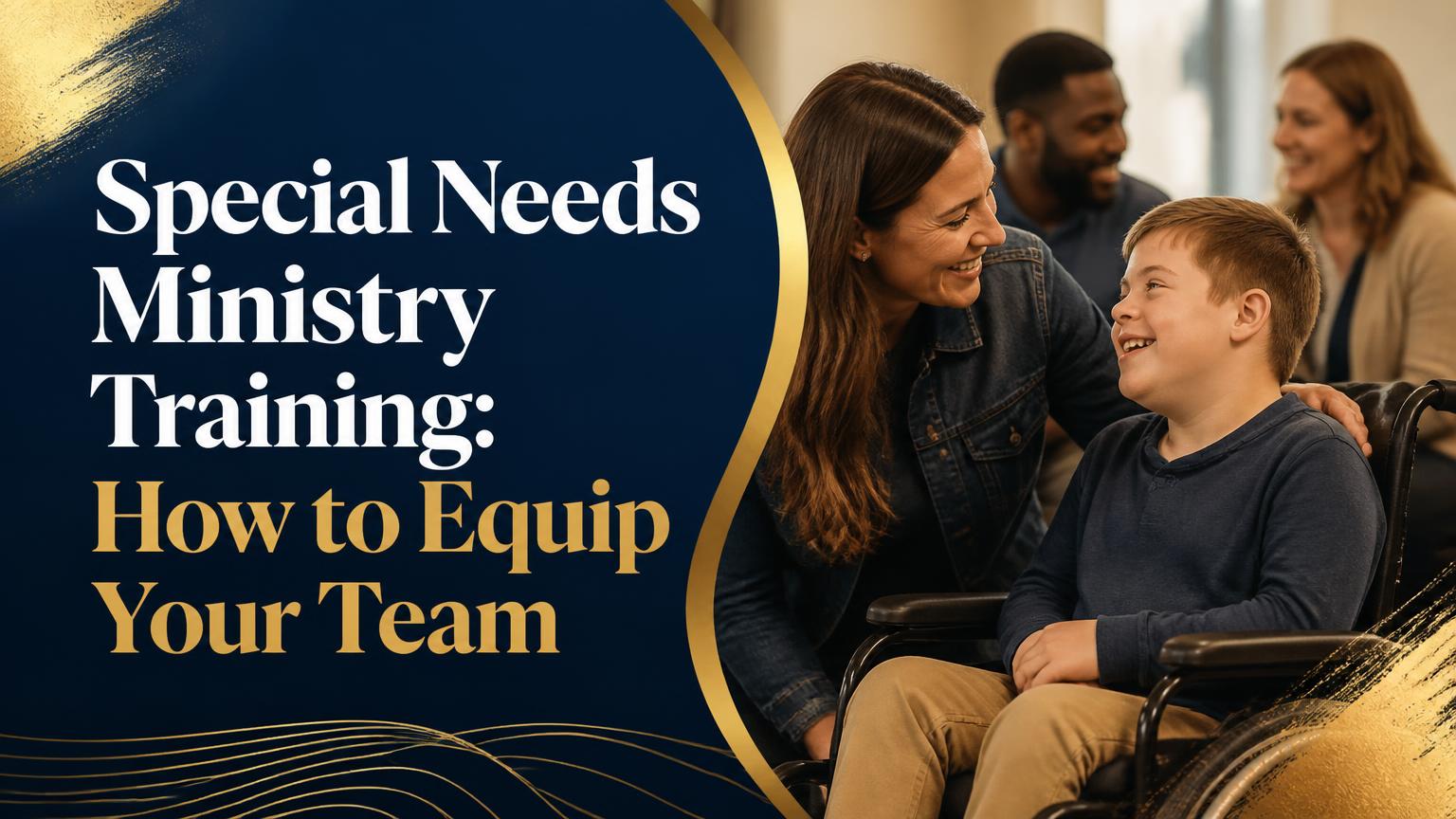
Churches need more than goodwill to serve children and adults with disabilities well. Special needs ministry training equips staff and volunteers to create genuine belonging, communicate effectively, respond safely, support participation, and partner respectfully with families. It also helps a church move beyond occasional accommodation toward a ministry culture in which people with disabilities are recognized as full members of Christ’s body, with gifts, preferences, responsibilities, and spiritual contributions of their own.
Special Needs Ministry Training for an Equipped Team
Effective training combines biblical conviction with practical competence. Volunteers should understand why inclusion matters, learn how each person communicates and participates, and know what to do when safety, sensory, medical, or behavioral concerns arise. Training should prepare a team to support people without treating them as problems to solve or projects to manage.
Build a Biblical Theology of Belonging
Christian ministry begins with the truth that every person bears God’s image (Genesis 1:27). A disability does not diminish a person’s dignity, spiritual worth, or place in the church. Paul’s description of the church as one body with many members also rejects the idea that some Christians are more valuable or necessary than others (1 Corinthians 12:12–27). People with disabilities are not merely recipients of ministry; they belong within the body and may teach, serve, lead, encourage, and worship alongside others.
Training should therefore address attitudes as directly as procedures. Volunteers need to recognize and reject pity, infantilization, exclusion, and assumptions that disability automatically indicates weak faith or spiritual deficiency. Jesus’ ministry consistently treated people as persons rather than interruptions. That principle affects how a team speaks, offers help, handles participation, and responds when a person’s behavior differs from conventional expectations.
Learn the Person, Not Just the Diagnosis
A diagnosis may provide useful background, but it does not tell a ministry team everything it needs to know. Two people with the same diagnosis may have very different communication styles, sensory needs, strengths, triggers, mobility requirements, and levels of independence. Training should teach volunteers to gather individualized information rather than rely on stereotypes.
A useful support profile may explain how the person communicates yes and no, what helps during transitions, what situations cause distress, which activities are enjoyable, and what assistance is appropriate. The goal is not to document every detail of someone’s life. It is to give the team practical knowledge while protecting privacy. Volunteers should ask, listen, observe, and update their understanding as the person develops.
Churches should also use respectful language and follow the preferences of the person and family when possible. Some people prefer person-first language, such as “a child with autism,” while others prefer identity-first language, such as “an autistic child.” Respectful ministry leaves room for those differences instead of turning terminology into a test of loyalty or correctness.
Develop Communication and Participation Skills
Training should cover multiple forms of communication, including speech, gestures, facial expressions, sign language, communication devices, pictures, writing, and behavior. A person who does not use spoken language may still understand far more than others realize. Volunteers should address the individual directly, allow extra processing time, and avoid speaking about the person as though they are absent.
Participation should also be broadened beyond sitting still, answering questions verbally, or completing an activity in the expected way. A person may engage through music, movement, art, observation, repetition, technology, or a shortened version of the lesson. The objective is meaningful connection with God and the church community, not identical performance from every participant.
For example, a children’s ministry may offer a visual schedule, a quiet location, simplified instructions, hands-on materials, and a choice between two activities. These adjustments do not lower the spiritual purpose of the lesson. They remove unnecessary barriers so the person can encounter the same truth and community in an accessible form.
Make Safety, Dignity, and Consent Nonnegotiable
Every volunteer needs clear instruction in safeguarding, supervision, boundaries, emergency procedures, and reporting concerns. Policies should address toileting and personal care, transportation, medication, allergies, elopement or wandering, physical intervention, and one-to-one support. Requirements vary by location and situation, so churches should align ministry procedures with applicable law, qualified professional guidance, and their own child-protection policies.
Safety does not justify taking away a person’s dignity or autonomy. Volunteers should explain what they are doing, ask permission whenever possible, offer choices, and use the least restrictive support that keeps people safe. They should never use shame, threats, restraint, isolation, or forced compliance as routine behavior-management tools. When a crisis occurs, the team should reduce stimulation, protect the person and others, call for designated assistance, and document what happened for thoughtful follow-up.
Training should also teach volunteers to interpret behavior carefully. Distress may communicate pain, fear, sensory overload, confusion, fatigue, or an unmet need. This does not mean every action is harmless or that boundaries are unnecessary. It means the team looks for causes and teaches safer alternatives instead of responding only with punishment.
Partner With Families Without Replacing Them
Families often know the person’s communication, medical history, routines, and calming strategies better than anyone else. A strong ministry treats parents and caregivers as partners while remembering that they should not have to carry the entire responsibility for inclusion. Churches can ask what support is helpful, clarify expectations, share observations, and invite feedback without demanding that families become unpaid ministry staff.
Partnership also requires appropriate confidentiality. Volunteers should receive the information necessary to serve safely, but private details should not become casual conversation. Churches should establish who may access records, how information is stored, and how concerns are communicated. When a person is an adult, the ministry must respect that adult’s own preferences and privacy rather than automatically treating family members as decision-makers.
What a Complete Special Needs Ministry Training Plan Should Include
A one-time presentation rarely changes ministry practice by itself. Effective special needs ministry training uses an ongoing process that combines foundational teaching, individual preparation, practical rehearsal, supervision, and review. The following elements give churches a workable structure.
Begin With Churchwide Orientation
All staff and volunteers—not only the disability ministry team—benefit from a basic orientation. This training can explain the church’s theology of belonging, respectful language, accessibility expectations, safeguarding rules, and the process for requesting support. Greeters, ushers, worship leaders, youth workers, teachers, and small-group leaders frequently encounter people with disabilities before a specialist does.
Churchwide orientation reduces the risk that inclusion becomes isolated in one department. It also helps volunteers respond naturally rather than staring, excluding, or directing every question to a parent. The session should include concrete examples, such as how to offer assistance, how to make room for mobility devices, and how to respond when someone makes noise or moves during worship.
Train for Individualized Support
After general orientation, volunteers need person-specific preparation. A short support plan might identify communication methods, health or safety concerns, preferred activities, transition strategies, and the level of assistance required. The plan should distinguish between what the person can do independently, what support increases independence, and what tasks require trained help.
Plans must remain flexible. A strategy that works in a quiet classroom may fail during a crowded church service. Staff should record useful observations, consult the person and family, and revise supports rather than assuming an original plan is permanent. Individualization protects people from both neglect and unnecessary help.
Practice Through Scenarios and Observation
Volunteers learn more effectively when training includes realistic scenarios. Teams can rehearse welcoming a nonspeaking participant, responding to sensory overload, supporting a person who leaves the room, assisting with a transition, or handling a disclosure of abuse. Role-play should be respectful and should not imitate disability for entertainment or “empathy exercises.”
Observation and mentoring are equally valuable. A new volunteer can serve alongside an experienced leader, receive specific feedback, and gradually assume responsibility. Debriefing after an incident should ask what happened before the difficulty, what support helped, what increased distress, and what the team will change next time. This turns experience into shared learning rather than blame.
Provide Ongoing Coaching and Accountability
Because people, volunteers, and environments change, training should be refreshed regularly. Short coaching sessions can address new support needs, recurring safety concerns, communication methods, or accessibility barriers. Leaders should make it easy for volunteers to ask questions before a problem becomes a crisis.
Accountability includes clear supervision, attendance records for required training, incident reviews, background checks where appropriate, and a process for receiving concerns from participants and families. A ministry should evaluate more than attendance numbers. It should ask whether people are forming relationships, participating meaningfully, remaining safe, and exercising gifts within the church.
How to Turn Training Into a Sustainable Ministry
Training works best when the church builds supportive systems around it. Begin with an accessibility review of buildings, classrooms, restrooms, entrances, worship spaces, signage, lighting, sound, and emergency exits. Physical access matters, but so do less visible barriers such as rigid schedules, confusing registration forms, excessive noise, and assumptions that everyone learns or worships in the same way.
Create a clear intake and communication process. Families should know whom to contact, what information will be requested, how support will be arranged, and what to expect on the first visit. Assigning a consistent point of contact can reduce anxiety and prevent families from repeating the same information to several volunteers. At the same time, avoid making one person indispensable; a small trained team provides continuity when schedules change.
Leadership should also identify the ministry’s limits. Volunteers may support a person, but they should not diagnose conditions, provide medical treatment beyond their training, give professional therapy, or promise a level of care the church cannot safely deliver. When needs exceed the ministry’s capacity, leaders should communicate honestly, seek qualified advice, and work with the family toward a responsible plan rather than improvising.
Common Training Mistakes to Avoid
One common mistake is treating disability ministry as a collection of techniques detached from relationships. A sensory tool, visual schedule, or behavior plan may help, but no strategy replaces patience, listening, and genuine friendship. Another mistake is assuming that a quiet person is fully included simply because they are present. Inclusion involves access to communication, teaching, relationships, leadership, and spiritual participation.
Churches can also over-rely on parents, use volunteers without adequate screening, or create a separate program that unintentionally excludes people from the wider congregation. Separate settings may be beneficial for particular needs, but they should serve participation rather than signal that people with disabilities do not belong in ordinary church life. The best arrangement may differ by person, age, activity, and consent.
Finally, training should not focus only on crisis response. If the team waits until a person is overwhelmed, it has already missed opportunities to prepare the environment, explain transitions, offer choices, and build trust. Prevention is usually more respectful and more effective than reacting after distress has escalated.
Conclusion
Special needs ministry training should equip a church to do four things well: welcome people with disabilities as full members of Christ’s body, understand their individual communication and support needs, protect their safety and dignity, and create meaningful opportunities for participation. Biblical conviction gives the ministry its purpose, while practical training gives volunteers the ability to serve responsibly.
The strongest programs are ongoing rather than one-time events. They combine churchwide awareness, individualized planning, scenario practice, family partnership, safeguarding, coaching, and honest evaluation. When churches treat accessibility as part of discipleship and community life—not as an optional program—they create space for people with disabilities to receive care, develop relationships, use their gifts, and help shape the church they belong to.