
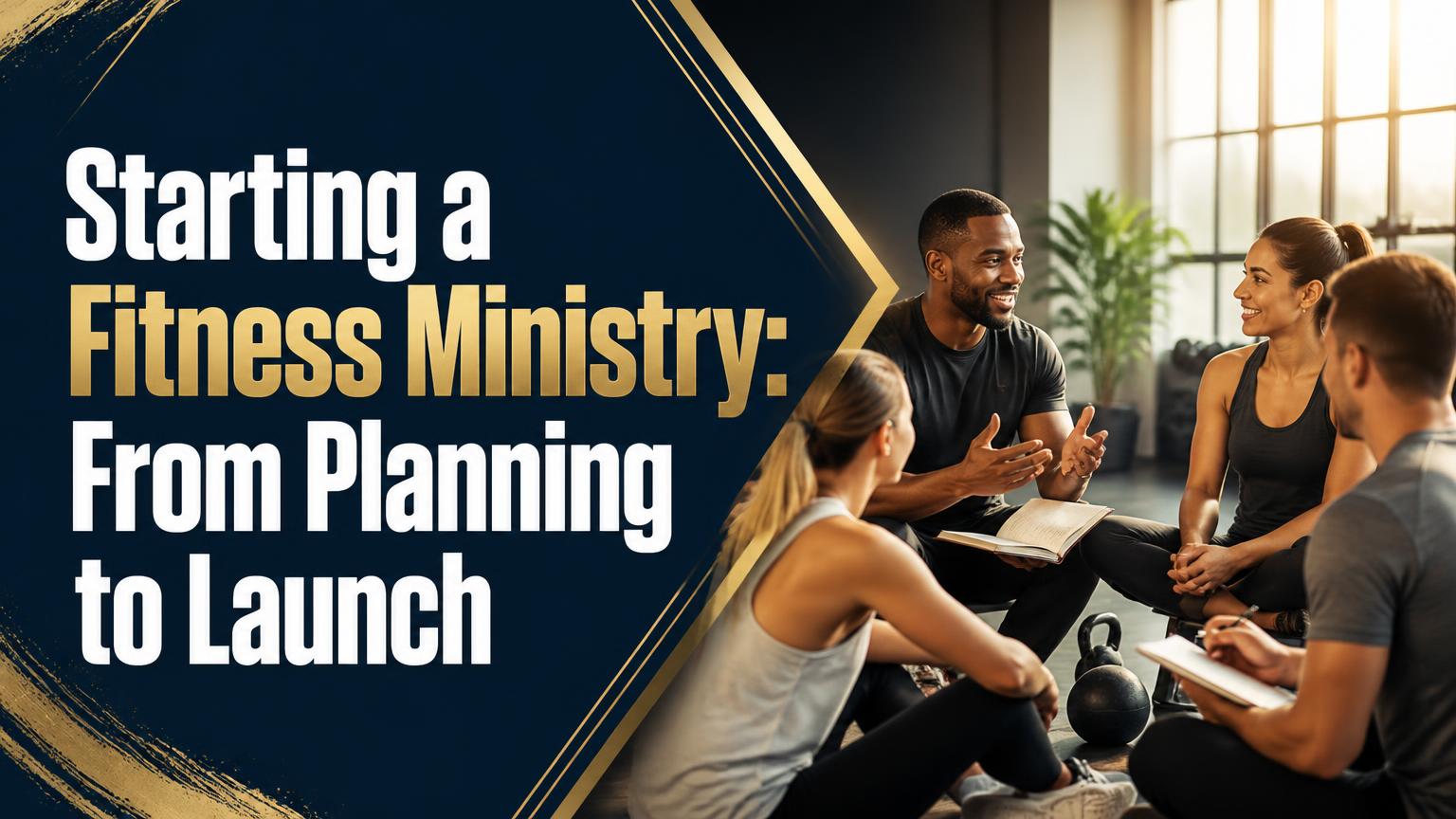
A fitness ministry combines physical activity with Christian community, discipleship, service, and care for the whole person. Starting one requires more than choosing a workout and advertising it. Leaders must clarify the ministry’s purpose, identify the people it will serve, create a safe and accessible program, recruit capable volunteers, and establish a launch plan that can continue beyond the first event. The strongest ministries treat exercise as a setting for relationship and spiritual formation rather than as a substitute for either professional fitness training or church life.
Starting a Fitness Ministry Step by Step
Clarify the Mission and the People You Will Serve
Begin with a written mission statement that explains what the ministry will do, whom it will serve, and how physical activity supports its Christian purpose. For example: “We help adults in our community build healthy habits, meaningful friendships, and a deeper relationship with Christ through accessible exercise and service.”
Define the primary audience before selecting the program. A ministry for teenagers will require different leaders, safeguards, communication methods, and activities than one for older adults, young parents, people new to exercise, or competitive athletes. Avoid trying to serve everyone at the beginning. A focused first audience makes programming, promotion, budgeting, and volunteer training much more manageable.
Also decide what the ministry is not. It should not imply that physical fitness determines spiritual maturity, personal worth, or acceptance by God. It should provide a welcoming environment for people at different fitness levels, abilities, body types, and stages of faith.
Choose a Ministry Model That Fits the Church
A fitness ministry can take several forms:
- Recurring group classes: Walking groups, strength training, mobility sessions, running clubs, or beginner exercise classes meet on a regular schedule.
- Small-group discipleship: Participants combine exercise with prayer, Bible discussion, and accountability.
- Community outreach events: The church hosts wellness fairs, neighborhood walks, sports days, or introductory classes.
- Service-centered activities: Members participate in charity walks, park cleanups, food distribution, or other physical service projects.
- Family or youth programs: Parents and children exercise, learn, and serve together.
The best model depends on the church’s facilities, volunteer capacity, budget, and local needs. A weekly walking group may be more sustainable than a large program requiring specialized equipment and several certified instructors. Begin with one dependable offering, learn from participation, and expand only when leadership and safety systems are ready.
Establish Safety, Oversight, and Appropriate Boundaries
Safety is a ministry responsibility, not an administrative detail. Before launch, identify who has authority over the program and create written procedures for emergencies, injuries, weather cancellations, participant communication, and facility use. Leaders should understand the limits of their training and avoid diagnosing injuries, prescribing medical treatment, or promising specific health outcomes.
Use qualified instructors for activities that require technical knowledge. Depending on the program, leaders may need current first-aid and CPR training, recognized fitness credentials, or sport-specific preparation. Ask participants to disclose relevant health considerations and encourage them to consult a medical professional when a condition, medication, pain, or extended inactivity could affect exercise safety.
Protect children and vulnerable adults through appropriate screening, supervision, transportation rules, reporting procedures, and compliance with applicable local requirements. Consider liability coverage, participant waivers, equipment inspections, adequate lighting, hydration, and an accessible emergency contact system. These measures do not eliminate every risk, but they reduce preventable harm and demonstrate responsible care.
Design a Simple First Program
A first program should be easy to explain and easy to repeat. Set a consistent day, time, location, duration, and registration process. For instance, a church might offer a free 45-minute Saturday morning walking and mobility session followed by coffee and a short devotional. Another church might begin with a six-week beginner strength class led by a qualified volunteer.
Build sessions around a predictable structure:
- Welcome and brief orientation
- Warm-up and movement preparation
- Main activity with options for different ability levels
- Cool-down, hydration, and informal conversation
- Short prayer, Scripture reflection, or practical discipleship connection
Keep the spiritual element genuine and proportionate. A devotional should connect naturally to themes such as perseverance, stewardship, community, service, or dependence on God. It should not be used to pressure participants into religious decisions while they are physically vulnerable or seeking help.
Recruit and Train the Right Leaders
Look for more than athletic ability. A strong leader is dependable, emotionally mature, teachable, encouraging, and able to notice when someone is struggling. Fitness expertise matters, but so do hospitality, listening, pastoral sensitivity, and the ability to include beginners without embarrassing experienced participants.
Assign clear responsibilities rather than expecting one person to do everything. A basic team might include a program coordinator, activity leader, hospitality volunteer, prayer or discipleship leader, safety contact, and communications volunteer. Train the team in the ministry’s purpose, safety procedures, inclusion standards, confidentiality expectations, and escalation process for pastoral or medical concerns.
Leaders should know when to refer someone elsewhere. A fitness ministry is not a replacement for a physician, physical therapist, licensed counselor, dietitian, or pastor. Responsible referral protects participants and keeps the ministry within its proper role.
Plan the Launch and Measure What Matters
A practical launch can occur in stages. First, assess community needs and church capacity. Next, pilot the activity with a small group, revise the format, and then promote a public launch. Use clear invitations that explain the activity, fitness level, cost, location, childcare arrangements, and what participants should bring.
Promotion can include church announcements, personal invitations, neighborhood groups, community partnerships, and simple digital registration. Avoid marketing that relies on shame, dramatic body transformations, or unrealistic promises. Emphasize belonging, accessibility, health-supportive habits, and the opportunity to serve and grow together.
After each session, gather useful feedback: Who attended? Did newcomers feel welcomed? Was the activity appropriately challenging? Were leaders prepared? Did the schedule and cost create barriers? Attendance is helpful, but it is not the only measure of fruitfulness. Stronger relationships, consistent participation, service involvement, prayer, and deeper connection to the church may reveal impact that a head count misses.
Ground the Ministry in a Biblical Understanding of Health
Christian fitness ministry should hold two truths together. Physical health matters, yet it is not the highest good. First Timothy 4:8 acknowledges that bodily training has value while placing it within a larger spiritual perspective. This prevents two opposite errors: treating exercise as unimportant or treating physical appearance and performance as a measure of righteousness.
Likewise, 1 Corinthians 6:19–20 describes the body as connected to honoring God. In context, that teaching concerns faithful bodily conduct and belonging to God; it should not be reduced to a slogan about appearance, dieting, or constant optimization. A ministry shaped by this passage encourages wise stewardship, rest, moderation, and integrity rather than fear-driven control. It can teach that bodies deserve care because people bear God-given dignity, while rejecting the idea that healthier or more athletic people are more valuable.
The ministry’s deeper aim is discipleship expressed through embodied life. Exercise creates repeated opportunities to practice patience, courage, self-control, encouragement, hospitality, and perseverance. Those virtues do not arise automatically from workouts, but a Christian community can intentionally connect them to following Christ.
Make Participation Welcoming, Affordable, and Sustainable
Accessibility should shape the program from the beginning. Offer modifications for different strength, mobility, age, and experience levels. Use language that welcomes people who are sedentary, recovering from illness, living with disability, or uncomfortable in traditional fitness settings. Provide chairs, lower-impact alternatives, rest periods, and clear instructions when appropriate. Never force public disclosure of weight, medical information, or personal struggles.
Consider practical barriers such as transportation, childcare, equipment, timing, cost, and cultural comfort. A no-cost walking group may reach people whom a paid gym-style class would exclude. If fees are necessary, explain them clearly and provide scholarships or reduced-cost options. Budget for equipment replacement, instructor compensation when appropriate, insurance, promotion, first-aid supplies, and facility use rather than assuming volunteers can cover every expense indefinitely.
Sustainability also requires boundaries. Do not schedule so many events that leaders burn out or the church cannot support the ministry pastorally. Review the program at regular intervals and be willing to change the format. A smaller ministry that operates safely and consistently can serve people more effectively than a highly ambitious launch that disappears after a few months.
Avoid Common Problems in Fitness Ministry
One common mistake is confusing a Christian atmosphere with a Christian ministry. Adding a Bible verse to an exercise class does not automatically create discipleship. The ministry should make its purpose visible through the way leaders treat people, how participants are welcomed, how suffering and limitation are handled, and how the group connects exercise with prayer, service, and community.
Another problem is allowing fitness culture to dominate the ministry. Competitive language, weight-loss pressure, body comparison, and public performance tracking can discourage the very people the church hopes to serve. Fitness goals may be appropriate for some participants, but they should remain voluntary and individualized. Progress might mean improved mobility, greater confidence, regular attendance, better sleep habits, or renewed social connection—not merely a smaller body or faster time.
Avoid assuming that enthusiasm can replace competence. An energetic volunteer who lacks preparation may unintentionally cause injury or give unsafe advice. Conversely, technical expertise without pastoral character can create an intimidating environment. The ministry needs both responsible instruction and Christlike care.
Finally, do not make attendance a condition for spiritual belonging. Participants should be free to join, rest, modify movements, or stop altogether without shame. The gospel is not a reward for physical discipline, and the church’s welcome should not depend on athletic ability.
Launch With Faithful Simplicity
Starting a fitness ministry succeeds when the church treats physical activity as a practical setting for love of neighbor, healthy stewardship, fellowship, and discipleship. The essential sequence is straightforward: define a focused mission, choose a sustainable model, establish safety procedures, design an accessible first program, train reliable leaders, and evaluate the ministry by both participation and relational fruit.
The goal is not to create a church-branded workout business or to make every exercise session intensely religious. It is to form a trustworthy community where people can care for their bodies, build meaningful relationships, encounter Christian hospitality, and grow in habits that support faithful living. A small, safe, consistent beginning usually provides a stronger foundation than a large launch without adequate leadership or purpose.