
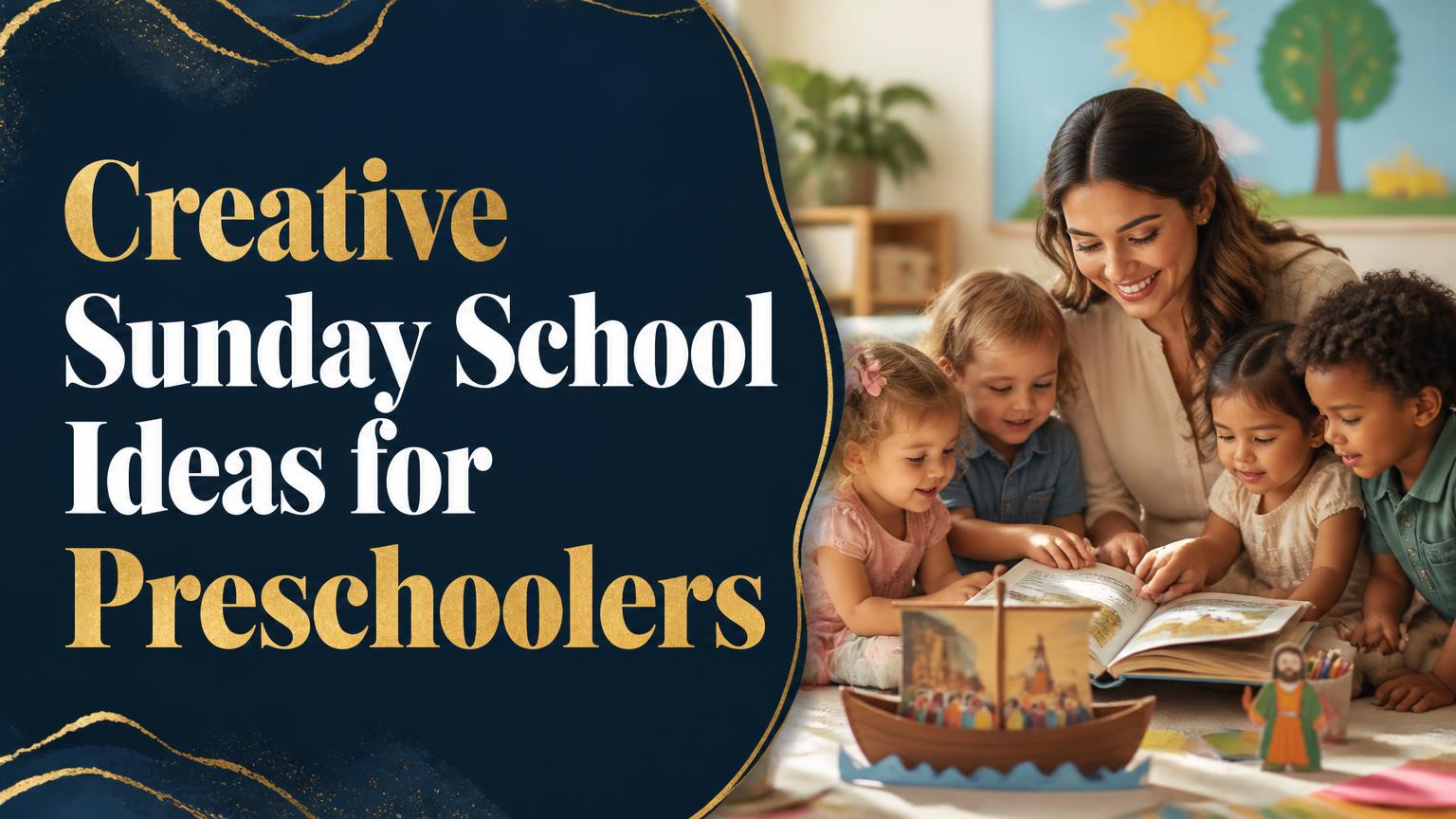
Preschool Sunday school works best when it is short, active, predictable, and centered on one clear Bible truth. Children ages three to five learn through repetition, movement, music, sensory experiences, simple stories, and warm relationships more readily than through lengthy explanations. The most effective Sunday School ideas for preschoolers connect a biblical message with something children can see, do, say, and remember.
Sunday School Ideas for Preschoolers
Begin With a Simple Bible Truth
Choose one main idea and repeat it throughout the lesson. Preschoolers may not remember every detail of a Bible story, but they can remember a short truth such as:
- “God made me and loves me.”
- “Jesus cares for me.”
- “I can show love to others.”
- “God hears me when I pray.”
- “The Bible teaches us about God.”
For example, when teaching Jesus calming the storm in Mark 4:35–41, the central truth might be, “Jesus is with us when we are afraid.” Use that sentence during the story, activity, song, and closing prayer. Repetition helps children connect the activity with the biblical message.
Use Interactive Bible Storytelling
Preschoolers need more than a spoken retelling. Use simple props, puppets, felt-board figures, picture cards, or objects that children can touch and move.
For the story of the lost sheep in Luke 15:3–7, hide a toy sheep in the classroom and invite the children to help find it. Explain that Jesus used the story to show that God cares about every person. The search activity gives children a physical experience that reinforces the shepherd’s concern.
Other effective storytelling techniques include:
- Letting children make animal sounds during Noah’s ark.
- Giving each child a paper fish for the story of Jesus calling His disciples.
- Using blue fabric as water for the crossing of the Red Sea.
- Asking children to pretend to sleep, wake up, or row a boat.
- Having the class repeat a key phrase whenever it appears in the story.
Keep the story focused. A preschool lesson usually benefits from one or two major details rather than a complete explanation of every event.
Add Movement-Based Bible Games
Movement helps young children stay engaged and gives them a way to process the lesson physically. The game should reinforce the Bible truth rather than merely fill time.
For a creation lesson from Genesis 1, call out different parts of creation and let children respond with movements:
- “Light” — stretch arms upward.
- “Birds” — flap arms.
- “Fish” — wiggle like fish.
- “Animals” — pretend to walk like an animal.
- “People” — place hands over the heart.
For the story of David and Goliath, children can practice saying, “God helps me be brave,” while tossing soft balls into a basket. Avoid turning the activity into a violent reenactment. The goal is to teach trust in God, not to glorify fighting.
Simple games include Bible-themed scavenger hunts, follow-the-leader activities, matching games, and “freeze” games connected to a worship song.
Plan a Bible-Related Craft
A craft is most useful when it helps children remember the lesson. It does not need to be elaborate or technically impressive. Choose projects that preschoolers can complete with limited assistance.
Examples include:
- A paper plate sheep for the lost sheep.
- A rainbow made from strips of colored paper after teaching about Noah.
- A paper heart labeled “God loves me.”
- A prayer booklet with one picture on each page.
- A paper fish for the story of Jesus and His disciples.
- A “kindness hand” made by tracing each child’s hand and writing one way to help someone.
Explain the meaning while children work. A heart craft should prompt a sentence such as, “God loves us, and we can show love to others.” Without that connection, the craft may be enjoyable but spiritually unrelated to the lesson.
Use washable, nontoxic materials, avoid small pieces with children who may put objects in their mouths, and prepare examples in advance so instructions remain brief.
Include Music and Repeated Motions
Songs help preschoolers remember biblical language through rhythm and repetition. Choose songs with simple words and motions rather than songs with long verses or abstract theological concepts.
A lesson about prayer might include a song with motions for “talk,” “listen,” and “thank.” A lesson about God’s creation could include motions for stars, animals, trees, and people. Songs about Jesus’ love can be paired with simple hand motions that children repeat each week.
A consistent opening song, offering song, and closing song can make the class feel secure. Familiar routines also help children transition between activities. Keep the volume comfortable and do not require every child to sing or perform. Some children will participate by watching at first.
Create a Sensory Learning Activity
Sensory activities allow children to explore a concept through touch, sight, sound, or movement. They are especially helpful for preschoolers who struggle to remain still during a traditional lesson.
Possible activities include:
- Water in a shallow bin for a lesson about Jesus calming the storm.
- Kinetic sand for building a “strong foundation” while teaching Matthew 7:24–27.
- Cotton balls for creating sheep.
- Smooth stones for discussing David’s faith in God.
- Seeds and soil for Jesus’ parable of the sower in Matthew 13:1–23.
- Scent-free play dough for shaping hearts, fish, or loaves of bread.
Sensory play requires close supervision and clear boundaries. Keep the activity simple, use materials suitable for the children’s ages, and provide an alternative for children who dislike certain textures.
Practice a Bible Story Through Dramatic Play
Dramatic play helps children enter a story without requiring them to memorize lines. Give them simple roles and allow them to act out the main movement of the passage.
For the Good Samaritan in Luke 10:25–37, children might pretend to help someone who has fallen, bring a blanket, or offer water. Explain that Jesus taught His followers to show mercy to others, including people who may seem different from them.
For Zacchaeus in Luke 19:1–10, one child can stand on a safe, low platform or behind a chair while others pretend to be the crowd. Do not allow children to climb on furniture. The teacher can narrate the story and emphasize that Jesus noticed Zacchaeus and brought him into a changed relationship with God and others.
Dramatic play should remain guided and brief. Preschoolers benefit from a few repeated actions more than from a complicated performance.
Turn Prayer Into a Concrete Activity
Preschoolers can learn that prayer is talking and listening to God, but they need simple and concrete ways to practice it. Use a prayer circle, picture prompts, or a “thank-you and help” format.
Place pictures of family members, food, homes, animals, and people who need help in a basket. Let each child choose a picture and offer a short prayer. The teacher can model language such as:
- “Thank You, God, for our families.”
- “Please help people who are sick.”
- “Thank You for food.”
- “Please help us be kind.”
A prayer chain made from paper strips can represent the people for whom the class is praying. Avoid pressuring children to pray aloud. They can pray silently, repeat after the teacher, or participate by saying “amen.”
Send Home a Simple Reminder
A small take-home item helps parents continue the conversation without creating extra work. It might be a coloring page, a card with the week’s Bible truth, a family prayer prompt, or a short activity such as finding three things God made.
Include one practical suggestion rather than a long lesson summary. For example: “At bedtime, ask your child to name one thing for which they are thankful.” This gives families a natural way to reinforce the biblical theme during the week.
How to Structure a Preschool Sunday School Lesson
A predictable lesson pattern often works better than constantly changing activities. A 30- to 45-minute class might follow this sequence:
- Welcome and free play: Greet each child by name and offer a quiet activity.
- Opening routine: Sing a familiar song, pray briefly, and introduce the Bible truth.
- Bible story: Tell one short story with props, pictures, or movements.
- Response activity: Use a craft, game, sensory station, or dramatic play.
- Review: Repeat the Bible truth and ask one or two simple questions.
- Closing prayer and transition: End consistently and explain what comes next.
The exact timing should reflect the group. Some classes may need several short activities, while others can remain with one activity longer. Transitions should be announced clearly: “In two minutes, we will clean up and hear our Bible story.”
Choosing Bible Lessons for Ages Three to Five
Good preschool lessons use concrete events and observable actions. Stories about Jesus, creation, prayer, helping others, obedience, forgiveness, and God’s care are generally easier for young children to understand than highly abstract theological discussions.
Useful lesson themes include:
- God made the world — Genesis 1
- Noah trusts God — Genesis 6–9
- God hears Hannah’s prayer — 1 Samuel 1
- David trusts God — 1 Samuel 17
- Jesus welcomes children — Mark 10:13–16
- Jesus feeds the five thousand — John 6:1–15
- Jesus calms the storm — Mark 4:35–41
- The Good Samaritan shows mercy — Luke 10:25–37
- Jesus seeks Zacchaeus — Luke 19:1–10
- The lost sheep — Luke 15:3–7
Preschool teaching should not imply that children earn God’s love by behaving perfectly. A lesson about obedience can explain that God’s instructions are good and that loving God shapes how we live. A lesson about kindness can encourage good choices while making clear that the gospel is more than simply being nice.
Managing Behavior and Including Every Child
Preschool behavior is often communication. A child may be tired, overwhelmed, hungry, unsure of the room, or unable to understand a long instruction. Give directions one step at a time, use visual demonstrations, and redirect calmly.
Helpful practices include:
- Keep craft supplies out of reach until needed.
- Offer limited choices, such as “Would you like the blue paper or the yellow paper?”
- Use a quiet area where a child can take a short break.
- Give transition warnings before changing activities.
- Praise specific behavior: “You waited for your turn,” rather than only saying “Good job.”
- Avoid forcing eye contact, singing, touching, or public participation.
- Provide seated and movement-based options when possible.
Children with sensory, developmental, communication, or mobility differences should be included as full participants. Adapt the activity rather than excluding the child. A child who cannot perform a hand motion might hold a picture card; a child who does not speak aloud might point, gesture, or repeat privately with a teacher.
Follow the church’s safeguarding procedures, maintain appropriate adult supervision, and use safe, age-appropriate materials. Spiritual formation and child safety belong together.
Common Mistakes to Avoid
The most common problem in preschool Sunday school is trying to do too much. A long story, elaborate craft, several games, and multiple memory verses can leave children confused and overstimulated.
Avoid:
- Teaching several unrelated Bible truths in one class.
- Using crafts that require adults to do most of the work.
- Expecting preschoolers to sit silently for extended periods.
- Treating memorization as the main evidence of learning.
- Using fear, shame, or threats to control behavior.
- Assuming every child understands figurative language.
- Turning Bible stories into moral lessons that leave out God’s character and action.
A successful lesson is not the one with the most activities. It is the one in which children experience a clear biblical truth in a safe, loving, memorable way.
Conclusion
The best Sunday school ideas for preschoolers combine a short Bible story with movement, music, play, sensory exploration, prayer, and repetition. Choose one understandable truth, connect every activity to it, and create a predictable environment where children feel welcomed and safe. Preschoolers may not remember every detail of a lesson, but they can begin to understand that God made them, Jesus loves them, Scripture teaches them, and they can respond to God with trust and love.