
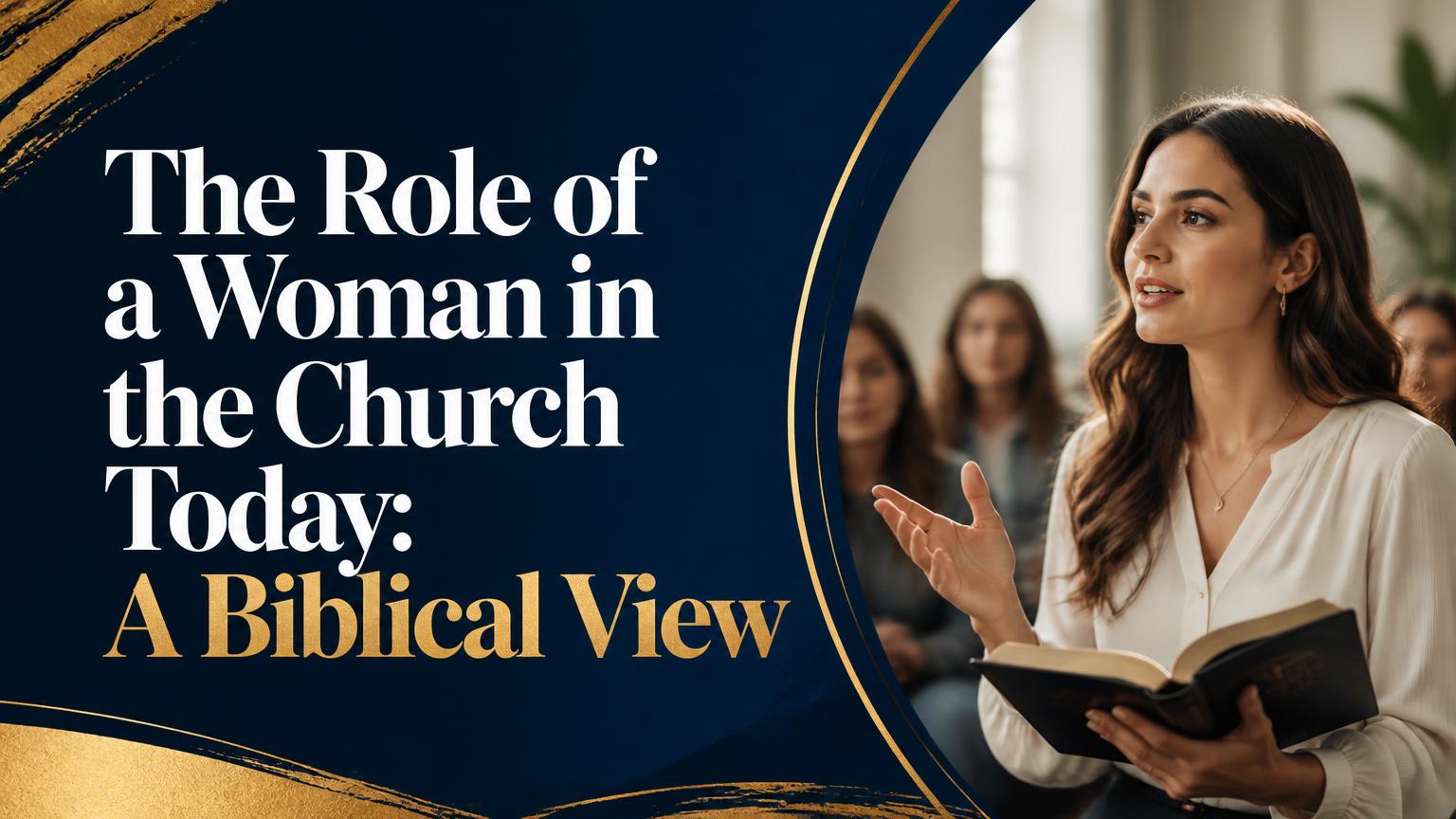
The role of a woman in the church today is grounded in the biblical truth that women and men bear God’s image, belong equally to Christ, and receive spiritual gifts for the building up of the church. Scripture presents women praying, prophesying, teaching, serving, evangelizing, discipling, supporting missions, and exercising significant influence in Christian communities. Christians differ, however, over whether certain governing or teaching offices are limited to qualified men. A biblical view must therefore distinguish what Scripture clearly affirms from areas where faithful traditions interpret key passages differently.
What Is the Role of a Woman in the Church Today?
Worship, Discipleship, and Spiritual Maturity
Women are full participants in the worship and spiritual life of the church. They pray, study Scripture, encourage other believers, receive pastoral care, practice spiritual gifts, and help form the faith of children and adults. Jesus treated women as morally responsible disciples and welcomed them as learners, as seen in Mary sitting at His feet in Luke 10:38–42.
This discipleship is not a secondary form of Christianity. Women are called to grow in holiness, wisdom, knowledge of Scripture, and love for God and neighbor just as men are. A church that values women only for service while neglecting their spiritual development fails to recognize their full identity as members of Christ’s body.
Serving According to Spiritual Gifts and Calling
The New Testament describes ministry as a work distributed through the gifts of the Holy Spirit. Romans 12, 1 Corinthians 12, and 1 Peter 4 connect service with God-given abilities rather than with personal status or social prominence. Women may be gifted in mercy, teaching, administration, evangelism, leadership, hospitality, generosity, counseling, prayer, music, missions, or other forms of ministry.
This means a woman’s role should not be reduced to a single stereotype. Some women serve publicly, while others exercise profound influence through mentoring, hospitality, prayer, care for the vulnerable, or faithful work in a local congregation. The relevant question is not whether a particular ministry appears prominent, but whether it is faithful, edifying, accountable, and consistent with Scripture.
Teaching, Testimony, and Gospel Ministry
Scripture gives several examples of women communicating truth and advancing the gospel. Priscilla helped explain the way of God more accurately to Apollos alongside her husband, Aquila, in Acts 18:24–26. The Samaritan woman testified about Jesus to people in her city in John 4. Mary Magdalene was commissioned to announce the resurrection to the disciples in John 20:17–18.
Paul also acknowledged women praying and prophesying in the gathered church in 1 Corinthians 11:5, while Acts 2:17–18 presents the outpouring of the Spirit as involving both sons and daughters. These passages establish that women can speak about God’s truth and bear witness to Christ. Churches that restrict women from every form of public teaching or testimony go beyond what these examples permit.
The continuing question is whether certain forms of teaching carry governing authority over the whole congregation. That question depends on how a church interprets passages such as 1 Timothy 2:11–15 and 1 Corinthians 14:33–35, not on whether women may minister at all.
Leadership, Authority, and the Central Debate
The most significant disagreement concerns the offices of elder, pastor, or overseer and the exercise of authoritative teaching in the gathered church. Some Christians believe Scripture reserves these offices for qualified men. Others believe the restrictions in passages such as 1 Timothy 2 address a particular situation, false teaching, or a culturally specific problem rather than establishing a universal rule.
Both positions should be distinguished from the idea that women cannot lead in any meaningful sense. Even churches that reserve eldership for men commonly recognize women who lead ministries, teach children and women, direct missions, organize congregational work, counsel believers, and influence the church’s spiritual direction. Likewise, churches that ordain women still require character, doctrinal soundness, maturity, and accountability; equality of access does not eliminate biblical qualifications.
The debate is therefore about the nature and limits of ecclesial authority, not about women’s value, intelligence, spiritual maturity, or importance to God’s mission.
Care, Mission, and Public Witness
Women have always contributed substantially to the church’s practical and missionary life. The New Testament commends women who supported Christian workers, hosted congregations, cared for widows, instructed others, and labored for the gospel. Phoebe is described as a servant or deacon of the church at Cenchreae in Romans 16:1–2, and Paul commends her for her service and support.
These ministries demonstrate that Christian service includes both proclamation and care. A woman may disciple a new believer, visit the sick, defend the vulnerable, welcome strangers, teach biblical truth, support missionaries, or lead an outreach ministry. Such work is not merely administrative assistance; it expresses the church’s mission to make disciples and embody Christ’s love.
Biblical Foundations for Women’s Ministry
The foundation for women’s ministry is creation, redemption, and the work of the Holy Spirit. Genesis 1:27 teaches that both male and female are created in God’s image. Women therefore possess equal human dignity and are not spiritually inferior to men. Through faith in Christ, women receive the same salvation, adoption, access to God, and inheritance promised to all believers. Galatians 3:28 emphasizes equal standing in Christ, although Christians debate how this equality relates to distinctions in church office.
Jesus’ treatment of women also corrects assumptions that women should remain passive or uninstructed. He taught women publicly, received their support, defended their dignity, and entrusted women with important testimony. The early church included women among Christ’s disciples, prayer partners, coworkers, and patrons. Romans 16 mentions several women serving the Christian mission, including Priscilla, Phoebe, Mary, Tryphena, Tryphosa, and Persis.
At the same time, the New Testament contains passages concerning order, authority, and qualifications for church leadership. First Timothy 3 and Titus 1 describe the character required of overseers, while 1 Timothy 2 and 1 Corinthians 14 raise questions about teaching and authority. A responsible biblical approach must consider all these texts together rather than selecting only the passages that support a preferred conclusion.
Why Christian Traditions Reach Different Conclusions
A Complementarian Reading of Scripture
Complementarian Christians generally affirm that men and women have equal worth before God but may receive different responsibilities in the home and church. They commonly understand 1 Timothy 2:11–15 and the male language associated with elders in 1 Timothy 3 and Titus 1 as indicating that the governing office of elder or pastor is reserved for qualified men.
This view does not necessarily prohibit women from teaching in every setting or exercising leadership in every ministry. Complementarian churches often encourage women to teach children and women, participate in evangelism, lead ministries, serve as missionaries, and use their gifts publicly within the church’s structure. Differences exist among complementarian congregations about deacons, preaching, theological education, and the boundaries of authority.
An Egalitarian Reading of Scripture
Egalitarian Christians generally believe that ministry roles should be assigned according to spiritual gifts, character, competence, and calling rather than sex. They point to women such as Priscilla, Phoebe, Junia, and the women who prophesied in Corinth as evidence that the early church recognized women in substantial ministry.
They commonly interpret restrictions in 1 Timothy 2 and 1 Corinthians 14 in relation to local false teaching, disorder, or specific congregational problems. They may also argue that “silence” in 1 Corinthians 14 cannot mean absolute silence because 1 Corinthians 11 already assumes women pray and prophesy. In this view, the gospel’s equalizing work and the Spirit’s distribution of gifts support women serving as pastors and elders.
What Both Views Must Affirm
Both interpretations should affirm the authority of Scripture, the equal dignity of women and men, the necessity of godly character, and the church’s responsibility to protect people from abuse and exploitation. Neither view permits arrogance, manipulation, or the use of authority without accountability.
A church should also avoid confusing biblical conviction with cultural preference. Restricting women from every visible ministry is not the same as defending a particular understanding of eldership. Conversely, appointing women to leadership does not automatically guarantee biblical faithfulness. The central tests are fidelity to Christ, obedience to Scripture, spiritual fruit, sound doctrine, and service that builds up the church.
How Churches Can Apply a Biblical View Today
A church can honor women by recognizing them as whole disciples rather than assigning them only supportive tasks. Women should receive serious biblical teaching, theological development, mentoring, opportunities to use their gifts, and meaningful participation in the congregation’s mission. Leaders should ask where a woman is gifted and called, not merely where the church has traditionally placed women.
Churches also need clear structures for accountability. Authority should never depend on personality, gender, seniority, or popularity alone. Leaders must be examined for character and doctrine, supervised by appropriate structures, and held responsible for how they treat those under their care. Women should neither be excluded from ministry through unbiblical assumptions nor pressured into unpaid labor while men receive recognition and decision-making power.
In traditions that reserve the office of elder for men, women can still be entrusted with substantial ministry and consulted as wise coworkers. In traditions that ordain women, women leaders remain responsible to the same biblical standards as men. In both settings, the goal is not representation for its own sake but faithful service that helps people know Christ, grow in holiness, and participate in God’s mission.
Conclusion
The role of a woman in the church today is broad, significant, and grounded in Scripture. Women are called to worship, discipleship, prayer, evangelism, teaching, care, mission, and service according to the gifts God gives them. The main disagreement among Christians concerns whether the governing office of elder or pastor is limited to men, not whether women belong fully to Christ’s body or may make substantial contributions to the church.
A faithful church will therefore reject both the marginalization of women and the careless dismissal of difficult biblical texts. It will honor women as equal image-bearers and fellow heirs of grace, interpret Scripture responsibly, uphold strong standards for every leader, and make room for women to serve with wisdom, courage, humility, and spiritual authority wherever their calling permits.