
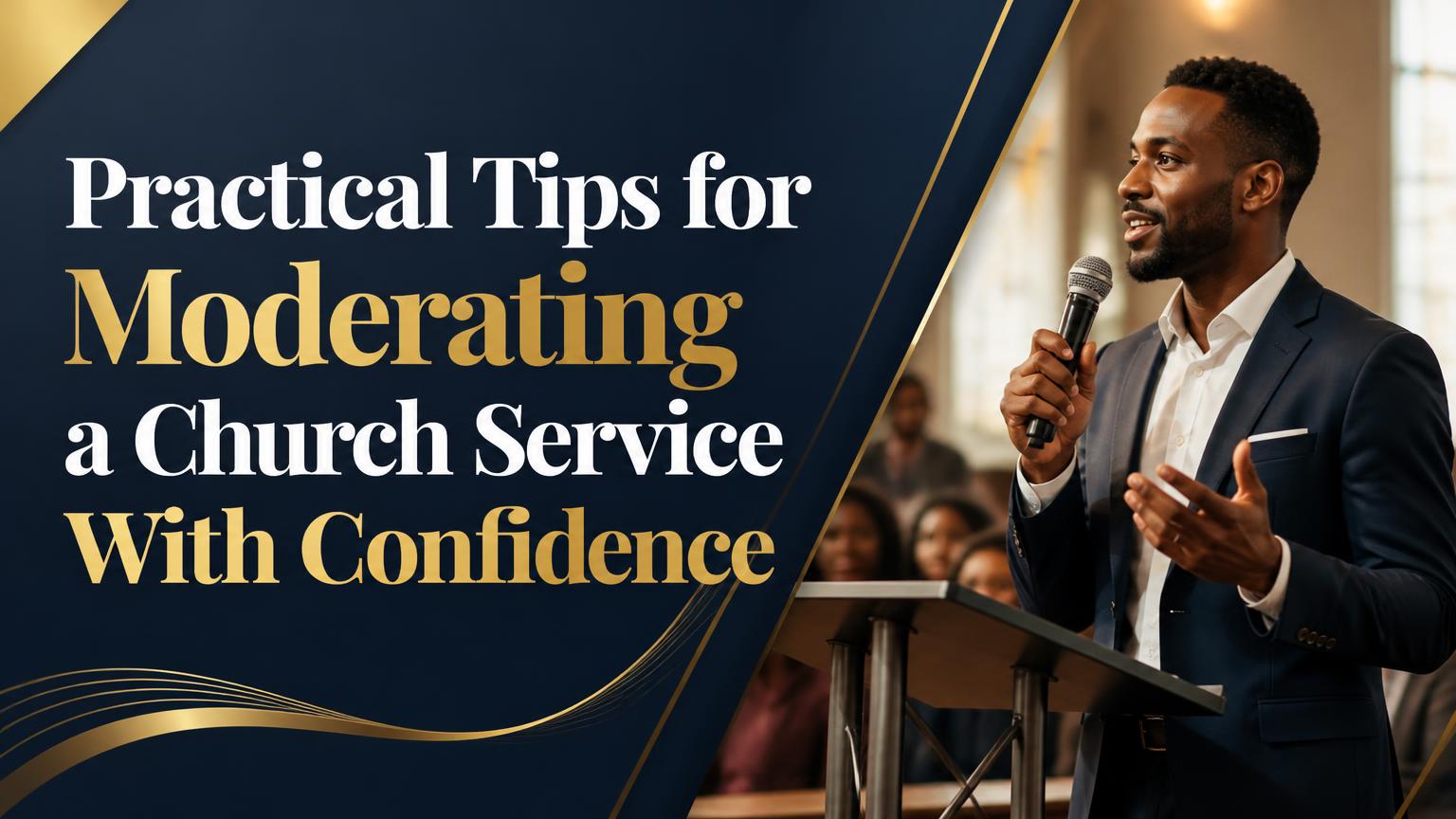
A church service moderator helps the congregation move through worship, prayer, Scripture, announcements, giving, and the message with clarity and reverence. The role is less about being the center of attention and more about serving the service: preparing carefully, introducing each element naturally, managing time, and helping the congregation remain focused on God.
The most effective moderator combines spiritual sensitivity with practical organization. Good preparation prevents confusion, while humility and attentiveness allow the moderator to respond wisely when the service does not go exactly as planned.
Tips on Moderating a Church Service
Prepare the Service Order in Advance
Obtain the final order of service from the pastor, worship leader, or service coordinator before the meeting. Confirm:
- The sequence of worship elements
- Who will lead each part
- Song titles and keys, if relevant
- Scripture readings and Bible translations
- Prayer leaders
- Announcements
- Offering arrangements
- Special presentations, baptisms, communion, or guest speakers
- Any changes to the usual schedule
Do not rely on memory or assume that last week’s format will be repeated. Keep a printed or digital service outline with brief notes about introductions, transitions, names, and timing.
Preparation also includes spiritual preparation. Pray for wisdom, humility, and attentiveness. The moderator is not merely managing an event; the moderator is helping create an environment in which the church can worship, hear God’s Word, and respond faithfully.
Understand the Purpose of Each Service Element
A moderator should know why each part of the service is included. Worship, Scripture, prayer, giving, preaching, communion, and announcements do not all serve the same function.
This understanding prevents empty transitions. Instead of saying, “Now we will have the offering,” the moderator might explain that giving is an act of gratitude and participation in the church’s ministry. Before Scripture, the moderator can briefly encourage the congregation to listen attentively because the passage will help prepare them for the message.
These comments should be concise. The moderator’s role is to connect the elements, not explain every detail or preach a second sermon.
Begin With Clarity and Warmth
The opening establishes the tone of the service. Welcome people clearly, especially guests and those joining from unfamiliar backgrounds, but avoid turning the welcome into a long speech.
A useful opening normally includes:
- A brief greeting
- A clear invitation to worship
- Any essential direction, such as standing, finding a seat, or preparing for prayer
- A smooth handoff to the first leader
For example:
“Good morning, church. We are grateful to gather together and worship God. As we begin, let’s quiet our hearts and turn our attention to the Lord. Please stand as the worship team leads us.”
The wording can vary, but the purpose remains the same: help people know what is happening and participate without uncertainty.
Make Transitions Short and Purposeful
Transitions are often where inexperienced moderators speak too much. A transition should connect one part of the service to the next, not compete with it.
A strong transition may do one of three things:
- Explain the relationship between two service elements
- Give the congregation a clear instruction
- Prepare people emotionally or spiritually for what follows
For example, after a song about God’s faithfulness, the moderator might say:
“We have just sung about God’s faithfulness. Let’s continue by bringing our needs and thanksgiving to Him in prayer.”
Then introduce the prayer leader and step aside.
Avoid repeating information, apologizing unnecessarily, or filling every moment of silence. A short pause is usually less distracting than a stream of improvised comments.
Introduce People Accurately and Respectfully
Learn the correct pronunciation of every person’s name and confirm their role before the service. Introduce guests, pastors, worship leaders, readers, prayer leaders, and speakers with appropriate respect, but do not exaggerate their achievements or make jokes at their expense.
A simple introduction is usually enough:
“Our Scripture reading comes from Philippians 2:1–11. Maria Hernandez will read the passage for us.”
When handing over to someone, make eye contact, use their name, and indicate clearly that they should begin. Afterward, thank them briefly if the service format calls for it.
The moderator should never create embarrassment by mispronouncing a name, announcing the wrong activity, or asking someone to lead without warning.
Manage Time Without Making the Service Feel Rushed
Time management protects the congregation’s attention and respects everyone serving in the meeting. It also helps the preacher, musicians, children’s workers, and other ministry teams operate within their responsibilities.
Set approximate time limits for announcements, introductions, testimonies, and special items. If an earlier part of the service runs long, make practical adjustments in consultation with the pastor or service leader. Do not independently remove significant elements or shorten someone’s ministry without authorization.
The goal is not to make worship feel mechanical. Biblical order does not mean emotional coldness or rigid control. Paul’s instruction that worship should be conducted “decently and in order” (1 Corinthians 14:40) supports responsible structure, while genuine worship still requires attentiveness to the Holy Spirit and the needs of the congregation.
Give Announcements That People Can Remember
Announcements should be selective, specific, and easy to follow. For each announcement, communicate:
- What is happening
- When it is happening
- Where it is happening
- Who should respond
- What action people should take
For example:
“The church prayer meeting is this Wednesday at 7:00 p.m. in the fellowship hall. Everyone is welcome, and the meeting will focus on praying for local families and ministry needs.”
Avoid reading a long list of notices without emphasis. If several announcements are necessary, group related information together and direct people to a bulletin, church app, or information desk for additional details.
Do not improvise dates, locations, or requirements. An incorrect announcement can create confusion long after the service ends.
Use Scripture With Context and Reverence
Scripture can provide a meaningful bridge between parts of the service. Read passages accurately and explain their connection briefly when appropriate.
For example, Romans 12:4–8 describes believers as members of one body with different gifts. That passage could introduce a prayer for ministry workers or a moment highlighting service within the church. The point is not to use a verse as decoration, but to help the congregation understand how it relates to the moment.
Read slowly enough to be understood. Identify the book, chapter, and verses, and give people time to locate the passage if that is part of the church’s practice. Avoid adding a lengthy interpretation unless you have been asked to teach.
Lead Public Prayer With Focus and Sensitivity
When the moderator leads prayer, the prayer should reflect the purpose of that moment. A prayer before the sermon might ask for understanding and faithful response. A prayer after a testimony might express thanksgiving and ask for continued strength. A congregational prayer might include the church, community, suffering people, leaders, and mission.
Public prayer should be understandable and sincere rather than theatrical. It should not expose private information without permission, turn into an indirect announcement, or become a second sermon.
Jesus warned against praying to impress others (Matthew 6:5–6). That principle applies to the moderator: pray to serve the congregation and honor God, not to demonstrate vocabulary or spiritual status.
Know When to Speak and When to Step Aside
Moderating is a ministry of support. The moderator should be visible enough to provide direction but restrained enough to let worship leaders, readers, preachers, and prayer leaders fulfill their roles.
Do not:
- Interrupt a song or prayer without a genuine need
- Correct another leader publicly unless safety or serious confusion requires it
- Add commentary after every contribution
- Tell personal stories that do not serve the service
- Compete with the pastor or worship leader
- Use humor that embarrasses people or weakens reverence
A moderator’s success is often shown by how naturally the service flows, not by how much the moderator says.
Respond Calmly When Something Goes Wrong
Unexpected problems are normal. A microphone may fail, a song may be unavailable, a speaker may arrive late, or the wrong announcement may appear on the screen.
When something goes wrong:
- Pause briefly and assess the situation.
- Give a clear, calm instruction.
- Use an appropriate alternative.
- Avoid blaming someone publicly.
- Resume the service without repeatedly referring to the mistake.
For example:
“We are going to take a brief moment while the microphone is adjusted. Please remain seated, and we will continue shortly.”
If a planned speaker is unavailable, the moderator may invite the congregation to pray, lead a congregational song, or move to the next prepared element—depending on the pastor’s direction. Calmness reassures the congregation and prevents a small technical problem from becoming the focus of the meeting.
The Moderator’s Spiritual and Relational Responsibilities
Moderating is not only a public-speaking assignment. The moderator influences the atmosphere through attitude, speech, and treatment of people.
Serve the Congregation Rather Than Performing for It
Philippians 2:3–4 calls believers to act with humility and to consider the interests of others. Applied to moderating, this means asking what will help the congregation participate rather than what will make the moderator appear impressive.
That may mean shortening a comment, allowing a moment of silence, making an instruction clearer, or adjusting language so that guests and children can understand. A moderator who serves others does not need constant recognition.
Practice Discernment and Hospitality
A church service may include people who are joyful, grieving, anxious, new to faith, unfamiliar with church customs, or carrying personal burdens. The moderator cannot address every need, but can use language that is welcoming and considerate.
Avoid inside jokes, unexplained abbreviations, and assumptions that everyone knows the congregation’s routines. Explain unfamiliar practices briefly and give people permission to participate without embarrassment.
Hospitality does not require changing the church’s convictions. It means communicating truth and worship practices in a way that treats people with dignity.
Keep Speech Gracious and Appropriate
Colossians 4:6 connects gracious speech with wisdom in how believers respond to others. For a moderator, this includes tone, humor, correction, and word choice.
Avoid sarcasm directed at late arrivals, children, musicians, guests, or technical workers. Avoid making light of serious prayer requests. Do not use exaggerated claims or emotionally manipulative language to force a response.
Warmth and reverence can coexist. The moderator can be friendly without becoming casual about sacred things.
Common Mistakes to Avoid
Several habits regularly weaken an otherwise well-planned service:
- Overtalking: Long comments make transitions feel like additional sermons.
- Vague instructions: People do not know whether to stand, sit, pray, sing, or move.
- Poor preparation: Names, Scripture references, and schedules are wrong.
- Unnecessary apologies: Repeatedly apologizing draws attention to minor problems.
- Unplanned theological statements: Casual remarks may confuse or misrepresent the church’s teaching.
- Excessive humor: Jokes can diminish reverence or embarrass individuals.
- Ignoring time: One extended segment places pressure on every later part of the service.
- Failing to coordinate: The moderator makes changes without communicating with the pastor or service team.
These mistakes are usually preventable through preparation, restraint, and clear communication.
A Practical Checklist Before the Service
Before the congregation gathers, the moderator should be able to answer:
- What is the exact order of service?
- Who is responsible for each segment?
- What are the key transitions?
- Which announcements are essential?
- Are names and Scripture references correct?
- What should happen if a speaker, musician, or technical resource is unavailable?
- Which elements require coordination with the pastor?
- How much time is available for each section?
- Are microphones, screens, music, and printed materials ready?
After the service, briefly review what worked and what caused confusion. Ask a trusted leader for specific feedback, such as whether the instructions were clear, whether transitions were too long, and whether the timing was appropriate. Improvement comes more quickly from concrete evaluation than from general impressions.
Conclusion
Effective church service moderation combines preparation, clarity, humility, spiritual sensitivity, and disciplined speech. The moderator guides the congregation without drawing attention away from worship, connects each part of the service without overexplaining, and responds to problems without creating distraction. When the role is approached as service rather than performance, the moderator helps the church participate attentively and allows each ministry contribution to support the central purpose of gathering: honoring God and building up His people.