
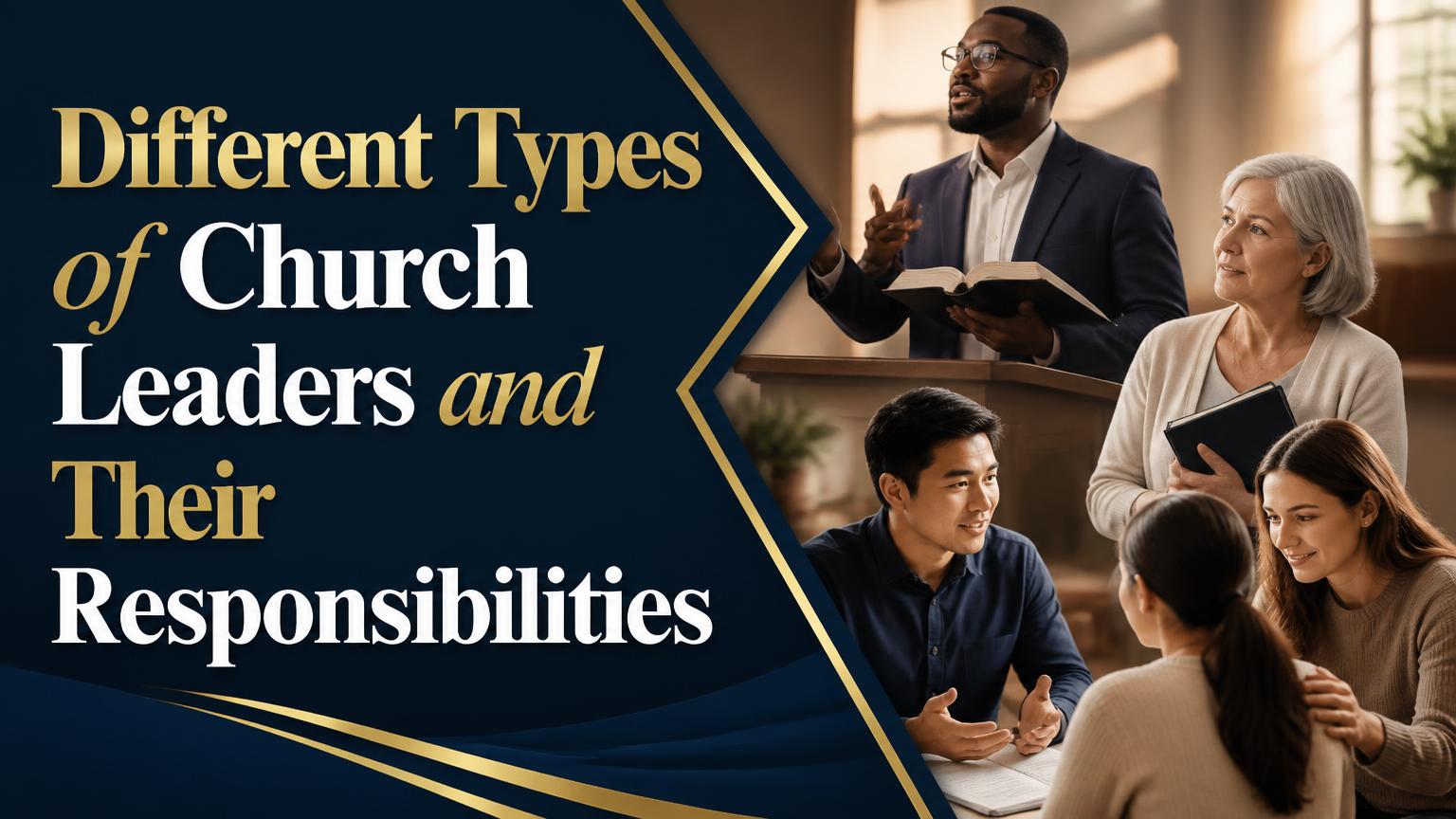
Church leaders guide congregations in worship, teaching, spiritual formation, pastoral care, mission, and practical service. The Bible describes several leadership functions, but churches do not all use the same titles or organizational structures. A pastor in one denomination may have responsibilities similar to an elder, minister, or priest in another.
The most useful distinction is between biblical offices, spiritual gifts, and local ministry roles. These categories overlap, but they are not identical.
Types of Church Leaders
Pastors, Elders, and Overseers
Pastors, elders, and overseers are closely related leadership terms in the New Testament. A pastor shepherds people spiritually, an elder provides mature spiritual leadership, and an overseer carries responsibility for watching over the congregation.
Several passages connect these functions. In Acts 20:17, Paul calls for the elders of the church at Ephesus; shortly afterward, he tells them to “keep watch” over the flock and to shepherd it (Acts 20:28). First Peter 5:1–4 likewise instructs elders to shepherd God’s people and exercise oversight. Titus 1:5–9 moves from the appointment of elders to the qualifications of an overseer, suggesting substantial overlap between the terms.
Their responsibilities commonly include:
- Teaching and explaining Scripture
- Guarding the church against destructive doctrine
- Leading worship and congregational life
- Praying for and caring for members
- Providing spiritual direction and correction
- Equipping believers to serve
- Making or guiding important decisions
- Protecting vulnerable people from exploitation or abuse
Different traditions organize this office differently. Some congregations are led by a single senior pastor; others use a plurality of elders. Some churches distinguish pastors from elders by assigning pastors primary teaching and pastoral duties while elders share governance. In other churches, the terms describe the same group of leaders.
The title bishop, or overseer, may also refer to this role or to a leader who supervises several congregations. In episcopal traditions, a bishop normally has authority beyond one local church. The title therefore cannot be interpreted without considering the church’s theological and organizational tradition.
Deacons and Ministry Servants
Deacons are leaders whose work emphasizes practical service, administration, compassion, and the orderly care of church needs. The qualifications for deacons appear in 1 Timothy 3:8–13, where character, faithfulness, self-control, and a trustworthy reputation receive major attention.
Acts 6:1–6 presents a closely related pattern: qualified believers are appointed to address a practical distribution problem so that the apostles can remain focused on prayer and the ministry of the word. The passage does not explicitly call those seven men deacons, but many churches view it as an important model for organized servant leadership.
Depending on the congregation, deacons may:
- Coordinate care for people in need
- Manage benevolence or relief efforts
- Assist with communion, worship, or facilities
- Support pastoral ministry
- Help oversee church property and practical operations
- Visit the sick, elderly, or homebound
- Promote unity by addressing logistical problems fairly
Deacons are not merely church employees or administrative volunteers. Their service is a spiritual ministry because it expresses Christlike humility and helps the whole church function faithfully. At the same time, not every person who performs a practical task holds the formal office of deacon.
Apostles, Prophets, Evangelists, and Teachers
Ephesians 4:11–12 names apostles, prophets, evangelists, pastors, and teachers as ministry gifts given to equip the church. These descriptions focus on how people serve the body of Christ rather than providing a complete organizational chart for every congregation.
An apostle is a commissioned messenger or representative. In the New Testament, the Twelve and Paul hold a uniquely foundational place. Christian traditions differ over whether the apostolic office continues in the same sense today. Some churches use “apostle” for church planters, missionaries, or leaders who oversee networks of congregations; others reserve the term for the original apostolic witnesses.
A prophet communicates a message believed to be given by God and applies God’s truth to a particular situation. Christian traditions also differ over the continuation and authority of prophetic ministry. No claimed prophecy should be treated as a replacement for Scripture or as exempt from wise testing.
An evangelist announces the gospel, often with a particular focus on calling people to faith in Christ. Evangelists may serve within a local church, travel between churches, plant congregations, or train other believers in evangelism.
A teacher explains Christian doctrine and Scripture so that believers can grow in truth and discernment. Teaching is not limited to people with a formal title, but those who teach publicly carry particular responsibility. James 3:1 warns that teachers will be judged more strictly because their influence can shape the beliefs and conduct of many people.
Ministry Leaders in the Local Church
Modern churches also appoint leaders for specific areas of ministry. These roles may include:
- Worship and music leaders
- Youth and children’s ministry leaders
- Small-group or discipleship leaders
- Missions and outreach leaders
- Prayer ministry leaders
- Christian education directors
- Counselors and pastoral care coordinators
- Administrative and operations leaders
- Church-planting or community-service leaders
These positions can be essential without being separate biblical offices. A worship leader, for example, may guide congregational singing but does not automatically possess the authority or qualifications of an elder. A small-group leader may shepherd a few people while remaining accountable to the church’s recognized pastors or elders.
The central question is not whether a role sounds prominent. It is whether the person serves faithfully, operates within appropriate authority, and helps the church fulfill its mission.
What Are the Main Responsibilities of Church Leaders?
Teaching and Guarding the Faith
Church leaders teach the gospel, explain Scripture, correct error, and help believers develop sound judgment. Paul charged Timothy to preach the word with patience and persistence (2 Timothy 4:2). Leaders therefore do more than deliver inspiring messages; they help a congregation understand what Christians believe and how those beliefs shape life.
This responsibility includes handling difficult passages honestly, distinguishing biblical teaching from personal preference, and refusing to use spiritual authority to promote speculation or manipulation.
Shepherding and Protecting People
Jesus compared spiritual leadership to shepherding. A shepherd knows, feeds, guides, and protects the flock. First Peter 5:2–3 tells elders to care for God’s people willingly and not to domineer over them.
Pastoral care may involve prayer, visitation, counseling, grief support, conflict mediation, discipline, and practical assistance. Healthy leaders do not control every aspect of members’ lives. They help people follow Christ with wisdom while respecting conscience, boundaries, and appropriate personal responsibility.
Protection also has an institutional dimension. Leaders should establish clear processes for handling misconduct, abuse, financial concerns, and conflicts of interest. Spiritual language must never be used to silence victims or shield leaders from legitimate accountability.
Equipping Members for Ministry
Ephesians 4:11–12 describes leaders as equipping the saints for works of ministry. This means church leadership is not meant to concentrate every ministry task in a pastor. Leaders train, encourage, delegate, and create opportunities for members to use their gifts.
A church is healthier when members become active participants rather than permanent spectators. A pastor may teach about compassion, for example, while deacons organize practical aid, small-group leaders provide relational support, and individual members visit or assist people in need.
Leading Mission, Worship, and Service
Church leaders guide congregations in worship and help them participate in Christ’s mission. That mission includes proclaiming the gospel, making disciples, serving neighbors, caring for the vulnerable, and pursuing reconciliation.
Leadership in worship is therefore more than managing a service schedule. It involves directing attention toward God rather than toward personalities, performance, or institutional branding. Likewise, mission leadership requires connecting stated beliefs with concrete practices in the community.
Governing With Wisdom and Accountability
Leaders make decisions about people, finances, facilities, programs, doctrine, and priorities. They must balance faithfulness to Scripture with practical wisdom and awareness of the congregation’s actual needs.
Acts 6 illustrates the importance of sharing responsibility rather than allowing every problem to depend on one or two leaders. Wise governance usually includes clear roles, transparent finances, multiple decision-makers, documented policies, and channels for concerns to be heard.
Christian leadership is authoritative, but it is not authoritarian. Jesus contrasted worldly rulers who “lord it over” others with the servant leadership expected of his followers (Mark 10:42–45). Authority exists to serve the church, not to secure personal status.
How Church Leadership Models Differ
Churches commonly use one of three broad structures, although many congregations combine features of more than one.
- Episcopal structure: Bishops exercise oversight over pastors and congregations, often with priests or ministers serving local churches.
- Presbyterian or elder-led structure: A group of elders shares spiritual oversight, sometimes with regional bodies providing broader accountability.
- Congregational structure: The local congregation retains substantial authority over pastors, leaders, membership, and major decisions.
Independent churches may use titles such as apostle, senior pastor, executive pastor, or ministry director in ways that differ considerably from one congregation to another. The same title does not guarantee the same authority.
Some traditions ordain only men to particular offices, while others ordain women to pastoral, elder, episcopal, or teaching leadership. Churches also differ over the continuation of apostles and prophets, the relationship between clergy and congregation, and the authority of bishops or denominational bodies. These are genuine theological differences and should not be hidden by assuming that every church uses biblical titles identically.
Qualifications That Should Mark Christian Leaders
The New Testament places character before charisma, popularity, education, or organizational ability. The qualifications in 1 Timothy 3:1–13 and Titus 1:5–9 emphasize qualities such as:
- Faithfulness and integrity
- Self-control and sound judgment
- Humility and emotional maturity
- A good reputation
- Ability to teach where teaching is required
- Hospitality and willingness to serve
- Faithfulness in family and personal responsibilities
- Freedom from greed, addiction, manipulation, and violence
These qualifications do not describe perfect people. They describe observable patterns of mature Christian character. A gifted speaker who lacks honesty or self-control is not made suitable for leadership by talent alone.
Leaders also need accountability. Shared leadership, financial transparency, independent oversight, appropriate discipline, and safe reporting procedures protect both congregations and leaders. Respect for church leadership should never mean unquestioning obedience to a person who acts contrary to Scripture, law, or basic moral responsibility.
Conclusion
The main types of church leaders include pastors, elders, overseers, deacons, apostles, prophets, evangelists, teachers, and various local ministry leaders. Their titles and authority differ among denominations, but biblical leadership has a consistent purpose: teaching the faith, shepherding people, equipping believers, serving practical needs, and guiding the church’s mission.
The defining standard is not prominence but faithful service. Church leaders are entrusted with authority so that they can build up the body of Christ, not dominate it.