
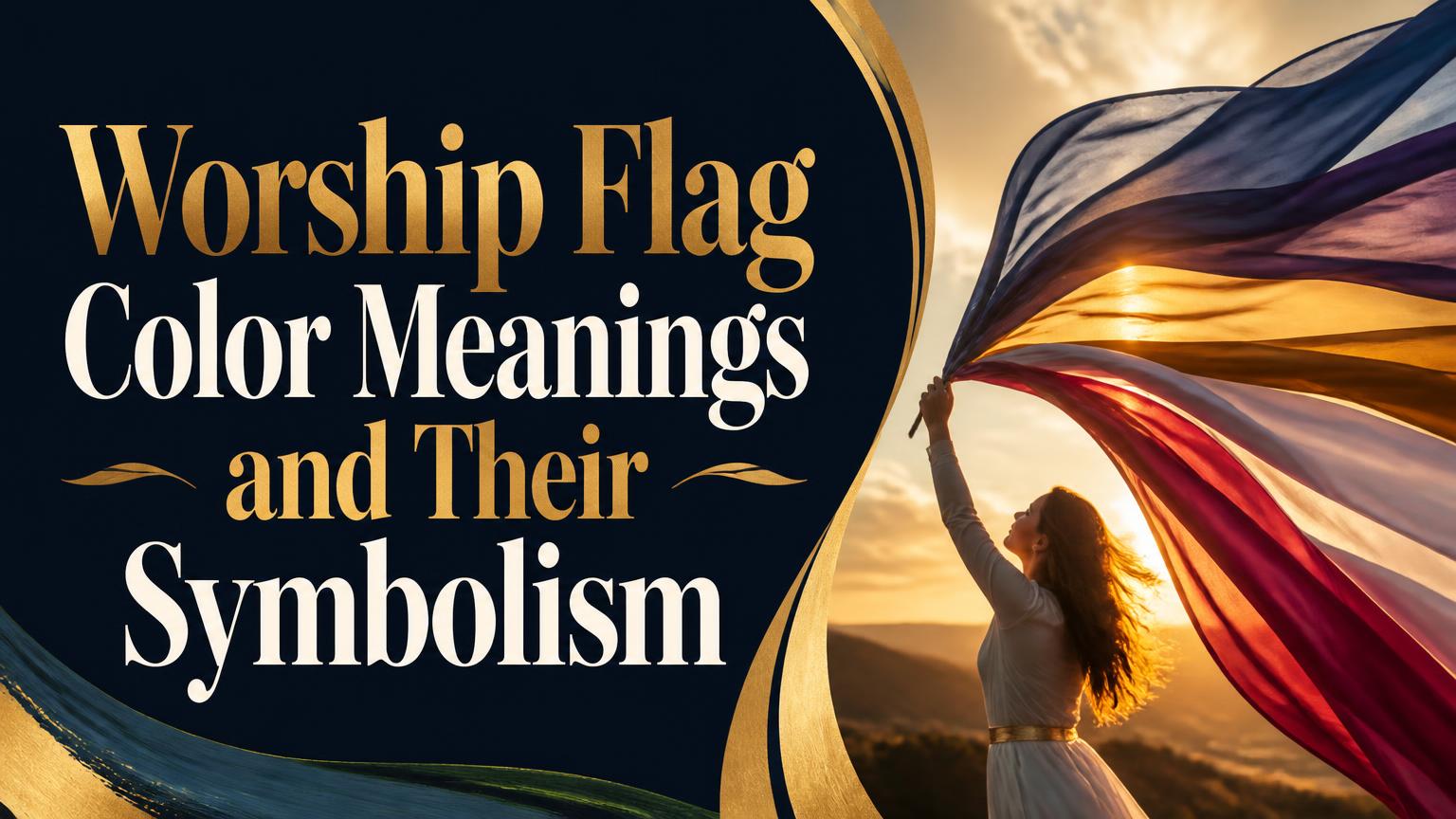
Worship flags are visual expressions of praise, prayer, celebration, spiritual warfare, surrender, and biblical themes. Their colors often carry symbolic meanings, but Christianity has no universally binding color code for flag ministry. Interpretations differ among churches and worship traditions, so a color should be understood in its biblical, musical, congregational, and personal context. The most reliable use of worship flags points attention toward God rather than treating colors, movements, or fabric as possessing spiritual power in themselves.
Worship Flag Color Meanings
The meanings below reflect common Christian worship-arts interpretations. They are useful starting points, not fixed rules. A worship leader may assign a different meaning to a color for a particular service, song, season, or prayer focus.
White Represents Purity, Peace, and Surrender
White commonly symbolizes holiness, cleansing, peace, surrender, victory, and the righteousness given through Christ. It may be used during worship centered on repentance, baptism, resurrection, communion, or complete submission to God. White garments appear in biblical visions of redeemed people, including Revelation 7:9–14, where white robes are associated with cleansing and belonging to the Lamb.
A white flag can also communicate rest and reconciliation. Its meaning is not that worshipers are naturally sinless; rather, it can point to God’s cleansing grace and the believer’s desire to walk in obedience.
Red Represents Sacrifice, Love, and Spiritual Zeal
Red is frequently associated with Christ’s blood, sacrificial love, covenant, courage, fire, and passionate devotion. It may accompany songs about the cross, redemption, spiritual warfare, or wholehearted praise. The connection with blood is especially relevant to passages describing Christ’s atoning sacrifice, while the connection with fire may reflect the Holy Spirit’s work and the zeal of devoted worship.
Red should not automatically be interpreted as anger or aggression. In one service it may express the seriousness of the cross; in another, it may represent joyful energy, bold faith, or fervent love for God.
Blue Represents Heaven, Revelation, and Faithfulness
Blue is often connected with the heavens, God’s presence, revelation, faithfulness, and spiritual identity. Biblical worship objects sometimes used blue materials, and Numbers 15:38–40 connects blue tassels with remembering God’s commands. These associations help explain why blue flags may be used during worship focused on hearing God, trusting His promises, or looking toward His heavenly rule.
Different shades can suggest different emotional tones. Deep blue may communicate mystery, authority, or stillness, while light blue may suggest peace, openness, or the expanse of the sky. These distinctions are artistic interpretations rather than prescribed biblical meanings.
Purple Represents Royalty, Authority, and Repentance
Purple commonly symbolizes kingship, dignity, authority, and the reign of Christ. Because it combines the intensity of red with the calm associated with blue, some worship ministries also use it to represent the meeting of divine authority and compassionate love. Purple may be appropriate for songs about Jesus as King, spiritual authority, or the church’s identity under God’s rule.
In some traditions, purple is connected with repentance, preparation, and seasons such as Advent or Lent. That meaning comes from the broader use of purple in Christian worship rather than from a universal command concerning worship flags.
Gold and Yellow Represent Glory, Joy, and Celebration
Gold often points to divine glory, majesty, kingship, honor, and the beauty of God’s presence. Yellow tends to be interpreted as joy, light, hope, gladness, and celebration. Because the colors are visually related, some ministries use them interchangeably, while others distinguish gold as a royal or heavenly color and yellow as a joyful, energetic one.
Gold and yellow flags may be used during praise songs, celebrations of God’s faithfulness, or worship emphasizing resurrection and victory. Their brightness can also communicate the response of a congregation that has received hope, though the colors themselves do not create joy or guarantee a particular spiritual experience.
Green Represents Life, Growth, and Restoration
Green is commonly associated with new life, spiritual growth, renewal, restoration, fruitfulness, and hope. It may be used in worship about discipleship, healing, creation, provision, or the continuing work of the Holy Spirit in a believer’s life. The imagery of flourishing plants, trees, and pastures appears throughout Scripture, including Psalm 23 and passages that describe righteous people as fruitful.
Green is especially suitable when the emphasis is gradual transformation. Christian growth is usually a process rather than a single emotional moment, so a green flag can represent patient formation, renewed strength, and the hope of future fruit.
Black Represents Mourning, Mystery, and the Seriousness of Sin
Black may symbolize grief, lament, death, darkness, judgment, or the seriousness of human sin. It can be used in worship that honestly acknowledges suffering, injustice, repentance, or the pain of waiting for God’s deliverance. Lament is a legitimate biblical response; the Psalms repeatedly bring sorrow and confusion into God’s presence rather than hiding them.
Black does not necessarily represent evil, and its use should not be treated as spiritually negative by definition. In combination with another color, it may emphasize contrast—for example, darkness giving way to light, death giving way to resurrection, or mourning giving way to comfort.
Orange, Pink, Silver, and Multicolored Flags
Less standardized colors usually depend more heavily on a ministry’s local teaching. Orange may suggest fire, enthusiasm, courage, or harvest; pink may communicate joy, tenderness, compassion, or celebration; and silver may represent refinement, redemption, truth, or value. These associations can be meaningful, but they have less consistent biblical grounding than themes such as white robes or royal purple.
Multicolored or rainbow flags may express God’s varied attributes, the unity of the church, the diversity of creation, or a broad celebration of His promises. Their interpretation requires particular care because colors can carry different cultural and theological associations. The worship leader should explain the intended meaning when confusion is likely.
Biblical Foundations and Limits of Color Symbolism
Scripture Provides Images, Not a Universal Flag Color Dictionary
The Bible uses colors in descriptions of worship, clothing, sacred objects, visions, nature, and royal settings. Blue appears in tabernacle materials, white is associated with cleansing and redeemed people, purple can evoke royalty, and red can recall blood or sacrifice. These examples provide meaningful theological imagery.
They do not, however, establish a complete system in which every color has one permanent definition. Biblical symbolism is often shaped by context. A color can carry different associations in different passages, and the Bible does not prescribe a universal Christian practice of assigning specific meanings to worship flags.
Flags Express Worship Rather Than Control Spiritual Outcomes
Worship flags can help a congregation embody praise through movement, color, and visual beauty. They may communicate themes that music and words reinforce, such as surrender, celebration, intercession, or spiritual victory. Psalm 20:5 uses banner imagery in connection with joyful confidence in God, and David’s dancing before the Lord in 2 Samuel 6:14 is often relevant to discussions of embodied worship.
Still, a flag is a ministry expression, not a spiritual mechanism. A particular color does not release power, force a healing, guarantee warfare victory, or make a prayer more acceptable to God. Christian worship depends on God’s grace and truth, not on an object’s color or movement.
How to Interpret Worship Flag Colors Responsibly
Consider the Biblical and Musical Context
A color should be interpreted alongside the lyrics, Scripture reading, sermon, season, and purpose of the service. A red flag during a communion song may emphasize Christ’s sacrifice, while the same color during a Pentecost celebration may represent fire and spiritual zeal. Context prevents symbolism from becoming an arbitrary color chart.
The movement also matters. A slow, lowered white flag can express surrender or quiet prayer, whereas a wide, upward movement may communicate resurrection, freedom, or celebration. Meaning comes from the relationship among color, motion, music, and the worshiper’s intention.
Use a Church’s Established Meaning Consistently
If a congregation has a worship-arts ministry, its leaders should teach the meanings they use and apply them consistently enough for participants to understand the visual language. A ministry might define blue as intercession, green as healing and growth, and gold as celebration, even though another church uses those colors differently.
Consistency helps the congregation recognize recurring themes without pretending that the meanings are universal. Written guidelines can also address appropriate movement, space, clothing, flag construction, safety, and how to serve without distracting from the gathered worship.
Let Symbolism Support, Not Replace, Christian Discernment
Color symbolism can deepen worship, but it should remain subordinate to Scripture, sound teaching, love, humility, and order. First Corinthians 14:26–33 presents gathered worship as something that should build up the church rather than create confusion. That principle applies to visual ministry as well as spoken and musical contributions.
Flag ministers should consider the room, the congregation, children and older adults, people with sensory sensitivities, and the possibility that dramatic movement may distract from prayer. The most spiritually mature presentation is not necessarily the most elaborate one; it is the one that serves the congregation and directs attention to God.
Common Questions About Worship Flag Color Meanings
Are Worship Flag Colors Biblical?
Some color associations have biblical imagery behind them, but worship flags and their color systems are not directly commanded in Scripture. The Bible offers themes that Christians may use creatively, while individual ministries develop practical interpretations. Therefore, it is accurate to call many meanings biblically inspired or commonly used, but not to claim that every color has a divinely mandated definition.
Can a Worship Flag Have More Than One Meaning?
Yes. A single flag may represent several related ideas, and a color’s meaning can change with the service. Purple might communicate Christ’s kingship, repentance, or preparation; red might signify sacrifice, love, or zeal. Multiple meanings are not necessarily a problem when the intended theme is clear and consistent with Christian teaching.
Is Worship Flag Ministry the Same as Spiritual Warfare?
Some churches use flags during intercession or spiritual-warfare worship, drawing on biblical images of banners, victory, and God’s protection. The flag may symbolize a declaration of faith or prayer. It should not be confused with a spiritual weapon that operates independently. Christian spiritual warfare centers on allegiance to Christ, prayer, truth, righteousness, and faithful obedience.
Conclusion
Worship flag color meanings can give visual form to biblical themes such as purity, sacrifice, heavenly hope, kingship, joy, growth, lament, and celebration. Their value lies in helping worshipers express truth with the whole body and engage the congregation’s attention thoughtfully. Yet no universal Christian color code makes one interpretation binding on every church. The wisest approach is to use Scripture as the foundation, explain local meanings clearly, consider the musical and pastoral context, and remember that the flag serves worship rather than directing it. Symbolism is most helpful when it strengthens understanding, reverence, unity, and genuine devotion to God.