
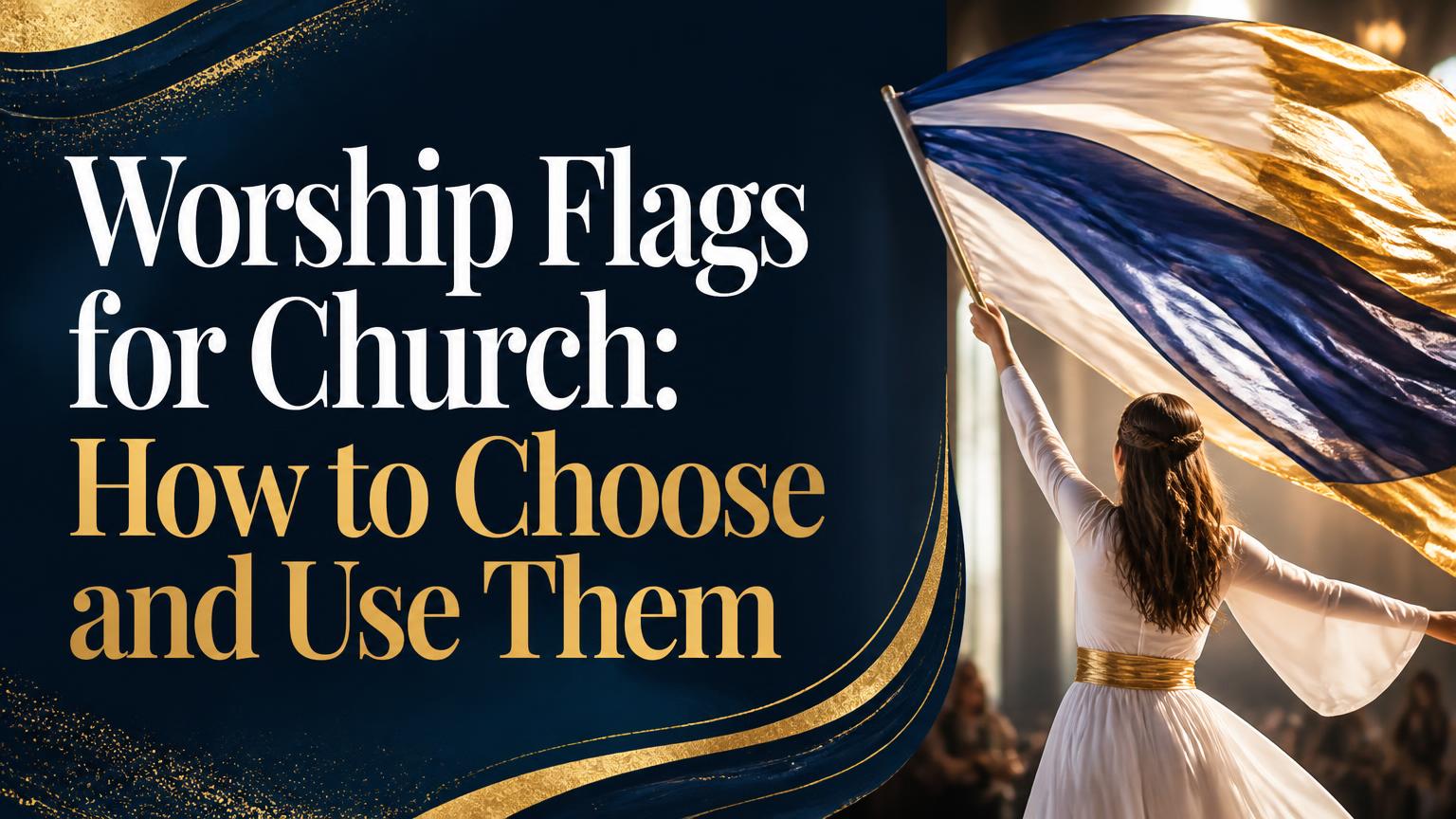
Worship flags for church are fabric banners used as a visual expression of praise, prayer, celebration, spiritual warfare, surrender, or movement before God. Churches may use them during congregational worship, prayer gatherings, processions, special services, or dance ministries. They are not required for biblical worship, and Scripture does not prescribe modern flag designs or specific colors. Their value depends on whether they help the congregation focus on God, communicate truth, and participate reverently rather than drawing attention to performance or individual talent. Choosing and using them well requires theological discernment, practical planning, artistic sensitivity, and consideration for the whole church community.
What Are Worship Flags for Church?
Worship flags are lightweight fabric banners attached to poles or handheld staffs and moved through choreographed or spontaneous gestures during Christian worship. Some are used by individuals, while others are carried by trained teams. Their movement can visually express themes such as joy, victory, repentance, intercession, spiritual freedom, or the greatness of God.
The meaning does not come from the fabric itself. A flag is a symbol or ministry tool, not a sacrament, talisman, or source of spiritual power. Its significance comes from the biblical truth, prayer, music, and congregational setting connected with its use.
What Worship Flags Represent
A worship flag can communicate an idea that words or music express in another way. A flag lifted high may represent praise, honor, or surrender. A sweeping motion may accompany a song about God’s faithfulness or the gathering of His people. Darker colors may be used during reflective prayer, while bright colors may accompany celebration. These meanings are interpretive rather than universally fixed.
Because color symbolism varies among churches and cultures, leaders should explain intended meanings instead of assuming that everyone will understand them. Red, for example, may represent Christ’s sacrifice, zeal, courage, or the fire of the Holy Spirit depending on the congregation. Clear teaching prevents symbolic gestures from becoming confusing or overly mystical.
The strongest use of a worship flag reinforces the central message of the service. It should help people attend to God’s character and work, not invite admiration for the person carrying it.
Biblical Foundations and Limits
The Bible contains several references to banners, standards, procession, dance, and physical expressions of praise. Psalm 20:5 speaks of lifting banners in the name of God, while Psalm 60:4 describes a banner given to those who fear Him. Israel also used tribal standards in the wilderness, and Miriam led women with tambourines and dancing after the crossing of the Red Sea in Exodus 15:20. David’s dancing before the Lord in 2 Samuel 6:14 is another example of embodied celebration.
These passages establish that visual symbols and physical movement can have a place in biblical expressions of worship. They do not, however, establish a command that churches must use modern worship flags. The New Testament emphasizes worship in spirit and truth, orderly gatherings, edification, and the exaltation of Christ. A church may therefore use flags faithfully, refrain from them faithfully, or permit them only in particular settings.
This distinction matters. A practice may be biblically consistent without being biblically required. Flags should support worship rather than become a test of spirituality or a measure of whether someone is truly responsive to the Holy Spirit.
How Flags Differ From Required Church Practices
Worship flags are generally an artistic and devotional expression, not an ordinance such as baptism or the Lord’s Supper. They also differ from a church’s essential doctrine, because faithful Christians may disagree about their usefulness without necessarily disagreeing about the gospel.
Church leaders should place flags within the church’s existing theology and worship policy. Some congregations welcome dance, banners, and other visual forms of ministry; others prefer a less visually active service. Neither preference should automatically be treated as evidence of greater faithfulness. The relevant questions are whether the practice is Christ-centered, biblically responsible, orderly, safe, and helpful to the congregation.
How to Choose Worship Flags for a Church
The best worship flags fit the church’s worship environment, available space, ministry goals, and theological culture. A flag designed for a large auditorium may be unsuitable for a small room with low ceilings. Likewise, a highly reflective metallic flag may overwhelm a quiet prayer service but work well during a celebratory gathering.
Choose Appropriate Materials and Construction
Worship flags should be made from lightweight, durable fabric that moves easily without becoming difficult to control. Polyester, nylon, and similar performance fabrics are common because they are relatively light, colorful, and quick to dry. The fabric should be securely attached to a smooth pole, and stitching should be strong enough to withstand repeated movement.
Inspect poles for cracks, splinters, rough edges, or loose connectors. Handles should be comfortable, and hardware should not create sharp points that could injure a participant. Well-made flags usually cost more than decorative fabric, but poor construction can limit movement, damage the flag, and create avoidable safety problems.
Care also affects longevity. Store flags clean and dry, avoid crushing them under heavy objects, and follow the manufacturer’s washing instructions. A church that uses flags regularly should maintain an inventory record and remove damaged equipment from service.
Consider Color, Design, and Symbolism
Design should serve communication rather than visual excess. Solid colors, gradients, contrasting panels, crosses, waves, and other patterns can support a service theme, but an overly busy design may be difficult to interpret from a distance. A church may choose a consistent color system, although it should explain that the system is local symbolism rather than a universal biblical code.
Consider how colors appear under the church’s lighting. A fabric that looks calm in daylight may appear dramatically different under colored stage lights. If flags will be used during livestreamed services, test them on camera because reflective materials and rapid movement can distract viewers or produce visual distortion.
A design may also carry cultural or congregational associations. Discuss significant imagery with church leadership before purchasing it, especially when symbols could be misunderstood or appear to make theological claims the church does not intend.
Match Flag Size to the Worship Space
Flag size and pole length should match the movement area. Oversized flags require greater skill, more clearance, and stronger control. In a small sanctuary, a compact flag may communicate just as effectively while reducing the risk of striking people, lights, instruments, furniture, or walls.
Before using a flag, measure the intended space and account for the full reach of the pole and fabric. Leave room for turning, raising, lowering, and recovering from an unexpected movement. A visually impressive flag is not a good choice if the carrier must constantly restrict movement to avoid hazards.
How to Use Worship Flags in Church Services
Flags should be introduced through preparation, clear leadership, and sensitivity to the congregation. The goal is not to add motion to every song. A thoughtful ministry uses flags when their symbolic or devotional function genuinely supports the service.
Prepare Through Prayer and Rehearsal
Flag ministry requires both spiritual preparation and physical training. Team members should understand the service theme, lyrics, Scripture, and desired tone. They should also rehearse basic movements, transitions, spacing, timing, and how to stop safely if a problem occurs.
Prayerful preparation does not eliminate the need for practice. Rehearsal reduces distraction because participants can concentrate on worship rather than figuring out where to move. It also helps leaders identify movements that are too complicated, too forceful, or inappropriate for the available space.
If movement is spontaneous rather than choreographed, participants still need boundaries. They should know where they may stand, which areas are restricted, how to respond when children or visitors enter the space, and who has authority to pause the ministry.
Keep the Focus on God and the Congregation
A flag carrier is serving the gathered church, not presenting a solo performance. Movements should complement congregational singing, prayer, Scripture reading, or a musical transition instead of competing with them. Excessive spinning, dramatic posing, or constant activity can make the congregation watch the minister rather than engage with God.
Leaders should also consider accessibility and visibility. Flags should not block the congregation’s view of the platform, Scripture, communion, or other worship leaders. People who are sensitive to rapid movement, bright colors, or crowded visual environments should not be treated as spiritually deficient if flags make participation difficult for them.
In some settings, using flags at the side or rear of the worship space is less distracting than placing them directly in front of the congregation. The right location depends on the service design and the church’s physical layout.
Establish Safety and Accountability Standards
Safety standards should be written rather than assumed. A church should determine who may carry flags, how participants are trained, where movement may occur, and how equipment is inspected. Children and inexperienced participants need age-appropriate instruction and close supervision.
Avoid flag use near ceiling fans, hanging fixtures, candles, electrical equipment, musical instruments, stairs, or crowded aisles. Do not swing poles through areas where people may unexpectedly walk. Participants should wear clothing and footwear that allow stable movement, and they should stop immediately if they lose control of the flag or notice a hazard.
A ministry leader should coordinate with pastors, musicians, ushers, media operators, and facilities staff. This prevents conflicts such as a flag striking a microphone, obstructing a camera, or interfering with an altar ministry. Accountability protects both the congregation and the integrity of the ministry.
Common Concerns About Worship Flags
Some Christians welcome worship flags as a meaningful expression of praise, while others worry that they can become theatrical, distracting, or insufficiently grounded in Scripture. These concerns deserve serious consideration rather than dismissal.
Are Worship Flags Biblical?
Worship flags are biblically permissible for churches that understand them as symbolic expressions of praise, prayer, or celebration, but they are not explicitly commanded as a Christian worship practice. Biblical references to banners and physical praise provide relevant principles, not a detailed model for modern flag ministry.
A church should therefore avoid claiming that using flags is required for obedience or that refusing them demonstrates spiritual resistance. The biblical test is broader: Does the practice honor God, agree with sound doctrine, build up the church, and function decently and orderly? Romans 14 also reminds Christians to avoid turning disputable practices into occasions for judgment, while 1 Corinthians 14 emphasizes order and edification in gathered worship.
How Can a Church Avoid Performance?
The risk of performance increases when movement becomes more important than the message, when carriers seek attention, or when leaders use flags to manufacture an emotional response. The remedy is not necessarily to remove all artistic expression. It is to establish a ministry culture of humility, preparation, submission to pastoral oversight, and willingness to remain unseen.
Leaders can evaluate each use by asking whether it supports the service’s purpose, whether it leaves room for congregational participation, and whether it would still be appropriate if few people noticed the individual carrier. A flag ministry should be able to become quieter, smaller, or absent when the pastoral moment requires it.
Do Colors Have Fixed Spiritual Meanings?
No universal Christian system assigns one mandatory meaning to every flag color. Churches and worship ministries may develop their own symbolism, but those interpretations should not be presented as biblical laws or guaranteed spiritual realities.
A color can remind worshipers of a theological truth, yet the color itself does not release power, secure healing, defeat evil, or communicate a prophecy automatically. Any prophetic or symbolic impression should be tested through Scripture, wise pastoral oversight, and the broader discernment of the church rather than accepted solely because it was expressed through a flag.
A Wise Approach to Starting a Flag Ministry
A church beginning this ministry should start modestly. First, define its purpose in plain language: visual prayer, congregational celebration, artistic support, processional use, or another specific function. Next, obtain pastoral approval and establish expectations for doctrine, conduct, clothing, rehearsal, safety, and scheduling.
Begin with a small number of trained participants and simple movements. Evaluate the ministry after several services, asking whether it helped people engage with worship or introduced distraction and confusion. Invite constructive feedback from pastors, musicians, ushers, parents, people with disabilities, and ordinary congregation members—not only from the flag team.
This approach allows the church to develop a ministry that is both expressive and accountable. It also makes clear that the church’s worship does not depend on special equipment. Flags may enrich a service, but prayer, Scripture, congregational participation, and devotion to God remain central.
Conclusion
Worship flags for church can provide a meaningful visual language for praise, prayer, celebration, and surrender when they are used with biblical discernment and practical wisdom. Scripture offers support for embodied and symbolic expressions of worship, but it does not require modern flag ministry or assign fixed spiritual power to fabric, colors, or movements. Churches should choose equipment suited to their space, train participants carefully, protect congregational focus, and submit the ministry to pastoral oversight. Used humbly, safely, and purposefully, worship flags can serve the church without becoming the center of worship themselves.