
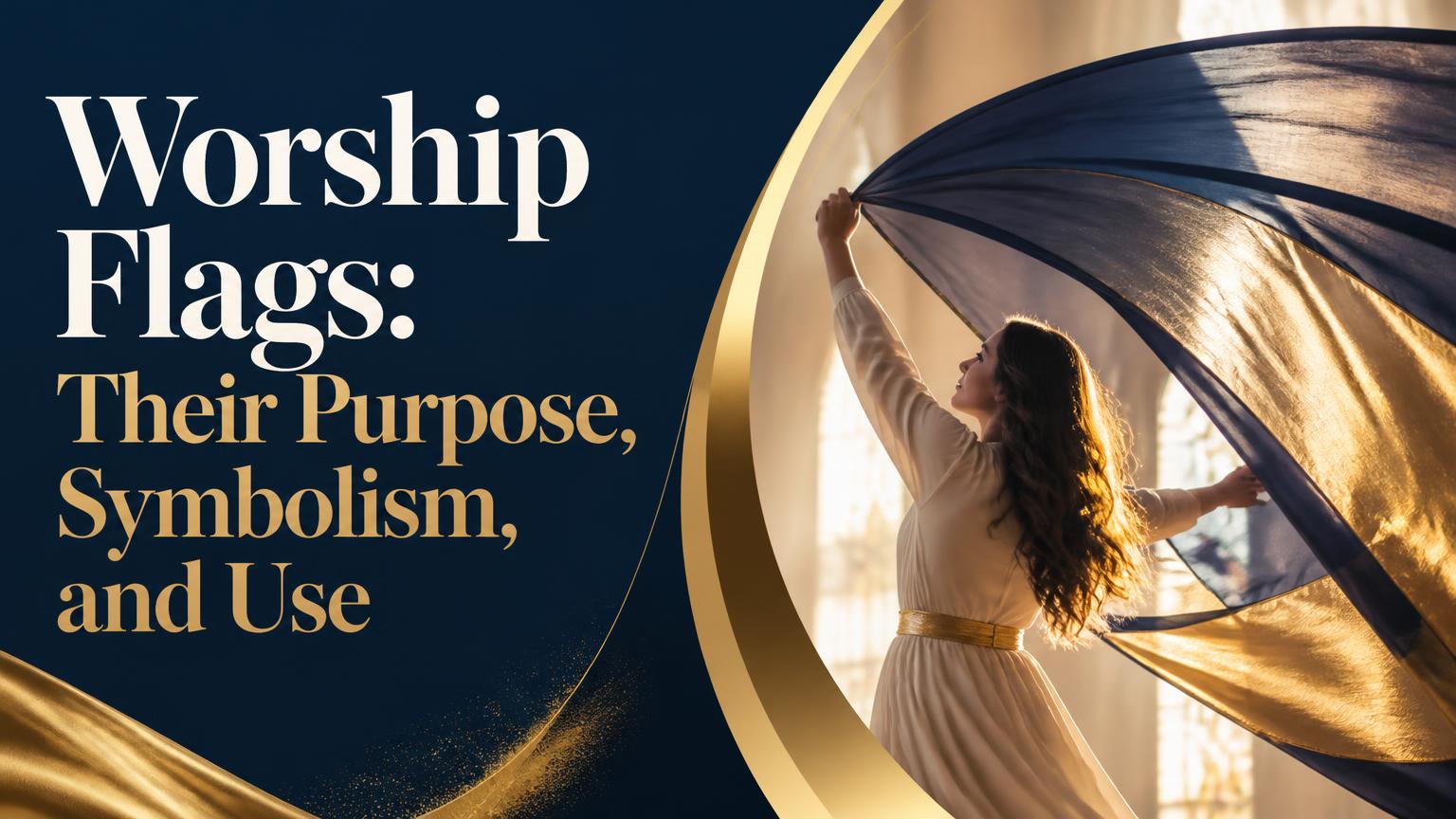
Worship flags are visual tools used by some Christians to express praise, prayer, biblical themes, and spiritual responses through movement and color. They may be carried, waved, lifted, or incorporated into choreographed worship. Their use is not commanded as a required Christian practice, and their symbolism is not universal. The meaning of a flag depends on Scripture, the worshiper’s intention, the church’s teaching, and the context in which it is used. Used thoughtfully, worship flags can support congregational focus without becoming a substitute for sincere worship.
Worship Flags: Their Purpose, Symbolism, and Use
What Worship Flags Are
Worship flags are lightweight fabric banners attached to poles, handles, or flexible rods. Individuals or teams use them during singing, prayer, celebration, procession, or dance. Some flags are single-colored, while others include stripes, crosses, flames, crowns, stars, or other designs.
They belong to a broader category of visual worship expressions that may include banners, ribbons, streamers, liturgical dance, and processional standards. A worship flag is not inherently mystical or spiritually powerful. Its value comes from the worship it helps communicate, not from the material, color, or movement itself.
Why Churches Use Worship Flags
Churches and worshipers use flags for several related purposes:
- Expression: Movement can give physical expression to joy, surrender, grief, gratitude, or spiritual expectancy.
- Attention and focus: A flag may help worshipers engage their bodies as well as their voices and minds.
- Symbolism: Colors and designs can represent biblical themes such as peace, holiness, hope, redemption, or the kingship of Christ.
- Celebration: Large, sweeping movements often accompany songs of victory, resurrection, praise, or thanksgiving.
- Prayer: A flag may be used as a visible expression of intercession, dedication, or dependence on God.
- Congregational participation: In some settings, movement helps people who struggle with conventional singing find another appropriate way to participate.
These purposes should remain subordinate to worship itself. A visually striking performance can draw attention toward the person carrying the flag rather than toward God. The question is therefore not simply whether flags are attractive, but whether their use serves the congregation and fits the church’s theology and order.
Biblical Connections Without Overclaiming
The Bible frequently uses the imagery of banners, standards, signs, and gathering under a visible emblem. Israel’s tribes camped under standards in the wilderness (Numbers 2), and Psalm 20:5 speaks of raising banners in the name of God. Exodus 17:15 records Moses naming an altar “The LORD Is My Banner,” expressing God’s identity as the source of Israel’s help and victory.
These passages provide biblical imagery that many Christians connect with worship flags. They do not, however, describe modern worship flags as a required element of Christian gatherings. Scripture also records physical movement in worship: Miriam led women with tambourines and dancing after the Red Sea crossing (Exodus 15:20), David danced before the Lord (2 Samuel 6:14), and Psalm 150:4 calls God’s people to praise with tambourine and dance.
The careful conclusion is that Scripture supports embodied, joyful, and symbolic expressions of worship, while leaving considerable freedom concerning their exact form. A modern flag may be a legitimate expression of worship, but it should not be presented as a biblical command or as proof of superior spirituality.
How Worship Flags Function During Worship
A flag can function differently depending on the moment. During a celebratory song, broad movements may communicate joy or victory. During prayer, a worshiper may hold a flag still, raise it slowly, or move it gently as an outward expression of surrender. During a procession, flags may identify a theme or help establish a visual rhythm.
Meaning is communicated through the combination of movement, music, posture, color, and context. A raised flag might symbolize praise, declaration, or dependence, but its precise interpretation should not be assumed automatically. The worshiper or ministry team should understand what the movement is intended to express, particularly when a congregation is being asked to interpret it symbolically.
What Do Worship Flag Colors and Shapes Represent?
Worship flag symbolism varies among churches, ministries, and designers. There is no universally recognized Christian color code that assigns one fixed meaning to every shade. For example, white may suggest purity, holiness, peace, or surrender; blue may suggest heaven, faithfulness, water, or the Holy Spirit; red may suggest sacrifice, love, fire, or spiritual warfare. These associations are possibilities, not binding definitions.
A church should explain its symbolism rather than assuming that everyone will interpret it correctly. Biblical associations can provide a foundation, but color meanings should not be treated as a secret language or guaranteed prophetic message. The following examples illustrate common interpretations:
- White: purity, righteousness, peace, or surrender
- Gold: glory, kingship, value, or divine honor
- Blue: heaven, faithfulness, revelation, or living water
- Green: growth, life, restoration, or renewal
- Purple: royalty, authority, or the majesty of Christ
- Red: sacrificial love, the blood of Christ, courage, or fire
- Black: mourning, repentance, darkness, or the seriousness of sin
Shapes also influence interpretation. A cross may point directly to Christ’s death and resurrection, while a crown may represent the kingship of Jesus. Flames may evoke the presence or purifying work of the Holy Spirit, although such symbolism must be distinguished from claiming that the object itself conveys spiritual power. Meaning should be anchored in clear Christian teaching rather than in arbitrary or constantly changing interpretations.
How to Use Worship Flags in a Church Service
Prepare the Worship Environment
Worship flag use requires more preparation than simply bringing fabric into a service. Leaders should consider the size of the room, the height of the ceiling, the location of musicians, lighting, seating, children, and people with mobility or sensory concerns. A flag that is safe in a large sanctuary may be disruptive or hazardous in a small meeting room.
The worship team should decide when flags will be used, what they are intended to communicate, and whether the congregation needs an explanation. Rehearsal helps performers coordinate movements with music and avoid distracting mistakes. Preparation also protects the ministry from appearing spontaneous when it is actually poorly organized.
Choose Movements That Serve the Moment
Movement should fit the tone and content of worship. Quick, expansive motions may suit celebration, while slower movements may better accompany confession, prayer, or reflection. The purpose is not to display technical skill but to make a fitting offering of worship.
Those carrying flags should remain aware of the congregation. They should avoid blocking people’s view, striking nearby worshipers, dominating the platform, or turning a congregational song into a performance. Simplicity is often more effective than constant movement because restraint allows the visual expression to support rather than overwhelm the words being sung.
Protect Safety and Accessibility
Flags require clear boundaries. Poles and fabric can hit people, catch on equipment, obstruct aisles, or distract drivers of visual media and musicians. Churches should establish safe movement zones and avoid using flags near open flames, unstable platforms, crowded exits, or equipment that can be damaged.
Accessibility also matters. Some worshipers may experience sensory overload, anxiety, or difficulty seeing around large flags. Others may interpret sudden movement as threatening or distracting. Wise leaders communicate expectations, preserve unobstructed areas, and ensure that participation in flag ministry never becomes a test of faith or commitment.
Serve the Congregation Rather Than the Performer
A flag ministry is most useful when it directs attention beyond itself. This may happen through coordinated movement, modest positioning, prayerful intent, and cooperation with worship leaders. It becomes less helpful when performers seek applause, compete for visual attention, or imply that their movements reveal an unquestionable message from God.
Leaders should also distinguish between artistic expression and prophetic speech. A flag design or movement may symbolize a biblical truth, but that does not automatically make it a direct revelation. If someone believes a flag ministry communicates a specific spiritual message, that claim should be tested through Scripture, wise pastoral discernment, and the church’s normal standards for evaluating spiritual impressions.
Benefits and Boundaries of Worship Flags
Worship flags can help some Christians connect physical movement with spiritual attention. They may express emotions that are difficult to communicate verbally, reinforce themes in a worship song, and provide a meaningful ministry for people gifted in dance, design, movement, or visual communication. They can also create a memorable picture of celebration or collective praise.
Those benefits depend on context. A flag cannot make worship more sincere by itself, and silence, singing, kneeling, or stillness are not spiritually inferior forms of worship. Romans 12:1 describes worship in terms of offering one’s whole life to God, not merely using a particular artistic practice. The central issue is the heart, truth, and obedience expressed through the action.
Several boundaries help preserve that focus:
- Do not claim that flags are necessary for the Holy Spirit to move.
- Do not treat colors or movements as infallible prophetic codes.
- Do not pressure people to participate.
- Do not use flags to create fear, confusion, or emotional manipulation.
- Do not allow a flag ministry to eclipse preaching, prayer, Communion, or congregational singing.
- Do not judge Christians who worship without visual or physical expressions.
- Do not assume that a dramatic atmosphere is the same as spiritual maturity.
These boundaries reflect broader New Testament principles. Worship should build up the church, be practiced with love, and be conducted in an orderly manner (1 Corinthians 14:26–33, 40). Freedom in worship and consideration for others must be held together.
Worship Flags, Banners, and Prophetic Acts
Worship flags and banners are closely related, but they are not identical. A banner is often designed to remain visible in one place or to communicate a fixed message. A flag is generally made for movement and may be carried through a service or used in dance. In practice, churches may use the terms interchangeably.
Some worship ministries describe flag use as a prophetic act. This usually means that a physical action symbolically represents a prayer, biblical truth, or spiritual hope. For example, lifting a white flag may represent surrender to God, while waving a victory-themed banner may express confidence in Christ’s triumph. Such actions can be meaningful when their symbolism is clear and biblically grounded.
A prophetic act should not be confused with a guarantee that a desired outcome will occur. Symbolic action can express faith, but it does not control God or replace wise decisions, pastoral care, repentance, or practical obedience. The distinction protects worship from becoming a technique for obtaining spiritual results.
How Can Someone Begin Using Worship Flags?
A person beginning to use worship flags should start with prayer, biblical understanding, and basic physical training rather than immediately seeking complex choreography. Learn how to hold the pole securely, control the fabric, maintain personal space, and move safely around others. Practice slowly before increasing speed or range.
It is also helpful to serve under the guidance of church leadership. Ask how the congregation understands visual worship, when flags may be appropriate, and what safety expectations apply. Begin with movements that correspond clearly to the music or prayer rather than trying to communicate multiple symbolic messages at once.
The most important preparation is inward. Worship flags should arise from reverence, humility, and a desire to serve. A person may use a flag skillfully while remaining spiritually distracted, just as someone may sing beautifully without genuine devotion. Skill can support worship, but it cannot substitute for love of God and love of neighbor.
Conclusion
Worship flags are optional visual expressions that some Christians use to communicate praise, prayer, surrender, celebration, and biblical hope through color and movement. Scripture gives meaningful imagery involving banners, standards, dance, and embodied worship, but it does not require modern flag ministry or establish a universal system of color symbolism. Their use is healthiest when it is biblically informed, physically safe, pastorally accountable, and directed toward God rather than performance. A flag may enrich worship, but sincere devotion—not the object itself—remains the substance of Christian worship.