
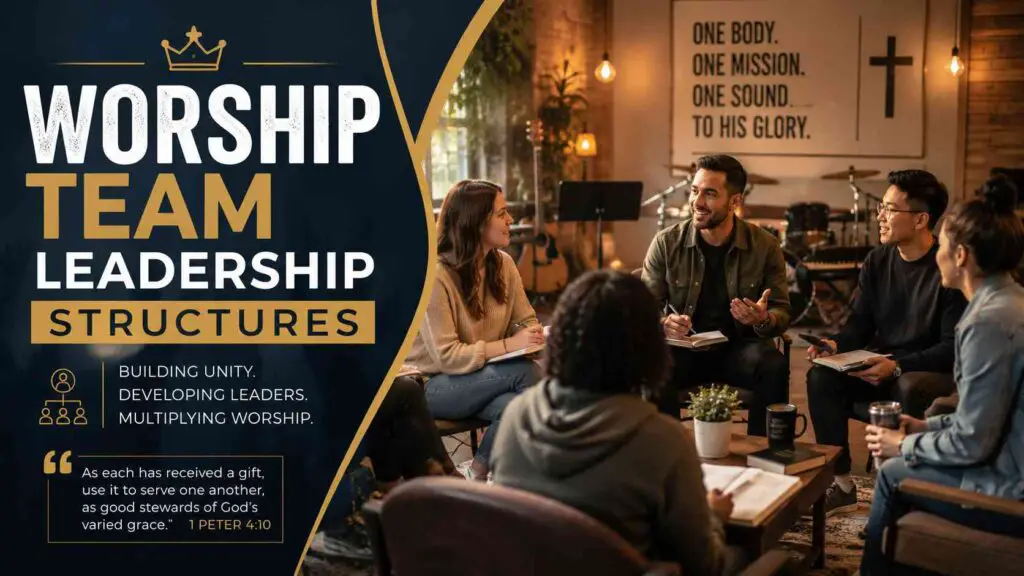
A healthy worship ministry does not happen by accident. Behind every powerful worship experience is a clear worship team leadership structure that supports spiritual growth, musical excellence, organization, and teamwork. Whether your church is small, mid-sized, or growing rapidly, establishing defined leadership roles helps eliminate confusion, strengthen communication, and create a sustainable ministry culture.
Many churches struggle because worship responsibilities fall on one person without support systems in place. A strong structure distributes leadership, develops future leaders, and ensures every volunteer understands their role. It also creates accountability while protecting the spiritual health of the team.
In this guide, we will break down a complete worship team leadership structure, explain the responsibilities of each role, and show how churches can build an effective and scalable worship ministry.
Worship Team Leadership Structure
A worship ministry thrives when leadership is organized, intentional, and spiritually grounded. The following structure provides a practical framework churches can adapt based on their size, culture, and resources.
#1. Worship Pastor / Worship Director
The Worship Pastor or Worship Director serves as the primary leader of the worship ministry. This role carries both spiritual and administrative responsibility and acts as the bridge between church leadership and the worship team.
The Worship Director sets the vision for worship within the church. They determine the direction of the ministry, create worship experiences that align with the church’s mission, and ensure worship remains spiritually focused rather than performance-driven.
Key Responsibilities
- Lead worship services and rehearsals
- Build the spiritual culture of the team
- Select songs and organize service flow
- Mentor musicians and vocalists
- Coordinate with pastors and ministry leaders
- Oversee scheduling and long-term planning
- Recruit and develop future leaders
A strong Worship Director balances musical excellence with pastoral care. Their leadership should cultivate unity, humility, discipline, and spiritual maturity throughout the ministry.
Essential Leadership Qualities
- Spiritual maturity
- Strong communication skills
- Musical competency
- Organizational leadership
- Ability to disciple and mentor others
- Vision casting and team building
In larger churches, the Worship Pastor may oversee multiple campuses, worship leaders, and production teams.
#2. Assistant Worship Leader
The Assistant Worship Leader supports the Worship Director and helps maintain consistency throughout the worship ministry. This role becomes especially important as the ministry grows and responsibilities increase.
An effective assistant leader helps reduce pressure on the Worship Director while ensuring the team remains organized and cared for.
Key Responsibilities
- Lead rehearsals when necessary
- Help coordinate worship sets
- Train newer team members
- Support vocal and musical preparation
- Provide spiritual encouragement to volunteers
- Assist with team communication
The Assistant Worship Leader also serves as a backup worship leader when the primary leader is unavailable. In many churches, this role becomes a leadership development position that prepares future Worship Directors.
Why This Role Matters
Without support leadership, worship ministries often become dependent on one person. The assistant role creates stability, continuity, and leadership depth.
#3. Vocal Director
The Vocal Director oversees all singers within the worship ministry. This role ensures vocalists are prepared, harmonies are organized, and the vocal team serves effectively during worship services.
A worship team with multiple singers requires leadership that focuses specifically on vocal unity and development.
Key Responsibilities
- Train and coach vocalists
- Organize harmonies and arrangements
- Conduct vocal rehearsals
- Help singers improve confidence and technique
- Ensure vocal consistency during services
- Maintain healthy stage dynamics
The Vocal Director also helps create unity among singers by encouraging teamwork rather than competition.
Important Focus Areas
- Breath control and vocal health
- Harmony development
- Stage presence
- Blend and balance
- Spiritual preparation before leading worship
Strong vocal leadership can dramatically improve the overall worship experience without making worship feel overly performance-oriented.
#4. Music Director / Band Director
The Music Director oversees the musicians and ensures musical excellence during worship services. This role is often responsible for creating arrangements, leading transitions, and helping musicians perform cohesively.
In many churches, the Music Director acts as the technical musical leader while the Worship Pastor focuses more heavily on spiritual leadership and overall vision.
Key Responsibilities
- Lead band rehearsals
- Arrange songs and transitions
- Coordinate keys, tempos, and song structure
- Ensure musicians are prepared
- Build musical dynamics for worship moments
- Help musicians grow technically and spiritually
A strong Music Director understands that worship is more than performance. Their goal is to support congregational worship rather than showcase musical ability.
Skills Needed for Success
- Strong understanding of music theory
- Leadership under pressure
- Ability to communicate clearly during rehearsals
- Flexibility during live worship moments
- Team-oriented mindset
This role becomes increasingly valuable in churches with larger bands or complex worship productions.
#5. Production Director
Modern worship ministries rely heavily on technology, making the Production Director one of the most important leadership roles in the church.
This leader oversees audio, lighting, presentation software, livestreams, and technical operations during services.
Key Responsibilities
- Manage sound systems and audio quality
- Oversee livestream production
- Coordinate lighting and stage visuals
- Train production volunteers
- Maintain equipment and troubleshoot issues
- Prepare service slides and media
The Production Director works closely with worship leadership to create distraction-free worship experiences.
Areas Commonly Overseen
- Front of House audio
- Monitors and in-ear systems
- Lighting programming
- Camera operation
- Livestream broadcasting
- Presentation software
An organized production team helps eliminate technical distractions that can interrupt worship moments.
#6. Scheduling Coordinator
One of the most overlooked roles in worship ministry is scheduling and communication. The Scheduling Coordinator keeps the ministry organized and helps volunteers stay informed.
Without proper scheduling systems, confusion and burnout can quickly develop.
Key Responsibilities
- Create monthly team schedules
- Manage volunteer availability
- Send rehearsal reminders and updates
- Coordinate substitutions when needed
- Organize planning tools and software
Many churches use platforms like Planning Center to simplify communication and scheduling.
Benefits of Strong Scheduling Systems
- Reduced volunteer stress
- Better rehearsal attendance
- Improved organization
- Stronger team accountability
- Fewer last-minute issues
A well-organized worship ministry allows leaders to focus more on discipleship and worship rather than administrative chaos.
#7. Team Leaders
As worship ministries grow, smaller leadership teams become necessary. Team Leaders help oversee specific departments and create stronger communication throughout the ministry.
Common Team Leader Roles
- Vocal Team Leader
- Guitar Team Leader
- Drum Team Leader
- Keyboard Team Leader
- Audio Team Leader
- Livestream Team Leader
Main Responsibilities
- Support volunteers within their department
- Help train new team members
- Encourage consistency and accountability
- Assist during rehearsals and services
- Communicate needs to leadership
Team Leaders help create community within the worship ministry and ensure volunteers feel supported and valued.
#8. Worship Team Members
Every worship ministry depends on committed volunteers who faithfully serve week after week. These team members are the foundation of the ministry.
Even though they may not hold formal leadership positions, their attitude, preparation, and consistency directly impact the health of the team.
Expectations for Team Members
- Arrive prepared for rehearsals
- Maintain spiritual discipline
- Support church leadership
- Pursue musical excellence with humility
- Work well within a team environment
Common Worship Team Roles
- Vocalists
- Guitarists
- Drummers
- Bass players
- Keyboard players
- Audio engineers
- Camera operators
- Lighting technicians
- Media operators
Healthy worship ministries emphasize servant leadership at every level rather than creating celebrity culture.
#9. Spiritual Oversight and Pastoral Care
A worship ministry should never focus solely on music and production. Spiritual health must remain the foundation of the team.
This is why many churches include spiritual mentors, elders, or pastoral oversight within the worship ministry structure.
Key Responsibilities
- Pray with leaders and volunteers
- Provide accountability and guidance
- Help resolve conflict biblically
- Support team members through challenges
- Protect ministry culture and unity
Worship leaders often carry emotional and spiritual pressure. Pastoral care helps prevent burnout, discouragement, and isolation.
Why Spiritual Leadership Matters
A talented worship team without spiritual depth will eventually struggle with pride, division, or unhealthy culture. Strong spiritual oversight keeps the ministry centered on Christ rather than performance.
#10. Leadership Flow and Organizational Structure
A clear chain of leadership improves communication and accountability throughout the worship ministry.
Example Worship Team Leadership Flow
Lead Pastor
      ↓
Worship Pastor / Worship Director
      ↓
Assistant Worship Leader
      ↓
Department Leaders
(Vocals, Band, Production, Scheduling)
      ↓
Team Leaders
      ↓
Volunteers and Team Members
This structure prevents confusion while ensuring every volunteer has support and leadership guidance.
#11. Building a Healthy Worship Ministry Culture
Structure alone does not create a thriving worship ministry. Culture matters just as much as organization.
Healthy worship teams prioritize:
- Unity over ego
- Servanthood over recognition
- Spiritual growth over performance
- Excellence without perfectionism
- Consistency and accountability
Leaders should create environments where volunteers feel encouraged, challenged, and spiritually supported.
Signs of a Healthy Worship Ministry
- Strong communication
- Consistent rehearsals
- Positive team relationships
- Spiritual growth among members
- Clear leadership development pathways
A healthy culture attracts committed volunteers and creates long-term ministry stability.
#12. Worship Team Structure for Small Churches
Smaller churches may not have enough volunteers for every leadership role, and that is completely normal.
In these situations, leaders often combine responsibilities while maintaining clear organization.
Example Small Church Structure
- One Worship Leader
- One Production Leader
- Team Captains for vocals and musicians
- Flexible volunteers serving in multiple areas
The key is simplicity. Even a small worship ministry benefits from clear expectations, communication, and spiritual leadership.
Practical Tips for Small Churches
- Focus on consistency over complexity
- Train multi-skilled volunteers
- Develop future leaders slowly
- Keep communication simple and clear
- Prioritize spiritual health over production quality
Small churches can still build powerful worship ministries with strong leadership foundations.
Closing Thoughts
Creating an effective worship team leadership structure is one of the best investments a church can make. Strong leadership systems improve communication, reduce burnout, develop future leaders, and create healthier worship environments for both volunteers and congregations.
The most successful worship ministries are not built on talent alone. They are built on clear vision, spiritual maturity, teamwork, accountability, and servant leadership.
Whether your church has five volunteers or fifty, implementing a thoughtful worship leadership structure can transform the health and effectiveness of your ministry. Start simple, develop leaders intentionally, and build a culture where worship remains centered on glorifying God above everything else.